A Stun-Gun Maker Struggles To Shake Off Safety Concerns

Tuesday, March 22nd, 2005

I did not know this bit of trivia from A Stun-Gun Maker Struggles To Shake Off Safety Concerns:

The Taser was invented in the late 1960s by Jack Cover, an advocate of alternatives to handguns. The name is an acronym for the Thomas A. Swift Electric Rifle, in honor of a series of science-fiction books about a teenage inventor.

I thought I’d cleverly make up a book title like Tom Swift and His Electric Rifle — but it’s a real book!

My Borg Pony

Sunday, March 20th, 2005

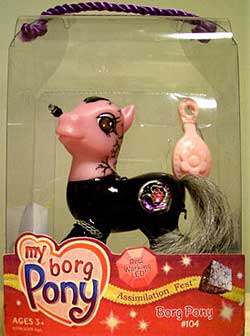
Boing Boing points to a number of peculiar toys, including My Borg Pony.

Certainly, My Borg Pony is funny, but I also enjoyed The Cubes: Create a corporate labyrinth!

Things are changing in upper management. There’s a new boss in charge: you. That means you control the fate of Bob. Will you make his job satisfying, boring or unbearable? Will he be your lackey, your fall guy or your best pal? It’s all up to you, because in this office, you’re the boss. Each set has one 2-3/4″ posable plastic figure and all the necessary plastic parts to build a classic corporate cube: four walls, desk, chair, file cabinet, in/out box, phone, and computer. Comes with a sticker sheet of decor for your cube, complete with graphs, charts, screens for the computer and pithy office posters. Also includes a job title sticker sheet so you can create a convoluted and meaningless position for your employee.

Hit by iPod and Satellite, Radio Tries New Tune: Play More Songs

Friday, March 18th, 2005

From Hit by iPod and Satellite, Radio Tries New Tune: Play More Songs:

Previously, like most stations, 105.1 let computer scheduling programs pick the songs from a library of 300-400 titles, with the same 30-40 songs playing most of the time. Now the station is going against the grain of the past two decades in radio, more than tripling the number of song titles played on any given day. With more than 1,200 songs on the playlist, most songs get played only once every few days, rather than several times a day. Program director Mike O’Reilly and his assistants handpick the music and the order in which they are played.

‘It’s all about train wrecks,’ Mr. O’Reilly says, using radio terminology for two unlikely songs played back-to-back. ‘If you hear MC Hammer go into the Steve Miller Band, I’ve done my job.’ Indeed, the station boasts that it might play a grunge rock anthem by Nirvana alongside a disco hit by K.C. and the Sunshine Band — the kind of serendipitous combination offered by an iPod.

So, they’re moving away from computerized scheduling to hand-picked playlists in order to emulate the randomness of an iPod. Fortunately, my ironometer goes to 11.

A little history:

Doomsayers predicted radio’s demise back in the 1950s, when television became widely available and long-playing records made listening to music on record players easy. But the industry adapted to competition from television dramas by cutting many of its own dramas and playing more music. And it turned out people who bought LPs didn’t stop listening to radio broadcasts. Once the 1960s hit and the invention of the transistor made receivers small and portable, radio boomed again.

When FM and stereo sound started to take off in the 1970s, conventional wisdom held that AM radio was finished. Instead, it became the home for talk radio, while music stations migrated to the FM dial. Radio overcame another perceived threat in the 1980s, when Sony Inc.’s popular Walkman became the first device to make custom-selected music truly portable.

Lucas Calls New ‘Star Wars’ a Titanic Tearjerker

Friday, March 18th, 2005

From Lucas Calls New ‘Star Wars’ a Titanic Tearjerker:

“I describe it as a Titanic in space. It’s a real tearjerker, and it will be received in a way that none of us can expect,” he told theater owners at the ShoWest convention.

It will be received in a way that none of us can expect. My question: can one expect to be disappointed?

Rock’s Oldest Joke: Yelling ‘Freebird!’ In a Crowded Theater

Thursday, March 17th, 2005

Rock’s Oldest Joke: Yelling ‘Freebird!’ In a Crowded Theater provides an apocryphal origin to the phenomenon:

How did this strange ritual begin? “Freebird” is hardly obscure — it’s a radio staple consistently voted one of rock’s greatest songs. One version — and an important piece of the explanation — anchors Skynyrd’s 1976 live album “One More From the Road.” On the record, singer Ronnie Van Zant, who was killed along with two other bandmates in a 1977 plane crash, asks the crowd, “What song is it you want to hear?” That unleashes a deafening call for “Freebird,” and Skynyrd obliges with a 14-minute rendition.

To understand the phenomenon, it also helps to be from Chicago. When asked why they continue to request “Freebird,” Mr. Hicks’s tormentors yell out “Kevin Matthews!”

Kevin Matthews is a Chicago radio personality who has exhorted his fans — the KevHeads — to yell “Freebird” for years, and claims to have originated the tradition in the late 1980s, when he says he hit upon it as a way to torment Florence Henderson of “Brady Bunch” fame, who was giving a concert. He figured somebody should yell something at her “to break up the monotony.” The longtime Skynyrd fan settled on “Freebird,” saying the epic song “just popped into my head.”

Mr. Matthews says the call was heeded, inspiring him to go down the listings of coming area shows, looking for entertainers who deserved a “Freebird” and encouraging the KevHeads to make it happen.

But he bemoans the decline of “Freebird” etiquette. “It was never meant to be yelled at a cool concert — it was meant to be yelled at someone really lame,” he says. “If you’re going to yell ‘Freebird,’ yell ‘Freebird’ at a Jim Nabors concert.”
[...]
But did “Freebird” truly start with the KevHeads? Longtime Chicago Tribune music writer Greg Kot says he remembers the cry from the early 1980s. He suggests it originated as an in-joke among indie-rock fans “having their sneer at mainstream classic rock.”

Other music veterans think it dates back to 1970s audiences’ shouts for it and other guitar sagas, such as “Whipping Post,” by the Allman Brothers Band, and “Smoke on the Water,” by Deep Purple.

They may all be right: It’s possible “Freebird” began as a rallying cry for Skynyrd Nation and a sincere request from guitar lovers, was made famous by the live cut, taken up by ironic clubgoers, given new life by Mr. Matthews, and eventually lost all meaning and became something people holler when there’s a band onstage.

It Happened One Night

Wednesday, March 9th, 2005

I hadn’t seen the film classic It Happened One Night until recently, but I knew one piece of trivia about it:

The scene in which Clark Gable removes his shirt is credited as the number-one cause for not only the decrease in undershirt sales for the following two years, but the implementation of product placement in movies to come.

In some ways, the film is very 1934, but in others, it’s way ahead of its time. I highly recommend it. Technically, Frank Capra made use of crane shots, back-projection, and wipes — cutting-edge filmmaking for the 1930s — but the humor is also cutting-edge for the 1930s.

The film is immensely important in terms of cultural literacy and its amazing influence on other works. In one scene, Clark Gable pulls out some raw carrots and starts chomping on them while talking:

Friz Freleng’s unpublished memoirs mention that this was one of his favorite films, and that it contains at least three things upon which the character “Bugs Bunny” was based:
  • The character Oscar Shapely’s (Roscoe Karns) personality
  • The manner in which Peter Warren (Clark Gable) was eating carrots and talking quickly at the same time
  • An imaginary character mentioned once to frighten Oscar Shapely named “Bugs Dooley”.

You may also have seen any number of movies (or cartoons) where a young lady hitchhikes by showing some leg. I believe that Claudette Colbert did it first.

No one making the movie had high expections, but it ended being the first film to win the Oscar “grand slam” (Best Picture, Best Actor, Best Actress, Best Director and Screenplay).

One last thing: it briefly features an autogyro. You have to like that.

The Resurrection of Indie Radio

Monday, March 7th, 2005

The Resurrection of Indie Radio opens with the story of Jonesy’s Jukebox, a radio show hosted by Steve Jones, from the Sex Pistols, on Indie 103, an “indie” station owned by Clear Channel, the corporate entity largely responsible for today’s bland, homogenized radio landscape. The highly targeted programming it pushed from its central offices helped drive away radio listeners to satellite radio and the iPod. Some parts of the dial have survived though:

It is striking to note that satellite radio and the iPod are not encroaching on National Public Radio. Unaccountably, NPR’s listeners apparently perceive it as a trembling invalid with such a tenuous hold on existence that people still regularly respond to an ancient email hoax claiming that Congress is about to destroy the network by eliminating its modest federal subsidies. In truth, NPR is a radio heavyweight whose audience has increased by a staggering two-thirds since 1999. And some in the industry have noticed. Though they did not consciously emulate public radio, a scatter of stations around the country — Indie 103 in Los Angeles, KBZT in San Diego, KQMT in Denver, KNDD in Seattle, WRNR in Annapolis, and perhaps a dozen others — have tried to create a kind of rock radio that models NPR’s conversational tenor, lengthy attention span, and relative lack of hype. Fred Jacobs calls it NeoRadio.

Thank you, Harlan Ellison

Sunday, March 6th, 2005

In the latest entry in his Battlestar Galactica Blog, Thank you, Harlan Ellison, Ron Moore mentions an example of what it’s like to work in Hollywood:

I was working on “Roswell” as an executive producer, but I was deep into preproduction on the ill-fated pilot I’d written for a series based on Anne McCaffrey’s “Dragonriders of Pern” books. It had been a difficult and unhappy development process, but we were only five days away from the first day of principal photography. A major problem had arisen, however. The network had commissioned another writer to rewrite my draft over my objections and in my opinion, had eviscerated everything that I loved about the project.

Ron Moore took Harlan Ellison’s advice (to new writers) to heart: “Don’t be a whore!” So he skipped that project.

Bambi

Sunday, March 6th, 2005

Bambi has just come out on DVD. I never saw Bambi as a child, but I just watched it, and it’s beautiful — beautiful backgrounds, beautiful animation:

Pre-production began in 1936 and was intended to be Disney’s second full-length animated film after Snow White and the Seven Dwarfs (1937). Disney’s perfection and quest for realism delayed the project significantly, so that Pinocchio (1940), Fantasia (1940), The Reluctant Dragon (1941) and Dumbo (1941) were released earlier than Bambi.

In fact, Bambi may be the most classically beautiful of the Disney films. Quality doesn’t come cheap though:

The movie lost money at the box office for the first run, but began to recoup its considerable cost (over $2,000,000) during the 1947 re-release.

Bambi was the first feature-length animated film to use the multi-plane camera Disney first tested in making “The Old Mill” in 1937.

I found Bambi even more family-oriented than most Disney films. The first act dwells on young Bambi’s physical awkwardness and Thumper’s social awkwardness (“He don’t walk so good”). I suppose young children and new parents find this amusing and endearing.

Bambi’s mother’s death comes much later in the film than I expected. It’s quite traumatic, despite happening off-screen, but the film doesn’t dwell on it at all; in moments we’ve cut to Bambi as a young adult, with antlers.

The second act finds Bambi and his friends “twitterpated,” smitten with spring love. It’s all very 1942 — which reminds me, the voice-acting and music throughout are very 1942, too.

The film’s climax presents a pretty straightforward anti-hunting message. The hunting dogs are creepy — but young-adult Bambi saves his girlfriend, and we get to see her with her two new fawns as the movie ends. Ah, the circle of life.
The Bridge on the River Kwai

Sunday, March 6th, 2005

I finally watched The Bridge on the River Kwai all the way through, and Alec Guinness (Obi-Wan Kenobi) is excellent as the extremely British commanding officer who gets “his boys” to show their Japanese captors how British soldiers make a bridge. In fact, he earned a best actor Oscar and Golden Globe for the role.

On the other hand, I found William Holden, who played the American, quite unappealing — despite the fact that he was brought in for his appeal:

William Holden, then a major star, was brought into the project to provide “box office appeal”. He was initially unwilling, but the offer of $50,000 a year for life was enough to convince him to take the part.

I found much of the movie pretty good, but the climax is a wonderful Hollywood moment — involving the bridge, of course:

While the bridge in the story was constructed by prisoners in two months, the actual one built in Ceylon by a British company for the filming (425 feet long and 50 feet above the water) took eight months, with the use of 500 workers and 35 elephants. It was demolished in a matter of seconds, and the total cost was 85,000 pounds.

They had six cameras rolling when they blew up the (real) bridge with a (real) train on it — no models, and, of course, no CGI.

WB on DVD – Warner Bros. is the new Criterion Collection

Thursday, March 3rd, 2005

In WB on DVD, Fred Kaplan explains how Warner Brothers is “the new Criterion Collection”:

In the 1960s, long before film preservation became a popular cause, MGM was one of two Hollywood studios — the other was Disney — that decided to preserve all its films. They spent millions of dollars to repair, properly store, and in some cases meticulously restore original negatives, black-and-white nitrates, or duplicate copies. As for Warner Bros.’ own black-and-white classics, original nitrates were long ago donated to the Library of Congress or UCLA, which stored them in temperature-controlled rooms and left them, ever since, untouched. To the extent possible, Warner DVDs have been mastered from the original negatives, preventing degradation in detail, sharpness, color, and contrast.

Then there’s Warner’s work with Technicolor. Even with careful preservation, color negatives fade over time. But Technicolor negatives can look as good as new after decades. This is because Technicolor films consisted of three black-and-white negatives, which ran simultaneously through a special camera. Light hit each film strip through a prism filter. Afterward, each film strip was coated with a dye, and the three strips were then aligned, on top of one another, to form a coherent color image. It was a complex, costly process, which lasted only from 1935-54. The point is that black-and-white negatives don’t fade. If the Technicolor black-and-white negatives have been stored well, and if some lab can replicate the Technicolor dye-processing, it should be possible to create a fresh print with perfect color.

[...]

Many DVD studios now scan films at “high-definition” — or 1,080 lines. Warners is one of just a few that scan at 2,000 lines (or, in the parlance, “2K scanning”). Soon, beginning with a Wizard of Oz reissue later this year, it will start releasing Technicolor DVDs scanned at 4,000 lines (“4K scanning”). This is a significant number. Engineers estimate that if you digitally reproduced all the information on a frame of 35mm film, you’d need about 4,000 lines of data. In other words, at least theoretically, 4K scanning captures everything that’s on a film.

Tales of Future Past

Tuesday, March 1st, 2005

Tales of Future Past presents lots of retro-future images from Popular Science, etc. Hop in your atomic car and swing by!

(Hat tip to BoingBoing.)

The Big Picture

Tuesday, March 1st, 2005

The Big Picture describes the Midas formula for a blockbuster movie:

The blockbusters are aimed at children and teenagers and are scripted according to ‘the Midas formula,’ the ingredients of which include ‘a child or adolescent protagonist,’ a ‘fairy-tale plot in which a weak or ineffectual youth is transformed into a powerful and purposeful hero,’ ‘bizarre-looking and eccentric supporting characters that are appropriate for toy and game licensing,’ a happy ending ‘with the hero prevailing over powerful villains and supernatural forces’ and ‘conventional or digital animation to artificially create action sequences, supernatural forces . . . and elaborate settings.’ In two words: ‘Harry Potter.’ In four: ‘Lord of the Rings.’

Ayn Rand, Economic/Political General Equilibrium Theorist

Monday, February 28th, 2005

Bryan Caplan looks at Ayn Rand, Economic/Political General Equilibrium Theorist:

Atlas came out in 1957, and it’s got more about rent-seeking than the next 15 years of public choice scholarship. As I explain in Atlas Shrugged and Public Choice: The Obvious Parallels:
Each piece of legislation [in Atlas] has the following components:
  1. A public-interest rationale.
  2. Supportive interest groups with a hidden financial agenda.
  3. Negative consequences for the general public.

To Catch a Thief

Monday, February 28th, 2005

I’ve been catching up on my Hitchcock movies, and I just watched To Catch a Thief, which “stars Cary Grant as a former thief suspected of a new series of crimes and Grace Kelly as the woman who romances him.” For a thriller, it’s not particularly thrilling; the plot’s fairly simple, and the tension’s never that great.

That said, it’s a beautiful film, featuring (1) the French Riviera, and (2) Grace Kelly.

Cary Grant, by the way, is supposed to play the athletic former-acrobat turned cat burglar, but he doesn’t do anything particularly acrobatic and, like most leading men in the 1950s, he really doesn’t have a very athletic physique. The punch-line: he really was an acrobat in his youth!