Clever Bird

Monday, August 10th, 2009

A study, published in Current Biology, shows that crows are innovative tool users — and the Times has video of a bird playing out one of Aesop’s fables:

As the 2000-year-old story goes, the crow filled the bucket of water with stones until the level became high enough for him to quench his thirst.

Just a fable? Apparently not. Footage shows a rook — a relation of the crow — performing the feat to reach a worm floating on the water’s surface.

Why you don’t want the Black Watch watching you

Monday, August 10th, 2009

The Daily Express, which bills itself as “crusading for a fairer Britain,” explains why you don’t want the Black Watch watching you:

A Scottish soldier has been praised for making the longest recorded kill in Afghanistan after shooting a top Taliban fighter from almost a mile away.

Corporal Christopher Reynolds took out the Afghan drug lord during some of the hardest fighting of the war so far.

The 25-year-old, of 3 Scots, The Black Watch, kept watch on a shop rooftop for three days to eliminate the target.

But he admitted the top-level Taliban fighter — known as Musa — was so far away it took him a couple of attempts to get the aim right.

Initially Musa, who was with four men, did not even realise he was being shot at.

But Cpl Reynolds, of Dalgety Bay, in Fife, together with his spotter Lance Corporal David Hatton, worked out different factors such as wind speed and the trajectory of the bullet to hit the target. Musa, who was more than 1,500 metres away, was taken out with a single shot to the chest.

Cpl Reynolds, who has killed 32 Taliban fighters, said: “I was quite proud of that shot. It is the longest recorded kill in Afghanistan. I am going to use that fact as a chat-up line in the pub when I get back home.”

His 20-year-old spotter, from Castlemilk, in Glasgow, added: “We had been in position for three days when he made that shot. He did a top job that day.”

(Hat tip to arkham88, who adds, “Awesome.”)

For $19, you’ll get nothing, and like it

Monday, August 10th, 2009

For $19, you'll get nothing, and like it — because you bought the “Survivor Package”:

The Rancho Bernardo Inn, a luxury resort with three pools, two restaurants, a spa and a golf course, is offering rooms this summer for as little as $19 a night.

There’s just one catch. The room comes without pillows, sheets, towels, toiletries — or a bed.

From Aug. 16 to 31, the Rancho Bernardo Inn is offering steep discounts to customers willing to bring their own toilet paper and sleep on the floor.

Under the unusual pricing scheme called the “Survivor Package,” guests can lower the standard $219 room rate with each amenity they give up. Going without breakfast, the honor bar, air-conditioning and pillows saves $80. Bringing your own sheets saves an additional $20, while the room rate drops $20 more if you also give up lights.

The lowest price is $19, which buys a room that’s had the headboard unscrewed from the wall and the mattress carted away by hotel staff, though they will leave behind a small tent.
[...]
It takes about 90 minutes for hotel staff to disassemble a room for a $19-a-night guest.

I guess they’ve succeeded in generating marketing buzz. It does make you think about costs versus benefits in a hotel room though.

(Hat tip to Yana.)

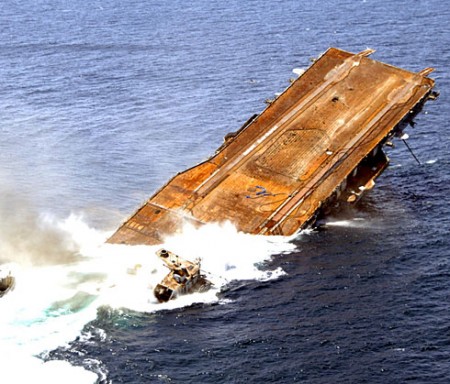
This Is How the Carriers Will Die

Monday, August 10th, 2009

Gary Brecher, the War Nerd, has been saying for a long time that aircraft carriers are just history’s most expensive floating targets, and that they were doomed:

But now I can tell you exactly how they’re going to die. I’ve just read one of the most shocking stories in years. It comes from the US Naval Institute, not exactly an alarmist or anti-Navy source. And what it says is that the US carrier group is scrap metal.

The Chinese military has developed a ballistic missile, Dong Feng 21, specifically designed to kill US aircraft carriers: “Because the missile employs a complex guidance system, low radar signature and a maneuverability that makes its flight path unpredictable, the odds that it can evade tracking systems to reach its target are increased. It is estimated that the missile can travel at mach 10 and reach its maximum range of 2000km in less than 12 minutes.” That’s the US Naval Institute talking, remember. They’re understating the case when they say that, with speed, satellite guidance and maneuverability like that, “the odds that it can evade tracking systems to reach its target are increased.”

You know why that’s an understatement? Because of a short little sentence I found farther on in the article—and before you read that sentence, I want all you trusting Pentagon groupies to promise me that you’ll think hard about what it implies. Here’s the sentence: “Ships currently have no defense against a ballistic missile attack.”

“Well, they must have thought of that already,” you might think. “They must have some defense in mind.”

When you start talking like that, just slap yourself and remember all the other military traditions that kept going long after anybody with sense knew they were finito.

The most obvious example is European heavy cavalry trotting into longbow fire again and again. Crecy demonstrated that knightly charges were suicide against the longbow in 1346. But the French aristocracy had so much invested in prancing around on their damn steeds that it took another demonstration, at Agincourt in 1415 to even start to get them thinking about it. I’m no math wiz but I think that 1415 minus 1346 — yup, that’s 69 years between catastrophes. Lessons learned? None.

These dodos always have one thing in common: whether it’s knights charging with lances on very expensive horses or top gun brats like McCain zooming onto carrier decks in history’s most expensive aircraft, you’ll always find that the worst, most over-funded services are always the ones where the rich kids go to show their stuff. Seriously: why are there aircraft carriers? For asses like John McCain to crash on. Why do they keep getting funded long after they’ve been shown up? The same reason knights were galloping around pretending that the longbow hadn’t turned half their friends into pincushions: because it was a way of life for the richest and dumbest people in the country and they weren’t about to let it go.

The US Navy, Brecher says, will be stuck with its own Harpoon:

Y’all remember the Harpoon, the US Navy’s first dedicated anti-ship guided surface to surface missile, right? Good ol’ AGM-84? A fine weapon by all accounts. You’ll remember it entered service in 1977.
[...]
Well, instead of just paging through Jane’s and drooling over the Harpoon’s range and 221-kg warhead (don’t bother lying, I spent years doing that stuff myself and I know), think about what that weapons means in terms of this key sentence from my last story: “Ships currently have no defense against a ballistic missile attack.” Now put that together with the fact that the Harpoon, way back in the Disco Era, had a cool little feature called “pop-up.” And what it meant is that the Harpoon itself worked as a ballistic missile. So even in our own inventory, we’ve had a weapon lying around for decades that could have taken out all our carriers.

What “pop-up” means is — well, it’s actually kind of cool and for once I can talk my old fave, hardware, without feeling like a tool. So anyway, the Harpoon has an interesting trajectory. It’s fired from vertical or diagonal tubes on the deck or the hold of surface ships, but there are other models that can be launched from aircraft or even subs. If you’ve seen video of a harpoon launch, you see it zoom up from the tube, then slide down to fly level, just above the waves, so’s to avoid enemy radar.

But once the Harpoon’s own radar has spotted the target, does it keep flying level to slam into the side of the ship? Nope. I’ll quote from the owner’s manual: “Once a target has been located and the seeker locked…the missile climbs rapidly to about 1800m before diving on the target (”pop-up maneuver”).”

In other words, the Harpoon does a last-minute transformation from wave-skimmer to ballistic missile. If you diagrammed its flight path, seen from the side, You’d get a capital “P” lying on its back, with the loop of the “P” being the pop-up maneuver.

The reason the Harpoon was designed to hit the target from above rather than the side is simple: a ships defenses are configured to stop planes (and missiles, even though they don’t work against missiles and everybody knows it) coming in diagonally or horizontally. To repeat that sentence again — and I’m going to keep repeating it till everybody realizes what it means — ”ships currently [just like in 1977 when the Harpoon entered service] have no defense against a ballistic missile attack.”

So we have the Navy’s own weapons system testifying against it: way back in Carter’s time the Navy bought a weapon that was designed to hit ships like a ballistic missile, yet now, forty years later, USN ships have no defense against ballistic missiles.

It gets worse. The Navy didn’t even want the Harpoon at all. It was only adopted because after seeing Soviet-made anti-ship missiles destroy the Israeli destroyer Eilat in 1967, a few of the more honest R&D guys at the Pentagon forced the Navy to shop for their own model. The Navy — remember, they’re just like the French heavy cavalry brass of the late 14th century, trying real hard not to think about the real world — didn’t like the idea of anti-ship missiles at all. They were the equivalent of the longbow: unmanned, longrange, un-chivalrous weapons, and you couldn’t drink with them at the officer’s club.
The "End of Politics" Delusion

Monday, August 10th, 2009

Futurist Jamais Cascio is terribly offended that the “staggeringly rich” Peter Thiel — an “I got mine, Jack” libertarian — wants to escape from politics. Cascio calls this the “end of politics” delusion:

Unless Thiel means that libertarians must live in splendid isolation from society and each other, he’s going to have a problem.
[...]
Politics is part of a healthy society — it’s what happens when you have a group of people with differential goals and a persistent relationship. It’s not about partisanship, it’s about power. And while even small groups have politics (think: supporting or opposing decisions, differing levels of power to achieve goals, deciding how to use limited resources), the more people involved, the more complex the politics. Factions, parties, ideologies and the like are simply ways of organizing politics in a complex social space — they’re symptoms of politics, not causes.

Calls to get rid of politics can therefore mean one of two things: getting rid of persistent relationships with other people; or getting rid of differential goals. Since I don’t see too many of the folks who talk about escaping politics also talking about becoming lone isolationists, the only reasonable presumption is that they’re really talking about eliminating disagreements.

It’s the latest version of the notion that “a perfect world is one where everyone agrees with me.”

Just as you may not be interested in war, but war is interested in you, you may not be interested in politics, but politics is interested in you — and it’s even harder to escape.

Further, politics may be part of a healthy society, but it’s an even bigger part of an unhealthy society.

I think it’s a grave mistake to say that politics is what happens when you have a group of people with differential goals and a persistent relationship. Isn’t a market a group of people with differential goals? Aren’t contracts persistent relationships?

The key distinction is that politics is what you get when shifting coalitions vie for power over resources they don’t own and aren’t really responsible for, while a market is what you get when property rights are well defined, and all transactions are voluntary trades between clear owners of resources.

It’s not always clear how to define all property rights in non-overlapping ways, so we often resort to politics, but that doesn’t mean that more politics yields more health.

Rules Change: North vs. South Korea

Monday, August 10th, 2009

Paul Romer agrees that culture matters, and that culture is hard to change, but he also believes that changing the formal rules can lead to big changes, an in North vs. South Korea:

There are many statistical measures of the large difference in the quality of life between the North and the South. One gripping visual indication comes from a satellite picture of the Korean peninsula at night. Compared to its neighbors, North Korea (outlined for clarity) seems like a black hole. South Korea, which looked like the North within living memory, is now a sea of lights.

Until the end of World War II, the North and South shared a common set of formal and informal rules, first as an independent nation, then under occupation by the Japanese. When the allies disarmed the occupying Japanese forces, Russia set up one system of government above the 38th parallel. The U.S. set up a different one below this arbitrary line on a map.

Officials then were very pessimistic about the prospects for both the North and South. One of the great surprises of the last half of the 20th century is the extent to which South Koreans prospered under their new government. The difference compared to the North and what could have been, is very revealing. As the economists Daron Acemoglu, Simon Johnson, and James Robinson have written, “Korea was split into two, with the two halves organized in radically different ways, and with geography, culture and many other potential determinants of economic prosperity held fixed. Thus any differences in economic performance can plausibly be attributed to differences in institutions.”

The circumstances in post WWII Korea were truly exceptional. Fortunately, few people today will live through a time when an army forces out an occupying power and fosters an entirely new system of government.

Romer recommends charter cities as the alternative to invasions by rival superpowers.

No Brown M&Ms

Monday, August 10th, 2009

Rock superstars Van Halen infamously included a no brown M&Ms clause in their concert contracts — but this was not an example of egomaniacal rock stars running amok, as David Lee Roth explains:

Van Halen was the first band to take huge productions into tertiary, third-level markets. We’d pull up with nine eighteen-wheeler trucks, full of gear, where the standard was three trucks, max. And there were many, many technical errors — whether it was the girders couldn’t support the weight, or the flooring would sink in, or the doors weren’t big enough to move the gear through.

The contract rider read like a version of the Chinese Yellow Pages because there was so much equipment, and so many human beings to make it function. So just as a little test, in the technical aspect of the rider, it would say “Article 148: There will be fifteen amperage voltage sockets at twenty-foot spaces, evenly, providing nineteen amperes…” This kind of thing. And article number 126, in the middle of nowhere, was: “There will be no brown M&M’s in the backstage area, upon pain of forfeiture of the show, with full compensation.”

So, when I would walk backstage, if I saw a brown M&M in that bowl… well, line-check the entire production. Guaranteed you’re going to arrive at a technical error. They didn’t read the contract. Guaranteed you’d run into a problem. Sometimes it would threaten to just destroy the whole show. Something like, literally, life-threatening.
[...]
The folks in Pueblo, Colorado, at the university, took the contract rather kinda casual. They had one of these new rubberized bouncy basketball floorings in their arena. They hadn’t read the contract, and weren’t sure, really, about the weight of this production; this thing weighed like the business end of a 747.

I came backstage. I found some brown M&M’s, I went into full Shakespearean “What is this before me?”… you know, with the skull in one hand… and promptly trashed the dressing room. Dumped the buffet, kicked a hole in the door, twelve thousand dollars’ worth of fun.

The staging sank through their floor. They didn’t bother to look at the weight requirements or anything, and this sank through their new flooring and did eighty thousand dollars’ worth of damage to the arena floor. The whole thing had to be replaced. It came out in the press that I discovered brown M&M’s and did eighty-five thousand dollars’ worth of damage to the backstage area.

Well, who am I to get in the way of a good rumor?

Actors See Status

Monday, August 10th, 2009

Economist Robin Hanson is fascinated by signaling, so a reader sent him Keith Johnstone‘s Impro, which teaches actors to see status:

‘Try to get your status just a little above or below your partner’s,’ I said, and I insisted that the gap should be minimal. The actors seemed to know exactly what I meant and the work was transformed. The scenes became `authentic’, and actors seemed marvelously observant. Suddenly we understood that every inflection and movement implies a status, and that no action is due to chance, or really ‘motiveless’. It was hysterically funny, but at the same time very alarming. All our secret maneuverings were exposed. If someone asked a question we didn’t bother to answer it, we concentrated on why it had been asked. No one could make an ‘innocuous’ remark without everyone instantly grasping what lay behind it. Normally we are ‘forbidden’ to see status transactions except when there’s a conflict. In reality status transactions continue all the time. …

Status is a confusing term, unless it’s understood as something one does. You may be low in status, but play high, and vice versa. … We always like it when a tramp is mistaken for the boss, or the boss for a tramp. … I should really talk about dominance and submission, but I’d create a resistance. Students who will agree readily to raising or lowering their status may object if asked to `dominate’ or `submit’. …

A further discovery is that there’s no way to be neutral. You can see people trying to be neutral in group photographs. They pose with arms folded or close to their sides as if to say `Look, I’m not claiming any more space than I’m entitled to’, and they hold themselves very straight as if saying `But I’m not submissive either.’ …

Many people will maintain that we don’t play status transactions with our friends, and yet every movement, every inflection of the voice implies a status. My answer is that acquaintances become friends when they agree to play status games together. … If I take a cup of tea to a friend then I may say `Get up, you old cow’ or `Your Highness’s tea’, pretending to raise or lower status. Once students understand that they already play status games with their friends, then they realize that they already know most of that status games I’m trying to teach them.

We soon discovered the `see-saw’ principle: ‘I go up and you go down.’ … The exception to the see-saw principle comes when you identify with the person raised or lowered. … When you claim status because you know some famous person, then you’ll feel raised when they are. …

Social animals have inbuilt rules which prevent them killing each other for food, mates, and so on. Such animals confront each other, and often fight, until a hierarchy is established, after which there is no fighting unless an attempt is made to change the ‘pecking order’. This system is found in animals as diverse as humans, chickens, and woodlice. I’ve known about this ever since I was given a book about social dominance in kittiwake colonies, yet I hadn’t immediately thought of applying this information to actor training. This is because normal people are inhibited from seeing that no action, sound, or movement is innocent of purpose. …

In animals the pattern of eye contacts often establishes dominance. A stare is often interpreted as an aggressive act. … Visitors to zoos feel dominant when they can outstare the animals. I suggest you try the opposite with zoo animals: break eye contact and then glance back for a moment. Polar bears may suddenly see you as food. Owls cheer up perceptibly. …

My belief (at this moment) is that people have a preferred status; that they like to be low,o or high, and that they try to manoeuvre themselves into the preferred positions. A person who plays high status is saying `Don’t come near me, I bite.’ Someone who plays low status is saying `Don’t bite me, I’m not worth the trouble.’ In either case the status played is a defence, and it’ll usually work. It’s very likely that you will increasingly be conditioned into playing the status that you’ve found an effective defense. You become a status specialist, very good at playing one status but not very happy or competent at playing the other. …

I’d suggest that a good play is one that ingeniously displays are reverses the status between characters.

The Wilderness of Childhood

Monday, August 10th, 2009

Michael Chabon contrasts the wilderness of childhood that he explored back in his day with the penned-in existence of modern children:

This is the kind of door-to-door, all-encompassing escort service that we adults have contrived to provide for our children. We schedule their encounters for them, driving them to and from one another’s houses so they never get a chance to discover the unexplored lands between. If they are lucky, we send them out to play in the backyard, where they can be safely fenced in and even, in extreme cases, monitored with security cameras. When my family and I moved onto our street in Berkeley, the family next door included a nine-year-old girl; in the house two doors down the other way, there was a nine-year-old boy, her exact contemporary and, like her, a lifelong resident of the street. They had never met.

The sandlots and creek beds, the alleys and woodlands have been abandoned in favor of a system of reservations — Chuck E. Cheese, the Jungle, the Discovery Zone: jolly internment centers mapped and planned by adults with no blank spots aside from doors marked staff only. When children roller-skate or ride their bikes, they go forth armored as for battle, and their parents typically stand nearby.

There are reasons for all of this. The helmeting and monitoring, the corralling of children into certified zones of safety, is in part the product of the Consumer Reports mentality, the generally increased consciousness, in America, of safety and danger. To this one might add the growing demands of insurance actuarials and the national pastime of torts. But the primary reason for this curtailing of adventure, this closing off of Wilderness, is the increased anxiety we all feel over the abduction of children by strangers; we fear the wolves in the Wilderness. This is not a rational fear; in 1999, for example, according to the Justice Department, the number of abductions by strangers in the United States was 115. Such crimes have always occurred at about the same rate; being a child is exactly no more and no less dangerous than it ever was. What has changed is that the horror is so much better known. At times it seems as if parents are being deliberately encouraged to fear for their children’s lives, though only a cynic would suggest there was money to be made in doing so.
[...]
What is the impact of the closing down of the Wilderness on the development of children’s imaginations? This is what I worry about the most. I grew up with a freedom, a liberty that now seems breathtaking and almost impossible. Recently, my younger daughter, after the usual struggle and exhilaration, learned to ride her bicycle. Her joy at her achievement was rapidly followed by a creeping sense of puzzlement and disappointment as it became clear to both of us that there was nowhere for her to ride it — nowhere that I was willing to let her go. Should I send my children out to play?

There is a small grocery store around the corner, not over two hundred yards from our front door. Can I let her ride there alone to experience the singular pleasure of buying herself an ice cream on a hot summer day and eating it on the sidewalk, alone with her thoughts? Soon after she learned to ride, we went out together after dinner, she on her bike, with me following along at a safe distance behind. What struck me at once on that lovely summer evening, as we wandered the streets of our lovely residential neighborhood at that after-dinner hour that had once represented the peak moment, the magic hour of my own childhood, was that we didn’t encounter a single other child.

Even if I do send them out, will there be anyone to play with?

(Hat tip to David Foster’s Photon Courier.)

What you have is not a combat skill

Sunday, August 9th, 2009

What you have is not a combat skill, Rory Miller notes, if your training doesn’t reflect the reality of a fight:

  1. Anything you teach, anything you practice must have a tactical use. If it is not useful, why are you practicing it? Case in point — returning a katana to the scabbard quickly, smoothly and without looking is one of the hallmark proofs of extreme skill. News flash — getting you weapon into the holster fastest has never won a fight. There is no tactical use for disarming yourself quickly. To be fair, the ability to secure your weapon without looking allows you to pay attention to potential emerging threats, and that is a good skill.
  2. You must be able to perform the skill moving. Fights (unarmed, guns, knives, swords or clubs) are not static affairs. They are conducted moving. You will be moving and so will the threat. If you have to freeze in order to strike hard or stop in order to shoot accurately, what you have is not a combat skill. If your opponent must freeze for an instant to give you time for your disarms or locks to work, it is not yet a combat skill.
  3. Your skills must work when you are scared. I can almost guarantee that if you ever need serious close-quarters survival skills, you will be scared. That affects your mind and your body. If the techniques you rely on require wide peripheral vision, calm planning, precise hand movements, or even a fairly complicated coordination of hands and feet they very likely won’t work. Levels of fear change with experience and somewhat with internal wiring — if you choose to believe that this doesn’t apply to what you do, you are counting on being a mutant. Best of luck to you.
  4. It must work whether you can see or not. Not just because bad things happen in the dark but because you can’t waste time looking at the weapons on your belt or checking to see which way your magazines are turned. Something else, like the threat’s hands, may well be in your face. You won’t get the choice that the threat will even be in front of you. Some things, like shooting, require some vision (country western songs aside) but there is a reason why so much time is spent on low-light and poor visibility shooting. Reason being, that’s how most of them happen. Touch is reliable. Anything you can do by touch, you do by touch.

Modernity as a Children’s Paradise

Saturday, August 8th, 2009

Bryan Caplan sees modernity as a children’s paradise, as demonstrated by youth mortality statistics:

Youth Mortality per 100,000, 1950 vs. 2005
Under 1
year
1–4
years
5–14
years
15–24
years
Cause of Death 1950 2005 1950 2005 1950 2005 1950 2005
Disease 3181 656 107 16 37 9 66 20
Accidents 115 29 37 11 23 6 55 38
War 0 0 0 0 0 0 51.7 1.2
Homicide 4.4 7.5 0.6 2.3 0.5 0.8 6.3 13.2
Suicide 0 0 0 0 0.3 0.7 2.6 10.0
Total 3300 693 140 29 60 16 182 83

From these numbers, he argues that the “television reality” painted by Leave It to Beaver versus Law and Order: Special Victims Unit gets it all wrong:

Overall, today is much safer than 1950. That’s probably no surprise to anyone who knows basic economic history. What’s particularly interesting is that safety gains are especially large for younger kids. The mortality rate for kids under 5 was almost five times greater in 1950, 3.7 times greater for kids 5-14, and 2.2 times greater for 15-24 year olds.

I suspect that many people will object, “Yes, but if you break the results down by cause of death, modernity is worse in both homicide and suicide – two out of the five categories.” My reply: All modernity has done is roughly double two vivid near-zero risks. In exchange, we are vastly safer from the formerly quantitatively fearsome risks of disease, accidents, and war.

Bottom line: Modernity delivers the children’s paradise that the fifties only promised. Maybe the nation’s parents should try turning off their televisions for a minute of gratitude that they aren’t Ward and June Cleaver?

I don’t see how it would come as any surprise to anyone — aware of economic history or not — that deaths from disease and accidents are down, while deaths from homicide and suicide are up. That’s the common wisdom, after all. Technology keeps improving, as the social fabric slowly unravels.

The only surprise might be the magnitudes of the changes.

Also, it’s a bit disingenuous to use 1950 for war deaths, when a year earlier or a few years later would show roughly zero deaths from war.

Controlled Anger

Saturday, August 8th, 2009

The outcome of a gunfight depends on attitude:

While talking with the people that I have interviewed, I could not help but notice that the people who performed the best (and could also remember the best) were the ones who were able to keep control of him or her self. Many remember getting control of their breathing and using this to fuel their inner drive. Those who could get control and overcome the startle response were able to handle the situation. Many of these folks reported that they were not surprised, but were angered by the audacity of the person trying to attack them. It appears that those who became angered were able to channel the chemicals flowing into their system into fight instead of flight or freeze. Many advised that they had taken the time to think about what they would do in the event they were attacked and had even played out scenarios in their head. It is clear that this role-playing or visualization prepared them to take action with little lag time.
[...]
Finally, how did these people feel after the incident was over and they were the victor? Again, a wide variety of responses are reported. There are those who survived only by sheer luck and actually had little input into their own survival. These people were “horrified” by what happened and what they had to do and will never be the same person that they were prior to the incident. These folks all seem to share one common trait–they thought that nothing could ever happen to them. They are life’s sheep and felt that criminal attacks happened to others or to society’s underbelly. It should be noted that some “gun shop commandos” or “gun bullies,” regardless of their outward bravado, fall into this category.

The other extreme, those who are totally comfortable with what they did, have no doubt in their justification to do so and have suffered no side effects whatsoever. These people tend to be those who are confident and well adjusted in their everyday life. They took the time to think about what may be, without dwelling on it, and made proper mental and physical preparations. The majority fall somewhere in the middle, what I call the compassionate survivor.

These folks regret having to take action against another human (it is not normal in the animal kingdom to prey on one’s own species. Mankind seem to have the patent on this), but they realize that if they had not, they would have been seriously hurt or killed. Some have a period of physical and mental distress, but it passes and they go on to live productive lives.

Voter Power

Saturday, August 8th, 2009

Anomaly UK discusses voter power:

[The state] is not controlled by the electorate, but neither is it independent of the electorate. The effect of the electorate’s limited power of choice is not catastrophe, but the slow expansion of the bureaucracy into every area of life, along with a slow decline of effectiveness in everything it does.

[...]

It’s easy to argue in terms of “Democracy means the people control the government” or “Our democracy is fake”, but the truth is more complex.

To a first approximation, democracy in Britain is fake. The real power lies with the civil service, who have to reach a compromise with other powerful interests in the media, other industry, the universities.

They also have to deal with the politicians who are nominally in charge of them, and who themselves are answerable to the electorate. In theory this is what gives the voters the power.

The politicians want to satisfy the voters by doing popular things, but that only works for them if they can appear successful. If the permanent establishment wants one thing, and the voters want another, the politician will do better in elections by following the wishes of the establishment than by following the wishes of the voters. Because if they do what the voters want, the establishment can make them look bad — everything that goes wrong (and lots of things always go wrong) will look like the politician’s fault if the government is following a policy which the establishment opposes.

What it amounts to is that the fact that politicians are elected is an essential part of the system, which would be very different without it, but that its effect is not to take power away from the permanent establishment to any large degree. The voters have no fine control over policy, but within the permanent establishment (which obviously itself contains factions and differences of opinion) policies which have more appeal to voters will always have a slight advantage over policies which have less.

On this very coarse level, what most clearly gains votes is the expansion of the clients of the state — those on benefits or those in government employment. An establishment policy which cuts government employment will be one which politicians will be able to resist, one which adds them will be very hard to resist. Detailed arguments about economics or technicalities are insignificant in electoral terms compared to that — because the context in which they are presented to the voters is set by the civil service and media.

Officers Who Won

Friday, August 7th, 2009

For years, shooters have been taught that real armed confrontations occur at very close distances, that few shots are fired, and that even fewer shots hit — based on statistics from the FBI’s Officer Killed Summary :

Note that the operative word here is killed; these are officers that lost their confrontation. Have you ever wondered what happened with the officers that won? Did they do anything different to help ensure they would prevail?

In 1992, veteran police officer Dick Fairburn, now a trainer for the Illinois State Police, was commissioned by the Police Marksmen Association to answer this very question. Mr. Fairburn’s original quest was to try and answer the stopping power debate of the time, in which he failed because the database of 241 shooting incidents was too small. However, what he did develop were some interesting trends that showed what officers did when they won the confrontation. One of the most interesting was the distances involved. While the FBI statistics show distances as being around ten feet, the PMA study showed the average distance being more like twenty. This makes sense, as distance will favor the person with the most training. This relates directly back to awareness as the sooner you see trouble coming, the more time you have to prepare for war. The PMA study also shows that the hit ratio per encounter was closer to 62 percent instead of the often-reported 18 percent. The history of gun fighting for more than a century has shown that the person that lands the first solid hit will usually win the confrontation. Hitting is hard to do without preparation and relying on luck is an invitation to disaster.

The Soviet Package of Liberty

Friday, August 7th, 2009

One hundred years ago the world was being carved up by the nations of the West, Joseph Fouche notes:

Much of this conquest was accomplished on the cheap by obscure men following obscure orders in obscure corners of the globe. Technological prowess let small groups of white men easily subdue the spear wielding tribesman and the obsolescent feudal levies of more ancient civilizations. Much of the “New Imperialism” happened because it was so easy. Inertia and a miserly effort could gain you as large an empire as all the frenetic efforts of the conquistadors of history combined were able to achieve.

Then the imperial powers turned their Maxim guns on one another — but the Soviet package of liberty also played a role in “freeing” the colonies:

That the package became a package of liberty was somewhat of an accident, an unintended consequence of the USSR’s own brand of imperialism.

The USSR was proficient in mass producing large numbers of cheap weapons. In order to further the Communist revolution and their own imperial sphere of influence, they exported millions of weapons to the colonial world. This gave incentive to casualty averse colonial powers to hasten their exit and let the rebels outgun any potential local communist resistance in order to seize power.

However, in the end, the weapons spread out of the hands of reliable cadres, undermining the imperial efforts of the USSR and hoisting it on its own petard. The USSR crumbled into the dustbin of history. The remnants were left with massive surpluses of weapons and little more than the capacity to manufacture more. The result was a flood of weapons into the developing world and a further arming of the global populace.

The AK-47 and its variants are based on a stolen German design and reduced to a simple rugged weapon that could be repaired by any village blacksmith anywhere in the world and turn any peasant into a praying and spraying Rambo. The RPG-7 is also based on a German design and provides simple and reliable firepower. Both are amenable to simple tactics and simple training.

In contrast, Western weapons were often more mechanically complex and assume greater tactical proficiency on the part of its users than can easily be achieved. My brother spent a great deal of time in remote villages in Nicaragua. A former Sandinista he met told the story of how they would wait for US parachute drops, pick off the contras waiting for it, seize the supplies, and discard the flaky M-16s, which they had found to be unsuited to their needs. Their beloved AK-47s, on the other hand, could fire to the point the barrel started to glow red and melt. Add in a RPG for firepower and you have enough firepower to cause a real ruckus.

Throw in the occasional PK machine gun and you have the Soviet package of liberty. That is liberty for a nation, which means liberty for a local elite, not liberty as in personal liberty. One justification for the Peloponnesian War for Sparta was to “free the Greeks”. This meant freedom from interference from other poleis in a polis’s affairs. More exactly it meant the freedom of local oligarchs from Athenian imposition of tribute and democracy. This is the sort of freedom many local elites sought from their European colonial masters: the freedom to rule and oppress their own people free of meddling from far off white masters.

The Soviet package of liberty helps ensure local oligarchic freedom by denying easy interventions to the West. Intervention by outsiders is likely to trigger resistance by local gunmen that is sufficient enough to cause political headaches back home. Western militaries are more powerful and more proficient but operate under a different cultural, political, and strategic regime. They have less incentive to kill recalcitrant locals than local gunmen.

As a strategy, weapon exports can make a great deal of sense if you’re a spoiler. As a spoiler, you don’t have enough power for hegemonic domination but you do have enough power to frustrate the hegemon’s initiatives. In the case of weapons exports, through the ubiquitous distribution of weapons you can create heavily armed hedgehogs. You can make it difficult for a hegemonic power to intervene or expand itself by making individual states a cause of hegemonic indigestion and making clumps of individual states a cause of hegemonic diarrhea. If, as in the case of the USSR, your weapons are easily duplicated, you will soon have other states replicating your weapons, selling the results, and making the problem worse. This spreads spoilage and counters the hegemon. Hedgehogs may not direct further your own power and you may eventually have to deal with them yourself but the proliferating effort serves to deny easy increases in power to dominant powers. You create a heavily armed world that requires each corner of the globe to be bloodily cleared and patrolled to keep them from having weapons leak back in.