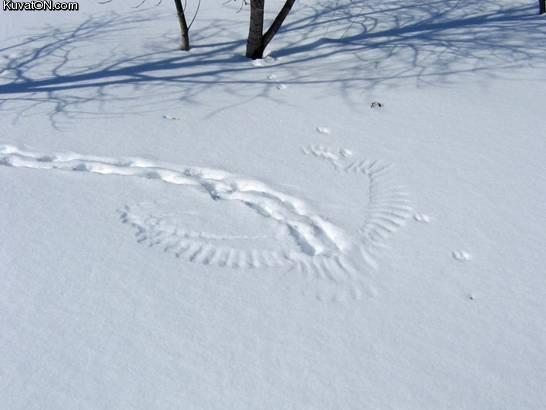
Oarfish

Friday, February 13th, 2009

Oarfish are “large, greatly elongated, pelagic Lampriform fish comprising the small family Regalecidae.”

In fact, one such “large, greatly elongated” species of oarfish, the Regalecus glesne or King of Herrings, is the longest bony fish on record, growing up to 11 meters long.

(The whale shark, Rhincodon typus, is longer but cartilaginous.)

The family name Regalecidae is derived from the Latin regalis, meaning royal:

The tapering, ribbony silver bodies of oarfish — together with an impressive, pinkish to cardinal red dorsal fin — help explain the perception of majesty taken from rare encounters.

Oarfish are rarely encountered and even more rarely encountered alive. They tend to linger at the surface or to beach themselves only when sick or dying, but these rare encounters may have led to stories of sea serpents.

Recently though an oarfish beached itself on the California coast:

Titanoboa cerrejonensis

Wednesday, February 4th, 2009

Titanoboa cerrejonensis sounds like something out of Robert E. Howard’s Hyborian Age:

Fossils from northeastern Colombia reveal the biggest snake ever discovered: a behemoth that stretched 42 to 45 feet long, reaching more than 2,500 pounds.


“This thing weighs more than a bison and is longer than a city bus,” enthused snake expert Jack Conrad of the American Museum of Natural History in New York, who was familiar with the find.

Henry and the Cape Buffalo

Wednesday, February 4th, 2009

On the site for their new book, The 10,000 Year Explosion, Cochran and Harpending share some “deleted scenes” that didn’t make it into the book, like the story of Henry and the Cape Buffalo, which sheds some light on just how dangerous it must have been to hunt big game with nothing but a thrusting spear:

When I (HCH) was a graduate student in the 1960’s I spent a year and a half in the northern Kalahari desert doing fieldwork with !Kung Bushmen, foragers who lived by foraging wild foodstuffs and hunting game animals. With several other graduate students we had a base camp near the border with Southwest Africa (now Namibia) about 100 miles south of the Caprivi Strip on the northern border of Botswana. The nearest source of supplies was a two-day trip from their camp by four wheel drive truck.

Several weeks after the rainy season ended there were reports in the neighborhood of a cape buffalo that was harassing people and animals. Often older males lose rank and leave herd to wander by themselves, angry and uncomfortable. They are a threat to people and stock, especially horses.

We were out of meat in our camp, and so with the confidence and foolishness of youth we decided to hunt down the buffalo. We had visions of steaks and chops as well as many pounds of dried meat for travel rations and dog food. At that time permits for Buffalo were only a few dollars from the Botswana game department, and we had several. Although there were stories of Buffalo being aggressive and dangerous to hunt, to my eye they were simply large cattle. Bushmen never hunted them with their poison arrow and spear technology, but they too were naïve and had great faith in our high-powered rifle.

One morning we set off to where the animal had last been reported. The party was a colleague, several young Bushman males, and myself. We soon picked up its tracks and for several hours followed its wanderings through the low thorny scrub. To me the tracks looked exactly like those of a cow but the Bushmen never hesitated. When it was apparent at one point that there were no tracks at all in view I asked, and the Bushmen told me that there was no point in following the tracks since they knew exactly where it was going. We often saw this hunting with Bushmen –they used actual tracks as a guide but knew the habits of animals so well that they often proceeded on their own to pick up actual tracks later on.

This went on for hours until, suddenly, a young man grabbed my shoulder and said “there it is.” I looked long and hard until I saw it, well camouflaged behind several yards of thick brush, sideways, staring hard at us with its bright pig eyes. It was about forty yards away.


As I brought the rifle up I was dismayed to realize that it still had a powerful telescopic sight. I should have removed it and use open iron sights in thick bush but I had forgotten. With the magnification of the scope I saw a black mass surrounded by brush. It took a moment to locate the front legs, then the chest. Oriented, I aimed and fired. “Bang-whump”, the bang from the rifle and the whump as the bullet struck the buffalo. He jerked a little, then simply stood there staring at me. “Bang-whump, bang-whump” as I fired two more rounds.

Now he tossed his head and snorted, then started running toward us. Buffalo charge with their nose high, only lowering their head to use their horns on contact. I fired one more round at the charging animal, head on, simply pointing at him because he was so close, then turned and ran. We discovered later that the bullet had struck his shoulder, ricocheted off his scapula, and exited through the skin on his side. It certainly didn’t slow him down at all: I might as well have been shooting at a railroad locomotive.

There were three of us running away now from the charging animal: my colleague, our camp dog, and myself. Perhaps fortunately for us the buffalo went after the dog, which handily outran it. After its charge the buffalo wandered off several dozen yards and collapsed in a thicket.

My colleague and I got together after the charge, brushed each other off, then noticed that none of the Bushmen with us was near. We looked around and called but got no response. Then, out of the corner of my eye, I saw a fellow about fifteen feet up a tree frantically signaling me to be quiet, then pointing at the (apparently) dead buffalo. I laughed and told him to come down, the animal was dead, it was getting dark and we needed to get started butchering it. He shook his head, silent, and frantically waved us back in the direction opposite the carcass. All the Bushmen were up in trees, all waving at us to get away, no one making any noise.

My rifle was empty, slung over my shoulder, as I honed a belt knife for the job ahead. I urged everyone to get out of the trees and get to work but everyone refused. I said “all right, we will just make sure”, then loaded my rifle and sat in a stable shooting position. The buffalo’s carcass was about forty yards away with its back to us. I took careful aim at the center of the neck, exhaled, and fired. “Bang-thump”.

Immediately the “dead” buffalo got to its feet, glared at us, and walked away.

Read the whole thing.

Extinct ibex is resurrected by cloning

Tuesday, February 3rd, 2009

The recently extinct Pyrenean ibex has been resurrected by cloning cryopreserved tissue samples:

Pyrenean ibex, which have distinctive curved horns, were once common in northern Spain and in the French Pyrenees, but extensive hunting during the 19th century reduced their numbers to fewer than 100 individuals.

They were eventually declared protected in 1973, but by 1981 just 30 remained in their last foothold in the Ordesa National Park in the Aragon District of the Pyrenees.

The last bucardo [Pyrenean ibex], a 13-year-old female known as Celia, was found dead in January 2000 by park rangers near the French border with her skull crushed.

Dr Folch and his colleagues, who were funded by the Aragon regional government, had, however, captured the bucardo the previous year and had taken a tissue sample from her ear for cryopreservation.

Using techniques similar to those used to clone Dolly the sheep, known as nuclear transfer, the researchers were able to transplant DNA from the tissue into eggs taken from domestic goats to create 439 embryos, of which 57 were implanted into surrogate females.

Just seven of the embryos resulted in pregnancies and only one of the goats finally gave birth to a female bucardo, which died a seven minutes later due to breathing difficulties, perhaps due to flaws in the DNA used to create the clone.

Despite the highly inefficient cloning process and death of the cloned bucardo, many scientists believe similar approaches may be the only way to save critically endangered species from disappearing.

Wolves Promote Forest Growth

Wednesday, January 21st, 2009

Orson Scott Card reviews Where the Wild Things Were, which makes the case that top predators can play important roles in maintaining a healthy, well-balanced ecological system:

For instance, the coastal waters of several north Pacific shores had little sea life — mostly a few huge sea urchins that consumed anything else that might sprout.

Then sea otters were reintroduced to these shores. Sea otters love to eat sea urchins. And with the sea urchin population falling, plant life began to thrive again. When the seaweeds and other plants returned, fish also came back to the newly-lush jungle.

Sea otters, in other words, made a rich ecology possible because they, as top predators, kept down the voracious sea urchins.

Or take Yellowstone. For generations there has been almost no new growth among the key species of trees. Why? Because the elks eat the new saplings right down to the ground. With their favorite foods gone, there were too many elk — and they were starving.

Hunters were fine with that — the more elk there are, the more licenses to hunt them that get issued.

But then wolves were reintroduced to Yellowstone, and the surprising result was that wolves killed far fewer elk than human hunters — but changed elk behavior in such a way that new trees were able to grow.

Why? Because wolves hunt by chasing their prey until their hearts or lungs give out and they stand there, exhausted, to be hauled down and torn apart.

Elks quickly learned to avoid streambeds, because it was precisely as they slowed to climb the far bank that the wolves invariably caught up with them. Elks on riverbanks were in greater danger than anywhere else; they learned not to linger there.

And since riverbanks are where most trees grow in the American west, the elks’ avoidance of those areas allowed huge numbers of new shoots to grow until they had a chance of thriving as actual trees. And the small animals that thrive in that environment now had new habitat. Again, a whole ecology was restored.

So wolves, in effect, promote forest growth!

Meanwhile, human hunters never had any such effect. What can the elks learn from the annual elk hunt? To avoid public lands in October and private lands in November?

(I’ve noted before how returning wolves to Yellowstone changed the ecosystem.)

Know Your Prehistory

Monday, January 19th, 2009

Cartoonist Rosemary Mosco offers up what she calls her paleobet with the admonition to know your prehistory.

You might also enjoy her “highly unscientific educational chart” of the parts of the bird or her demonstration of why evolution sucks if you’re a prehistoric terror bird.

Top 10 Wired Animal Photos

Tuesday, January 13th, 2009

Wired shares the Top 10 Animal Photos submitted and voted on by users:

As humans hunt, their prey gets smaller

Tuesday, January 13th, 2009

Scientists have confirmed something that I assumed was true: as humans hunt, their prey gets smaller:

Hunting and gathering has a profound impact on animals and plants, driving an evolutionary process that makes them become smaller and reproduce earlier, U.S. researchers reported on Monday.

Their study of hunting, fishing and collecting of 29 different species shows that under human pressure, creatures on average become 20 percent smaller and their reproductive age advances by 25 percent.

The human tendency to seek large “trophies” appears to drive evolution much faster than hunting by other predators, which pick off the small and the weak, the researchers report in the Proceedings of the National Academy of Sciences.

“As predators, humans are a dominant evolutionary force,” said Chris Darimont of the University of California, Santa Cruz. “It’s an ideal recipe for rapid trait change.”

Extinct Tasmanian "tiger" DNA has clues to demise

Tuesday, January 13th, 2009

Extinct Tasmanian "tiger" DNA has clues to demise:

DNA taken from the hair of two extinct Tasmanian “tigers” suggests the Australian marsupials last seen 70 years ago may have become too inbred to survive as a species, researchers reported on Monday.
[...]
The thylacine was hunted by European settlers and declared extinct in 1936 when the last zoo specimen died.

The research team pulled and sequenced DNA from the hair of a male thylacine brought to the U.S. National Zoo in Washington in 1902 and a female that died in the London Zoo in 1893.

They got sequences both from the nucleus of the cell, and the mitochondria, where DNA is passed down with few changes from mother to offspring.

Penn State’s Stephan Schuster said the work, described in a study in the journal Genome Research, shows it is possible to use hair to resurrect extinct animals — and perhaps to some day do so in real life.

“The speculation was that the only reason we were able to extract DNA from mammoth hair is that the mammoths had remained frozen in the Arctic permafrost, but our success with the Tasmanian tiger shows that hair can protect DNA for long periods under a variety of environmental conditions,” Schuster said.

I’ve mentioned the Thylacine before.

Edible Protein Weeds

Monday, January 12th, 2009

You may see a rat-like bird, but Alexis Madrigal sees a waste-scavenging, protein-generating biomachine:

You see, city pigeons are the feral descendants of birds that were domesticated by humans thousands of years ago so that we could eat them and use their guano as fertilizer, we read in Der Spiegel. They’re still doing their part, i.e. eating and breeding, but we humans have stopped doing ours, i.e. eating them.
[...]
“Killing makes no sense at all,” Daniel Haag-Wackernagel, a biologist at the University of Basel, told Der Spiegel. “The birds have an enormous reproduction capacity and they’ll just come back. There is a linear relationship between the bird population and the amount of food available.”
[...]
Pigeons are direct waste-to-food converters, like edible protein weeds, that leave droppings that could be used as fertilizer as a bonus.

And yet we expend energy trying to get rid of them.
[...]
Really, all pigeons need is a re-branding. Just as the spurned Patagonian toothfish became the majestic Chilean sea bass and the silly Chinese gooseberry became the beloved kiwifruit, pigeons can merely reclaim their previous sufficiently arugula-sounding name: squab.

(Hat tip to Todd.)

How big Jurassic flying reptiles got off ground

Saturday, January 10th, 2009

Pterosaurs (“winged lizards”) like Hatzegopteryx could grow to weigh more than 500 pounds, and how such big Jurassic flying reptiles got off ground has been a point of contention for some time. A new study suggests that the bat-like reptiles took off in a bat-like manner:

They leapt into the air off all four legs, said Mike Habib, of [Johns Hopkins University]‘s Center for Functional Anatomy and Evolution. Only vampire bats do something like that.
[...]
Last year, researchers tried to figure out how they got off the ground by looking at the largest bird now flying, the albatross. They concluded that anything much bigger couldn’t get off the ground the same way.

But Habib said pterosaurs shouldn’t be compared to birds.

“The catch is that they are not built like birds,” Habib said in a telephone interview.

Habib used CT scans of the bones of 155 bird specimens and a dozen species of pterosaurs and found that they were greatly different in strength, size and proportion. In birds, the hind legs were stronger than the front and in some pterosaurs the front legs were several times stronger than the hind ones.

“It’s a lot like a leapfrog,” Habib said, describing how he figures the pterosaurs got off the ground. “They kind of pitch forward at first, the legs kick off first, then the arms take off.”

That allowed some of the ancient giants to get into the air in less than a second. Habib calculated that the 550-pound pterosaur called Hatzegopteryx thambema launched at a speed of 42 miles per hour.

The ancient flier “accelerates more like a Porsche and less like a Volkswagen,” Habib said. “That’s really handy if you live in a world filled with tyrannosaurs, which it did.”

Sharks have wimpy bites

Wednesday, December 31st, 2008

Sharks have wimpy bites — for some definitions of wimpy:

“Pound for pound, sharks don’t bite all that hard,” Daniel Huber of the University of Tampa in Florida, who led the study, said in a telephone interview.

Huber and colleagues had trouble collecting data for their study, “due to the experimental intractability of these animals,” they wrote dryly in their report, published in Physiological and Biochemical Zoology.

“The vast majority of the data that went into this study was biomechanical models,” Huber said.

They also measured the bites of small sharks such as sand sharks, and tested larger sharks by knocking them out and using electricity to stimulate the jaw muscles.

Their conclusions? Sharks can do a lot of damage simply because their teeth are so sharp and their jaws are so wide.

“Our analyses show that large sharks do not bite hard for their body size, but they generally have larger heads,” they wrote.

A 20-foot (6-meter) great white shark can “bite through anything that you come across,” he adds.

Many must use a sawing motion to break apart their prey, said Huber, whose team studied 10 different species of shark. Mammals have evolved much more efficient jaw muscles, he noted.

Earth Piglet

Thursday, December 25th, 2008

Today’s dose of cute — “hideously cute” — comes from newborn aardvark Amani:

Zoo officials are awaiting DNA test results to determine the sex of its newborn aardvark, Amani (Swahili for “peace”), born at 1:05 a.m. Dec. 8 to mother Rachaael and father Mchimbaji.

The 23-inch infant arrived hairless, weighing 3 pounds, 10 ounces, with ears measuring 4 inches. “This baby can only be described as hideously cute,” said Director of Conservation and Animal Welfare Scott Carter. “Rachaael is a first-time mother and is showing great maternal instincts.”

Due to the aardvark’s clumsy nature and poor eyesight, zoo officials are assisting Rachaael with raising the fragile baby to prevent the possibility of it being injured. Since the birth, Amani has more than doubled in size. Adult aardvarks can weigh from 90 to 145 pounds and grow 5 to 6 feet in length.

The aardvark (Orycteropus afer) is an African mammal whose name derives from the Afrikaans word “earth pig.” The animal’s unusual appearance plays a part in its success as a forager. The ears point forward to enable it to listen for the sound of insects. The snout is long and filled with hair that acts as a filter, letting scents in and keeping dirt out. Strong limbs and spoon-shaped claws can tear though the sturdiest of termite mounds, allowing the aardvark to trap insects with its long, sticky tongue which can be up to 12 inches long.

Octopuses give eight thumbs up for high-def TV

Tuesday, December 23rd, 2008

Octopuses give eight thumbs up for high-def TV — sort of:

[Macquarie University marine biology researcher Renata Pronk] collected 32 common Sydney, or gloomy, octopuses from Chowder Bay, near Mosman, and showed them a series of three-minute videos screened on a monitor in front of their tank.

One video featured a crab, an octopus delicacy.

A second starred another octopus, while a third had a “novel object” they would not have seen: a plastic bottle swinging on a string.

Miss Pronk then watched each octopus for any consistent response pattern, such as boldness or aggression.

When the crab movie was screened “they jetted straight over to the monitor and tried to attack it”, she said, adding that was strong evidence they knew they were watching food.

When the octopus movie was screened some became aggressive while others changed their skin camouflage or “would go and hide in a corner, moving as far away as possible”.

On viewing the swinging bottle, some puffed themselves up, just in case the object was a threat, while others paid no attention.

But significantly, when the experiment was repeated over several days, she found no consistent response from any octopus. Such random responses implied octopuses have no individual personalities.

She suspected previous efforts to show movies to octopuses failed because their sophisticated eyes were too fast for the 24-frame per second format of standard-definition video.

“They would have seen it as a series of still pictures,” said Miss Pronk, who had success using high-definition, operating at 50 frames per second.

Bunny didn’t make it

Monday, December 22nd, 2008