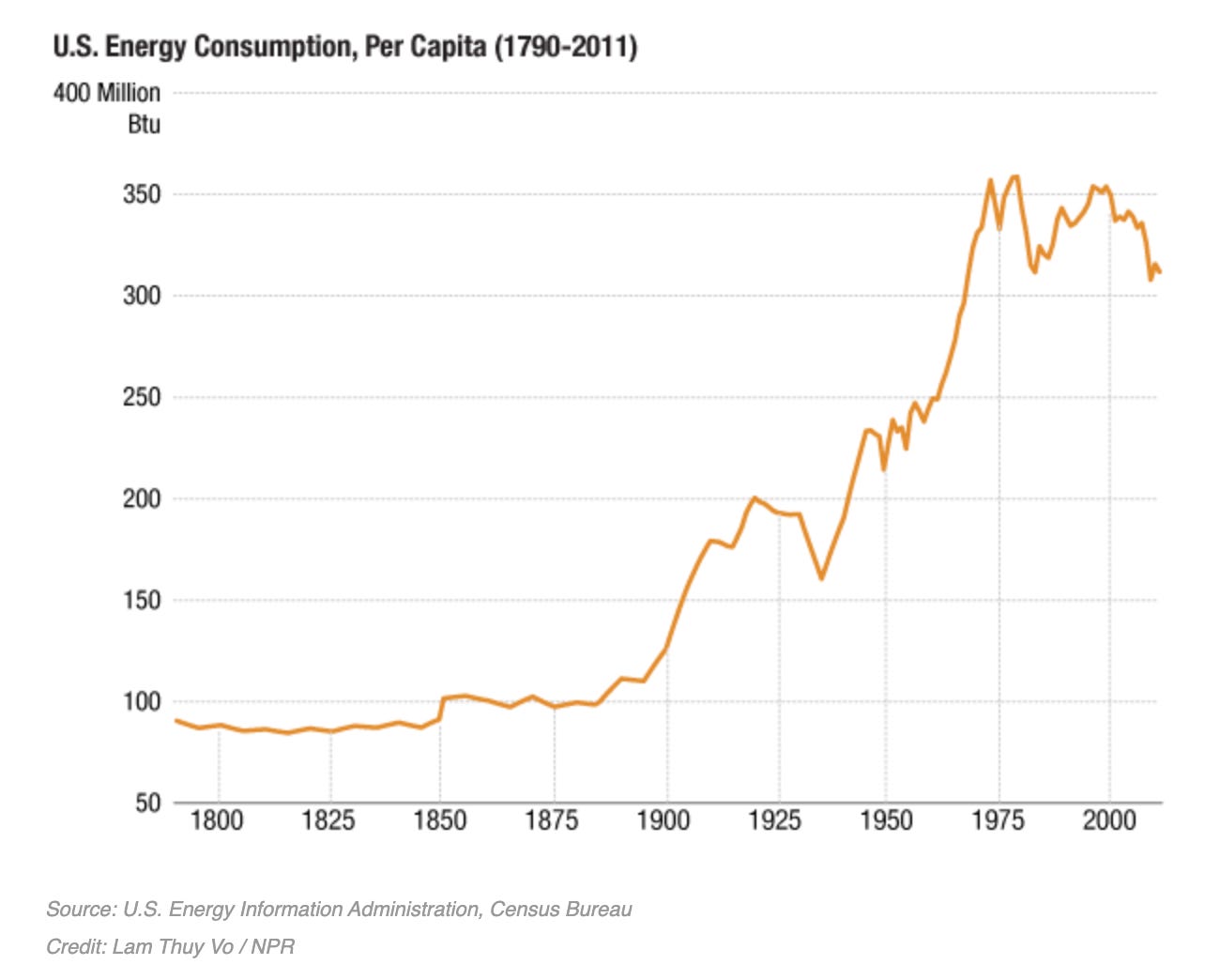
We want to replace much more than 100% of current gas, coal, and oil with zero-carbon sources of electricity

October 10th, 2021

Over the centuries, Matthew Yglesias reminds us, people have invented many different kinds of machines that help us do things and improve living standards:

But in a very general way, what most of these inventions do is let us substitute some form of power for human effort. And as long as we were totally ignoring the costs of burning coal and oil, this was a great mechanism for progress — you invent new ways to do things by burning coal and oil, so then you burn more coal and oil.

But since the mid-1970s we’ve been increasingly aware of the limits and problems with this model, and it’s put us on an energy diet. Now when we invent something cool, we often have to say “too bad the energy requirements are so high.”

But as Ryan Avent (from whom I borrowed that chart) and others have written, this is a backward way of looking at things. The turn toward conservation and efficiency was a necessary evil in an era when we couldn’t come up with a better way to deal with geopolitical instability linked to oil and pollution linked to all forms of fossil fuels.

Instead, we should raise our clean energy production ambitions. We don’t want to replace 100% of our current dirty energy — we want to generate vastly more energy than we are currently using and make it zero carbon.

What difference does it make in how you look at it?

In the “energy is a necessary evil” frame, we look at our current electricity needs and then ask, “How can we generate all that from zero-carbon sources?” In the alternate framing, you say that to the extent we can develop affordable, zero-carbon sources of electricity, we want to generate tons and tons of electricity. Ideally, we would want to replace much more than 100% of current gas, coal, and oil with zero-carbon sources of electricity and use that to literally power a bold new era of rapid economic growth.

I find that this vision tends not to be intuitively compelling to a lot of people who are accustomed to living in the efficiency era. But let’s just imagine a world with small modular nuclear reactors and advanced geothermal energy production — a world in which we have plenty of baseline power. As our ability to make batteries gets better and better, we can put them all in vehicles rather than using them to address intermittent renewables. Then when the sun shines or the wind blows, we have even more power that we can use for stuff that doesn’t need to be on all the time. It’s a world of energy abundance — Lewis Strauss’ dream of electricity that’s “too cheap to meter.”

John Lennon was embarrassed by his former radicalism

October 9th, 2021

Today is John Lennon’s birthday, and I’d like to once again remind people that by 1979 Lennon was embarrassed by his former radicalism — at least according to Fred Seaman, who was his assistant at the time:

John, basically, made it very clear that if he were an American he would vote for Reagan because he was really sour on Jimmy Carter.

[...]

I also saw John embark in some really brutal arguments with my uncle, who’s an old-time communist… He enjoyed really provoking my uncle… Maybe he was being provocative… but it was pretty obvious to me he had moved away from his earlier radicalism.

He was a very different person back in 1979 and 80 than he’d been when he wrote Imagine. By 1979 he looked back on that guy and was embarrassed by that guy’s naivete.

He would not respect rules and regulations that threatened to prevent him from achieving his mission objectives

October 7th, 2021

The troops and officers from some of the least belligerent nations in the world — namely, Sweden, Denmark, and Norway — turned out to be quite adept at both using force and playing the odds in the high-stakes political game played in Bosnia:

In late 1993, a reinforced Swedish-Danish-Norwegian mechanized battalion (Nordbat 2) deployed to Bosnia as part of an ongoing UN peacekeeping mission, known as UNPROFOR (United Nations Protection Force). The battalion was under Swedish command, and with the exception of a Danish tank company and a Norwegian helicopter detachment, was comprised of Swedish former conscripts, led by active-duty officers. The former conscripts had volunteered to return from civilian life to serve in a professional capacity. These Swedish troops, coming from a nation that had not experienced war for almost 200 years, faced a rigid UN bureaucracy, an unclear mandate, and the UN-imposed rules of engagement bordered on the absurd. However, the Swedes had one thing the others didn’t: a culture of mission command that had grown and developed for decades.

[…]

The Swedish Armed Forces were consequently trained to respond to a massive Soviet invasion force, which was expected to attack over land (via Finland), across the Baltic Sea, and by deploying airborne units. The Swedish Army estimated that a breakdown of command and control was a likely scenario as the Soviets would inevitably disrupt communications, destroy command centers, and seize territory, thereby isolating segments of the Swedish Army. In order to cope with this contingency, all units were trained to engage in what was known as “the free war,” (i.e. autonomous operations against local targets, without centralized command). The free war was intended as a last resort, which would only end when the invader had finally retreated. The official doctrine stated that all Swedish citizens were to, without exception, consider any order to surrender to be false, regardless of its origin. This was even printed in all phone books, which also contained instructions for the civilian population in case of war.

Considering that all Swedish Army units were expected to be able to operate autonomously, the culture of mission command completely permeated the entire organization. The officers and non-commissioned officers (NCOs), all the way down to the lowest-ranking enlisted men, were taught that the only truly mortal sin was to hesitate. To seize the initiative and act was the primary imperative. There was no priority higher than that of achieving the mission objectives at hand. Orders could be disobeyed, rules could be broken—as long as the mission was successful.

The battalion commanders who deployed to Bosnia to take charge of Nordbat 2 had spent their entire professional lives in this culture, and their men had known it since the earliest days of their own military training. To them, it was as natural as breathing.

[…]

Shortly after it had been deployed to Bosnia in December 1993, Nordbat 2 found itself in its first serious hostile encounter. A Swedish platoon was sent to relieve a Canadian company which was providing security for a mostly abandoned hospital compound in a remote area. As soon as the Canadians left, a Croatian battalion-sized unit showed up and promptly mined the only road leading to the compound, ensuring that the Swedes would be unable to receive reinforcements.

Then they issued an ultimatum: hand over the three Muslim nurses, and we will leave you alone. The Swedish platoon leader, Captain Stewe Simson, radioed battalion command, and was told that it was his call to make, since he was the one in charge at the location. Captain Simson refused to hand over the nurses and instead ordered his men to prepare for combat.

Vastly outnumbered and outgunned, Captain Simson realized that it was unrealistic to expect that his unit would survive a full-out assault. Nevertheless, he was determined not to give in. The Croats started to fire mortar rounds, but the Swedes held their positions. After a few hours, the Croats issued a new ultimatum: the nurses could stay if the Croats were granted free passage to the compound. Again, Captain Simson refused. The situation remained tense throughout the night, with the Swedes maintaining full combat readiness. In the morning, the Croats negotiated with the Swedes and eventually left, quietly dropping their ultimatums. Nordbat 2 had shown resolve even in the face of hopeless odds, achieving a strategically important victory as a result of a decision made by a platoon commander.

Other incidents followed. When fired at, Nordbat 2 often shot back, frequently disregarding the UN rules of engagement. Colonel Henricsson made it clear that he would not respect rules and regulations that threatened to prevent him from achieving his mission objectives. When his own government tried to rein him in, he simply told his radio operator to pretend that the link was down until he had a fait accompli to present to Stockholm.

In one particularly infamous incident, the Bosnian Serb Army set up an ambush for the battalion’s Danish tank company. By launching a feint attack against a remote outpost, the Bosnian Serb Army lured a detachment from the tank company to drive straight into a trap. Anti-tank missiles and heavy guns opened up from concealed positions. Once the Danes started to take fire, their response was furious. The detachment commander simply told his crews to neutralize the anti-tank positions. The Leopard tanks directed accurate and deadly fire against the Bosnian Serb Army positions, using up no less than 72 main gun rounds. One by one, the anti-tank missile batteries and gun positions fell silent. During the fight, a Bosnian Serb Army ammunition supply was hit, resulting in a large explosion. After the engagement, Nordbat 2 estimated that as many as 150 troops may have been killed, although the Bosnian Serb Army denied this.

The incident greatly upset the UN regional command, which threatened to relieve Nordbat 2′s battalion commander and have him sent back to Sweden. Nevertheless, Nordbat 2 had once again refused to let the parties to the conflict dictate the terms of its deployment. In several other incidents, Nordbat 2 personnel intervened to protect refugees and took action to prevent the cover-up of ethnic cleansing operations. On several occasions this took the form of forcing passage through roadblocks. During one such event, the battalion commander himself forced a sentry to remove the anti-tank mines used to block passage by threatening to blow the sentry’s head off with a heavy machine gun.

(Hat tip to Dominic Cummings.)

The lithium-metal battery with this architecture had an energy density of 560 Wh/kg

October 4th, 2021

One of the more promising possibilities for improving lithium-ion batteries involves swapping out the graphite used in one of the battery’s electrodes for pure lithium metal, a material that can hold as much as 10 times the energy:

The researchers started off with what’s described as a cobalt-poor, nickel-rich layered cathode (NCM88) and a commercially available organic electrolyte called LP30. While the cathode reached high energy density, instability soon took hold and storage capacity decreased as the battery was cycled.

“In the electrolyte LP30, particles crack on the cathode,” explains Professor Stefano Passerini, Director of HIU. “Inside these cracks, the electrolyte reacts and damages the structure. In addition, a thick mossy lithium-containing layer forms on the anode.”

So the team swapped out the LP30 electrolyte for an alternative, and one that brought about profound gains in performance. Described as a non-volatile, poorly-flammable, dual-anion ionic liquid electrolyte (ILE), this ingredient proved to largely avoid the structural defects on the cathode and saved the battery from the fatal electrochemical reactions.

[…]

The lithium-metal battery with this architecture had an energy density of 560 Wh/kg. For context, there are research consortiums dedicated to breaking through the 500-Wh/kg density threshold in order to power next-generation electric vehicles, while today’s best-in-class lithium-ion batteries have energy densities of 250 to 300 Wh/kg.

Forty-nine are cute quirks, and one is destroying civilization

October 3rd, 2021

Julia Galef, author of Scout Mindset, earned her celebrity status honestly, Scott Alexander quips, through long years of hard labor in the rationality mines:

Back in ~2007, a bunch of people interested in biases and decision-making joined the “rationalist community” centered around the group blogs Overcoming Bias and Less Wrong. Around 2012, they mostly left to do different stuff. Some of them went into AI to try to save the world. Others went into effective altruism to try to revolutionize charity. Some, like me, got distracted and wrote a few thousand blog posts on whatever shiny things happened to catch their eyes. But a few stuck around and tried to complete the original project. They founded a group called the Center For Applied Rationality (aka “CFAR”, yes, it’s a pun) to try to figure out how to actually make people more rational in the real world.

Like, a big part of why so many people — the kind of people who would have read Predictably Irrational in 2008 or commented on Overcoming Bias in 2010 — moved on was because just learning that biases existed didn’t really seem to help much. CFAR wanted to find a way to teach people about biases that actually stuck and improved decision-making. To that end, they ran dozens of workshops over about a decade, testing various techniques and seeing which ones seemed to stick and make a difference. Galef is their co-founder and former president, and Scout Mindset is an attempt to write down what she learned.

Reading between the lines, I think she learned pretty much the same thing a lot of the rest of us learned during the grim years of the last decade. Of the fifty-odd biases discovered by Kahneman, Tversky, and their successors, forty-nine are cute quirks, and one is destroying civilization. This last one is confirmation bias — our tendency to interpret evidence as confirming our pre-existing beliefs instead of changing our minds. This is the bias that explains why your political opponents continue to be your political opponents, instead of converting to your obviously superior beliefs. And so on to religion, pseudoscience, and all the other scourges of the intellectual world.

But she also learned that just telling people “Hey, avoid confirmation bias!” doesn’t work, even if you explain things very well and give lots of examples. What does work? Research is still ongoing, but the book concentrates on emotional and identity-related thought processes.

[…]

Instead of thinking “I’m sure global warming is fake!”, try to think in terms of probabilities (“I think there’s a 90% chance global warming is fake.”) Instead of thinking in terms of changing your mind (“Should I surrender my belief, and switch to my enemy’s belief that global warming is true”), think in terms of updating your probabilities (“Now I’m only 70% sure that global warming is fake”). This mindset makes it easier to remember that it’s not a question of winning or losing, but a question of being as accurate as possible. Someone who updates from 90% to 70% is no more or less wrong or embarrassing than someone who updates from 60% to 40%.

[…]

A lot of the best rationalists I know instinctively apply these tests to everything they think. One technique for cultivating this practice (not the book’s recommendation) is to go on Twitter, where the adage is “there’s always an old tweet”. Argue that people who say racist things should be cancelled, and someone will dig up your old racist tweet and make you defend why you shouldn’t face the same consequences. Argue that it’s disgraceful when the other party uses extreme violent language about their outgroup, and someone will dig up an old tweet where you used even more extreme language about yours. Demand that the Republican senator resign for sexual misconduct, and someone will find the old tweet where you said the Democratic senator should tough it out. Eventually, if you want to maintain any dignity at all, you learn to double-check whether your beliefs are consistent with one another or with what you’d believe in vaguely similar situations.

Scout Mindset says: why not try the same thing, even when you’re not on Twitter, just to determine what’s true?.

And one very likely answer is: because it would hurt.

Scout Mindset tries to differentiate itself from other rationality-and-bias books by caring a lot about this. It argues that, while other rationality books just told you what to do, most people wouldn’t do it; they’d be too emotionally attached to their existing beliefs. So after giving a few intellectual suggestions, it goes on a deep dive into the emotional side.

[…]

It reminds me of C.S. Lewis — especially The Great Divorce, whose conceit was that the damned could leave Hell for Heaven at any time, but mostly didn’t, because it would require them to admit that they had been wrong. I think Julia thinks of rationality and goodness as two related skills: both involve using healthy long-term coping strategies instead of narcissistic short-term ones.

[…]

Julia is trying to normalize changing your mind, to assure you that lots of great people who you respect do it, that there are whole communities out there of people who do it, that she does it and she is a TED-talk-having celebrity who you implicitly trust.

Big money for container carriers

October 2nd, 2021

Two years ago, a 40-foot container cost less than $2,000 to transport goods from Asia to the U.S:

Today the service fetches as much as $25,000 if an importer pays a premium for on-time delivery, which is a luxury. That’s translated into big money for container carriers, with the industry on track to post $100 billion in net profit this year, up from about $15 billion in 2020, says John McCown, an industry veteran and founder of Blue Alpha Capital.

Harden’s Folly

October 1st, 2021

Steve Sailer describes Kathryn Paige Harden’s The Genetic Lottery as Harden’s Folly:

After years of trying out on the science conference circuit her arguments for why the Woke shouldn’t be so anti-genetics, The Genetic Lottery is finally here. It turns out to be an elaborately contrived triple-bank-shot attempt to head off growing Ibram X. Kendi-style science denialism by claiming that ignoring the influence of genetics upon human differences just enables the Real Bad Guys, led by archvillain Charles Murray, to easily dunk on the libs:

When social scientists routinely fail to integrate genetics into their models of human development, they leave space for a false narrative that portrays the insights of genetics as a Pandora’s box of “forbidden knowledge.”… Why would we want to hand people opposed to the goals of social equality a powerful rhetorical weapon, in the form of a widely prevalent and easily understood methodological flaw in social research?

[…]

The Genetic Lottery is all over the map. Some people try not to get canceled by adopting an obscure prose style. Harden, instead, artlessly expresses herself, and then goes back and says the opposite later.

[…]

Harden is proud of her book’s title:

A lottery is a perfect metaphor for describing genetic inheritance: the genome of every person is the outcome of nature’s Powerball.

But, except for the potential big payoff, lotteries are boring. In contrast, how a particular baby gets made is fascinating on multiple levels: scientific, sociological, romantic, and erotic. A less bad metaphor for how humans are conceived would be poker, a game that combines luck, strategy, and psychology. Murray, by the way, plays poker.

Moreover, Murray is an Aristotelian. The Greeks valued excellence not just for what it could do for the poor, but for its own sake.

This can lead to excessive Nietzscheanism. Yet, Harden’s Rawlsian conviction that society must be organized around helping the lowest potential people narrow gaps seems comparably unbalanced. The old Benthamite notion of the greatest good for the greatest number seems more sensible (but is out of fashion for its majoritarianism).

Harden propounds a sophomoric view that intelligence is “socially valued, not inherently valuable,” and follows that up with a conspiracy theory that early-20th-century eugenicists plotted to get us:

…to see intelligence (as measured on standardized IQ tests) and educational success, perhaps more than any other human phenotypes, in terms of a hierarchy of inferior and superior persons is not an accident. It is an idea that was deliberately crafted and disseminated.

In truth, intelligence has been viewed as valuable for a lot longer than that. For instance, the most famous work of ancient philosophy, Plato’s Republic, is basically about why philosophers deserve to be kings.

More reasonably, the Greeks felt it smart to invest the most in the education of the highest potential students. Thus, it used to be seen as a good thing that Plato had Socrates for a teacher and Aristotle for a pupil. Similarly, society invested heavily in the young Harden’s potential, granting her a full ride to a private college due to her high test scores.

The ideology of The Genetic Lottery seems motivated in sizable measure by Harden’s maternal feelings for her two very different children. One of her children is healthy and bright, while the other, to whom Harden devotes more of her efforts, was born with a congenital defect.

Innocence is like a dumb leper who has lost his bell

September 30th, 2021

Quiet American by Graham GreeneI had been meaning to read the copy of The Quiet American on my shelf for some time, when I finally got the audiobook and listened to it instead. As Wikipedia explains, Greene worked as a war correspondent for The Times and Le Figaro in French Indochina 1951–1954 and was inspired to write The Quiet American while driving back to Saigon from Ben Tre province in October 1951, when he was accompanied by an American aid worker who lectured him about finding a “third force in Vietnam”.

The two main characters are the first-person narrator, Thomas Fowler, a jaded British journalist in his fifties who has been covering the French war in Vietnam for more than two years, and the quiet American of the title, Alden Pyle, an idealistic Harvard man working for the recently renamed OSS.

I wasn’t even aware of the 2002 film, but its casting seems perfect: Michael Caine as Fowler, and Brendan Fraser as Pyle. There’s a reason I hadn’t noticed its release:

The first rough cut was screened to a test audience on September 10, 2001 and received positive ratings. However, the September 11 attacks took place the next day, and audience ratings dropped with each subsequent screening. Reacting to criticism of the film’s “unpatriotic” message, Miramax shelved the film for a year. It was finally screened publicly at the Toronto International Film Festival in September 2002 to critical acclaim. The film received an Oscar qualification release in November 2002 and a limited release in January 2003.

Fowler is painfully cynical, and Pyle is painfully earnest, leading to remarks like these:

  • I wish sometimes you had a few bad motives, you might understand a little more about human beings.
  • That was my first instinct — to protect him. It never occurred to me that there was a greater need to protect myself. Innocence always calls mutely for protection when we would be so much wiser to guard ourselves against it: innocence is like a dumb leper who has lost his bell, wandering the world, meaning no harm.
  • Thought’s a luxury. Do you think the peasant sits and thinks of God and Democracy when he gets inside his mud hut at night?
  • I never knew a man who had better motives for all the trouble he caused.
  • He was impregnably armored by his good intentions and his ignorance.
  • God save us always from the innocent and the good.
  • They killed him because he was too innocent to live. He was young and ignorant and silly and he got involved. He had no more of a notion than any of you what the whole affair’s about…

The novel seems oddly prescient — and, like Cassandra, unheeded:

However, after its publication in the United States in 1956, the novel was widely condemned as anti-American. It was criticised by The New Yorker for portraying Americans as murderers, largely based on one scene in which a bomb explodes in a crowd of people. According to critic Philip Stratford, “American readers were incensed, perhaps not so much because of the biased portrait of obtuse and destructive American innocence and idealism in Alden Pyle, but because in this case it was drawn with such acid pleasure by a middle-class English snob like Thomas Fowler whom they were all too ready to identify with Greene himself”.

One small line from the novel caught my attention: “the restaurant had an iron grille to keep out grenades.”

Many people would like to do what Ayn Rand did

September 29th, 2021

Ayn Rand pretty much failed as a philosopher, Michael Huemer says, but she was a brilliant novelist:

Most literature buffs disagree with this; indeed, most would probably say Rand was a terrible novelist. I think the reason for this is not that Rand was objectively terrible, but rather that the overwhelming majority of literature fans (especially, e.g., students and professors of literature) fall within a certain range of tastes, which are connected to their general personality traits. This is a selection effect, i.e., only people with a certain psychology choose to become literature experts.

Rand intentionally wrote a particular kind of novel, which literature people happen not to like; thus, no matter how good the novels are within that category, most literature people will hate them.

And what category was that? You might call it “the propaganda novel” (where “propaganda” is of course used in a purely descriptive sense, not as a term of abuse). They are novels designed to advance a philosophical worldview, and to do so in a clear, forceful, and (to those who might be receptive to that worldview) inspiring manner. They are not subtle, nor are they supposed to be. They are supposed to dramatize Ayn Rand’s worldview.

Leaving aside (for now) the question of whether Rand’s worldview is right, is this a worthy goal for a novel? Well, consider all the novels whose central goal is to provoke a feeling of horror (horror novels), or wonder (science fiction and fantasy), or excitement (action novels). Communicating one’s philosophy is at least as worthwhile and reasonable as those goals. Whether this counts as “literature” or not is neither here nor there.

Given that this is in principle a worthwhile thing to do, and given that that is the type of novel Rand set out to write, her works have to be judged by the standards of that genre. By those standards, she succeeds about as well as anyone has ever done. Can you think of another novel that has created as many devoted followers of a philosophical movement as Atlas Shrugged?

Many people would like to do what Ayn Rand did — many would like to communicate their ideas to people all over the world, and many would like to write bestsellers. Some of the world’s smartest people have tried to do those things. Almost none of them can do it. If you or I try to do what Rand did, we will not succeed. So let’s admit that Rand had an exceptional talent for that kind of writing.

That said, I understand very well what some people hate about her writing. It is very heavy handed, black-and-white, and often angry and deliberately insulting towards people with different ideas. These characteristics, however, are part of how Rand succeeded. If she had communicated her ideas in a manner that most literature fans would like, then you would have never heard of her and we wouldn’t be talking about her now.

Rand’s most subtle novel, by the way, was her first: We the Living. It is the only of her works that features a socialist character who has integrity. It’s also far less popular than her more propagandistic novels.

In sum: Ayn Rand set out to do something that is in principle worthwhile, that hardly anyone is capable of doing, and she succeeded better than just about anyone ever has. That requires enormous talent.

Nobody will pay you more for cleaner air directly

September 28th, 2021

Alex Tabarrok finds it puzzling that there isn’t more attention given to air filtration and UV light disinfection in hospitals, since these techniques have been shown to kill superbugs:

The authors installed portable air filters with UV disinfection on two COVID hospital wards in the UK. The air was tested for viruses, bacteria and fungi before the filters were turned on, during the time the filters were on and then again after the filters were turned off.

The results:

Airborne SARS-CoV-2 was detected in the ward on all five days before activation of air/UV filtration, but on none of the five days when the air/UV filter was operational; SARS-CoV-2 was again detected on four out of five days when the filter was off.

Importantly, in addition to greatly reducing SARS-CoV-2 the portable filters and UV light also greatly reduced multiple viral, bacterial, and fungal pathogens.

A commenter explains why this hasn’t become common practice already:

The main regulation rests largely on ASHRAE 170-2017. That in turn has been addended over a dozen times since the pandemic began. We have done things to change how air is handled in light of these and the more direct regulators (e.g. the Joint Commission) are adapting.

But it is not trivial to do all of this. Some hospitals have ductwork that is over a 100 years old. Adding in UV creates problems for reactive species in the air. And then there is the problem that any refits (e.g. to handle higher pressures/volumes) often means opening up the ceilings inside the ICUs or going through the floor in the the floor above. These are highly disruptive activities at the best of times. When you are (or may soon) be at or above bed capacity, well not the best time to bring in a small legion of contractors to close large areas of the hospital.

Then, yes, money is a huge thing. Funny thing is, nobody will pay you more for cleaner air directly. You might be able to eke out some sort of capital return through fewer nosocomial infections or uncharged readmissions, but those are speculative returns at this point and pretty long run things when, again, right now beds in many places are still exceptionally highly utilized. Worse, when you do open up the tubes and start mucking around there is a very high risk that you will disturb some collection of spores that has found some dark corner to accumulate in over the last few decades. When you have a bunch folks who already have respiratory compromise, this is a particularly bad time to risk that sort of contamination.

So faced with high upfront costs, a strong litigation risk, and remote cost savings, this is not a priority right now. If you want a massive overhaul of the air system right now it is going to need liability waivers and giveaways to the AHA crowd. A slower roll out via changes in ASHRAE and the like is already underway, but I figure it will be over a decade before everyone updates.

What if Audrey Hepburn played chess?

September 27th, 2021

I haven’t watched Netflix’s Queen’s Gambit, but I’ve heard good things. It never occurred to me that it was based on a 40-year-old book — which does not describe its protagonist as looking like the show’s star, Anya Taylor-Joy:

Beth learned of her mother’s death from a woman with a clipboard. The next day her picture appeared in the Herald-Leader. The photograph, taken on the porch of the gray house on Maplewood Drive, showed Beth in a simple cotton frock. Even then, she was clearly plain. A legend under the picture read: “Orphaned by yesterday’s pile-up on New Circle Road, Elizabeth Harmon surveys a troubled future. Elizabeth, eight, was left without family by the crash, which killed two and injured others. At home alone at the time, Elizabeth learned of the accident shortly before the photo was taken. She will be well looked after, authorities say.”

In the Methuen Home in Mount Sterling, Kentucky, Beth was given a tranquilizer twice a day. So were all the other children, to “even their dispositions.” Beth’s disposition was all right, as far as anyone could see, but she was glad to get the little pill. It loosened something deep in her stomach and helped her doze away the tense hours in the orphanage.

Mr. Fergussen gave them the pills in a little paper cup. Along with the green one that evened the disposition, there were orange and brown ones for building a strong body. The children had to line up to get them.

Foundation is hard science fiction at its least aesthetic and humanistic

September 24th, 2021

Isaac Asimov began writing his Foundation when he was in his early 20s, after reading Gibbon’s Decline and Fall of the Roman Empire and Toynbee’s Study of History and coming up with the idea of a Science of History that predicts the future:

This is an idea that only a very young man who hasn’t much experience with how inevitably wrong his predictions will turn out to be could dream up.

On the other hand, it’s also a really interesting idea. Foundation is hard science fiction at its least aesthetic and humanistic. Asimov wasn’t all that good at writing characters, but his mathematical psychohistorian Hari Seldon and The Mule who upsets Hari’s careful plans are useful shorthand references when talking about forecasting.

The smoke of the country went up as the smoke of a furnace

September 22nd, 2021

A Tunguska sized airburst destroyed a Middle Bronze Age city — or two — in the Jordan Valley near the Dead Sea 3,600 years ago:

We present evidence that in ~1650 BCE (~3,600 years ago) a cosmic airburst destroyed Tall El-Hammom, a Middle-Bronze-Age city in the southern Jordan Valley northeast of the Dead Sea. The proposed airburst was larger than the 1908 explosion over Tunguska, Russia, where a ~50-m-wide bolide detonated with ~1,000x more energy than the Hiroshima atomic bomb.

We’ll be laughing about those three weeks of regular high school for the rest of our lives

September 15th, 2021

Bryan Caplan explains his family’s homeschooling Odyssey:

Six years ago, I began homeschooling my elder sons, Aidan and Tristan.  They attended Fairfax County Public Schools for K-6, becoming more disgruntled with every passing year.  Even though they went to an alleged “honors” school for grades 4-6, they were bored out of their minds.  The academic material was too easy and moved far too slowly.  The non-academic material was humiliatingly infantile.  And non-academics — music, dance, chorus, art, poster projects — consumed a majority of their day.  As elementary school graduation approached, my sons were hungry for a change.

So what did we do? In consultation with my pupils, I prepared an ultra-academic curriculum. Hours of math every day. Reading serious books. Writing serious essays. Taking college classes. And mastering bodies of knowledge.

[…]

While my sons’ objective performance and subjective satisfaction in middle school were both sky-high, my wife insisted that they try regular high school. Back in those days, the political brainwashing at FCPS was modest, but the anti-intellectual pedagogical philosophy was already overwhelming. I never liked high school, but at least in my day teachers actually taught their subjects. Not so at FCPS. With the noble exception of their calculus teacher, my sons’ high school teachers just showed videos and treated teens like babies. After three weeks, my wife gave a green light to resume homeschooling.

Silver lining: Since comedy is tragedy plus time, we’ll be laughing about those three weeks of regular high school for the rest of our lives. Yes, a kid in their Spanish class really did raise his hand and say, “Spain’s in… South America, right?”

[…]

I hired an excellent Spanish tutor to give them Spanish five days a week year-round. And I asked their tutor to use the immersion method: ¡No Inglés!

The results were phenomenal. In months, the twins started speaking exclusively Spanish to each other. The wishful thinking of, “You hate it now, but work hard and you’ll come to love it” came true for them.

[…]

In 12th grade, the college application process took over my sons’ lives. While they still prepared themselves for AP Statistics and Physics C: Electricity and Magnetism, filling out applications consumed almost the entire first semester. Despite everything we’d accomplished, I was nervous. The most reliable researchers I cornered told me that discrimination against homeschoolers was now mild, but short of a major lawsuit, how can anyone really find out?

To cope, I gave my sons the same advice I give everyone in this situation: Not only is admission random; funding is random as well. So throw a big pile of dice.

In response, my sons maxed out the Common App, which allows you to apply to up to 20 schools. (They also applied to Georgetown, which stubbornly refuses to join the Common App).

The college application weighed heavily on my students. I raised them to think clearly and speak bluntly. They knew to pull their punches on AP essays, but the whole college admission process is simply drenched in Social Desirability Bias. If you write a personal statement that admits, “I want to attend your school because I need a strong signal to advance my career, and you’re selling the thirteenth-best signal on the market,” you won’t be getting in. This was the one time I had to push them to do their work. Tristan averred that the academic refereeing process (four rounds of revisions!) was easy by comparison. My many pep talks largely fell on deaf ears. Still, they soldiered on, and finally resumed their actual studies. Intellectually, the highlight of their year was probably auditing my Ph.D. Microeconomics class.

Soon, college acceptances started to come in. Once the University of Virginia admitted them to their honors program, I stopped worrying. Johns Hopkins, by far the highest-ranked school in the DC area, took them as well. Then in early February, Vanderbilt offered both of them full merit scholarships. No one else came close to that deal, so that’s where they decided to go. And that’s where they are this very day. (Hi, sons!) If you see Aidan or Tristan on campus, be sure to introduce yourself. They’re not attention hogs like me, but they have much to say about anything of substance, and are hilarious once you put them at ease.

My general read: I think the median school probably did discriminate against my sons for being homeschooled. Their SATs were 99%+, their AP performance was off the charts, they ran an impressive podcast, and they had a refereed history publication. (At many schools, five such pubs would buy an assistant professor tenure!) Yet they were waitlisted by Harvard and Columbia, and rejected by all the lesser Ivies. All public schools accepted them; I don’t know if this stems from lower discrimination or just lower standards. Nevertheless, the net effect of homeschooling was almost certainly highly positive. My sons used their immense educational freedom to go above and beyond, and several top schools were suitably impressed. The critical factor at Vanderbilt, I suspect, was that their faculty, not their admissions committees, hand out academic merit scholarships.

[…]

Yes, they missed their chance to have a normal high school experience. They had something much better instead. At least in their own eyes.

New York City’s police commissioner on 9/11 sounded like he was right out of central casting

September 12th, 2021

When I listened to a recent interview with Bernard Kerik, who was New York City’s police commissioner on 9/11, he sounded like he was right out of central casting — a New York tough guy that I couldn’t quite trust.

He goes from dropping out of high school, to joining the army, to working security for the Saudi royal family, to joining the NYPD, to becoming Rudy Giuliani’s personal bodyguard, to taking over as commissioner of the city Department of Corrections, to becoming police commissioner, to being appointed Interim Minister of Interior of Iraq!