There just are not enough good schools to go around

Monday, May 8th, 2017

This recent New York Times piece on “the broken promises of choice” in New York City schools is so willfully naive it’s painful:

Within the system, there is a hierarchy of schools, each with different admissions requirements — a one-day high-stakes test, auditions, open houses. And getting into the best schools, where almost all students graduate and are ready to attend college, often requires top scores on the state’s annual math and English tests and a high grade point average.

Those admitted to these most successful schools remain disproportionately middle class and white or Asian, according to an in-depth analysis of acceptance data and graduation rates conducted for The New York Times by Measure of America, an arm of the Social Science Research Council. At the same time, low-income black or Hispanic children like the ones at Pelham Gardens are routinely shunted into schools with graduation rates 20 or more percentage points lower.

While top middle schools in a handful of districts groom children for competitive high schools that send graduates to the Ivy League, most middle schools, especially in the Bronx, funnel children to high schools that do not prepare them for college.

The roots of these divisions are tangled and complex. Students in competitive middle schools and gifted programs carry advantages into the application season, with better academic preparation and stronger test scores. Living in certain areas still comes with access to sought-after schools. And children across the city compete directly against one another regardless of their circumstances, without controls for factors like socioeconomic status.

Ultimately, there just are not enough good schools to go around. And so it is a system in which some children win and others lose because of factors beyond their control — like where they live and how much money their families have.

We send the kids with good grades and test scores to the selective schools and the kids with bad grades and test scores to the unselective schools, and that’s clearly unfair, because those unselective schools underperform the selective schools!

There just are not enough good schools to go around.

Make America first again

Friday, May 5th, 2017

The ideas made it,” Pat Buchanan says, “but I didn’t”:

A quarter-century before Trump descended into the atrium of his Manhattan skyscraper to launch his unlikely bid for the White House, Buchanan, until then a columnist, political operative and TV commentator, stepped onto a stage in Concord, New Hampshire, to declare his own candidacy 10 weeks ahead of the state’s presidential primary. Associating the “globalist” President George H. W. Bush with “bureaucrats in Brussels” pursuing a “European superstate” that trampled on national identity, Buchanan warned his rowdy audience, “We must not trade in our sovereignty for a cushioned seat at the head table of anybody’s new world order!” His radically different prescription, which would underpin three consecutive runs for the presidency: a “new nationalism” that would focus on “forgotten Americans” left behind by bad trade deals, open-border immigration policies and foreign adventurism. His voice booming, Buchanan demanded: “Should the United States be required to carry indefinitely the full burden of defending rich and prosperous allies who take America’s generosity for granted as they invade our markets?”

This rhetoric — deployed again during his losing bid for the 1996 GOP nomination, and once more when he ran on the Reform Party ticket in 2000 — not only provided a template for Trump’s campaign, but laid the foundation for its eventual success. Dismissed as a fringe character for rejecting Republican orthodoxy on trade and immigration and interventionism, Buchanan effectively weakened the party’s defenses, allowing a more forceful messenger with better timing to finish the insurrection he started back in 1991. All the ideas that seemed original to Trump’s campaign could, in fact, be attributed to Buchanan — from depicting the political class as bumbling stooges to singling out a rising superpower as an economic menace (though back then it was Japan, not China) to rallying the citizenry to “take back” a country whose destiny they no longer dictated. “Pitchfork Pat,” as he was nicknamed, even deployed a phrase that combined Trump’s two signature slogans: “Make America First Again.”

“Pat was the pioneer of the vision that Trump ran on and won on,” says Greg Mueller, who served as Buchanan’s communications director on the 1992 and 1996 campaigns and remains a close friend. Michael Kinsley, the liberal former New Republic editor who co-hosted CNN’s “Crossfire” with Buchanan, likewise credits his old sparring partner with laying the intellectual groundwork for Trumpism: “It’s unclear where this Trump thing goes, but Pat deserves some of the credit.” He pauses. “Or some of the blame.”

Buchanan, for his part, feels both validated and vindicated. Long ago resigned to the reality that his policy views made him a pariah in the Republican Party — and stained him irrevocably with the ensuing accusations of racism, anti-Semitism and xenophobia — he has lived to see the GOP come around to Buchananism and the country send its direct descendant to the White House.

“I was elated, delighted that Trump picked up on the exact issues on which I challenged Bush,” he tells me. “And then he goes and uses my slogan? It just doesn’t get any better than this.” Buchanan, who has published such books as The Death of the West, State of Emergency, Day of Reckoning and Suicide of a Superpower, admits that November’s election result “gave me hope” for the first time in recent memory.

Does inequality cause crime?

Thursday, May 4th, 2017

It is often argued that inequality or poverty causes crime, Devin Helton notes, and that only by addressing these “root causes” can we reduce crime:

But as we know from Statistics 101, correlation does not prove causation. There are numerous variables that differ between countries or states that can have a correlated impact on inequality and crime: governance, ethnicity, culture, institutions, traditions, etc.

To avoid these confounders, another way to test the link between inequality and crime is to examine the treatment effect. If public policy choices increase inequality, does crime go up? If public policy choices decrease inequality, does crime go down?

From 1910 until the late 1970s, both England and America undertook concerted programs to reduce inequality. Both introduced progressive income taxes. Both changed laws to support unionization. And then in the 1980s both countries reversed course. Britain elected Thatcher, the U.S. elected Reagan. They lowered tax rates, made life more difficult for unions, and promoted business. Inequality rose in both countries for the next few decades.

I hope you see where this is going:

Turns out that inequality reduces crime, and equality increases crime. For every 10% decline in inequality according GINI coefficient, homicide nearly doubles! That is a very strong correlation. (You can download my spreadsheet here).

Does he actually believe this?

No. My results above are due to tricks and confounding factors.

[...]

In total, the statisical analysis above does not prove causation. But — all those studies using correlations to show the opposite, that inequality causes crime, are also bogus. They are also cherry-picked, confounded, and intellectually dishonest. With so many interlocking causal factors, anyone who calculates a correlation with regards to inequality and crime and tells you this proves X causes Y is either appallingly stupid or utterly mendacious.

Read the whole thing.

The Man Who Invented Identity Politics for the New Right

Tuesday, May 2nd, 2017

New York magazine has written a remarkably fair profile of Steve Sailer, The Man Who Invented Identity Politics for the New Right:

After Mitt Romney’s 2012 loss to Barack Obama, the Republican establishment undertook a rigorous postmortem and, looking at demographic trends in the United States, determined that appealing to Hispanics was now a nuclear-level priority. And yet their successful candidate in the next election won by doing precisely the opposite. The Trump strategy looked an awful lot like the Sailer Strategy: the divisive but influential idea that the GOP could run up the electoral score by winning over working-class whites on issues like immigration, first proposed by the conservative writer Steve Sailer in 2000, and summarily rejected by establishment Republicans at the time. Now, 17 years and four presidential cycles later, Sailer, once made a pariah by mainstream conservatives, has quietly become one of the most influential thinkers on the American right.

Sailer himself says that he’s really not much of an inventor:

I’m more of an analyst. My contribution perhaps is to explain the inevitability of identity politics and to recommend prudent policies for moderating their impact.

He also notes that the article doesn’t link to anything it cites, so he provides his own references.

No cop had to deal with the trauma of killing him

Monday, May 1st, 2017

Reason looks at alternatives to deadly police force:

The man in the Camden, New Jersey, police video is practically begging to be shot. After using a knife to menace a cashier and a customer in a fast-food restaurant, he strides down a street slashing at the air as police repeatedly order him to drop his weapon. The man keeps walking, defiantly waving the knife.

Several cops form a ring around him and move along at a safe distance, block after block. This goes on for several tense minutes, as the viewer waits for shots to ring out. But they never do. Eventually, the man drops the knife and is collared.

It’s a reasonably happy outcome. Had the 2015 incident occurred a year earlier, before the department adopted new tactics, “we would more than likely have deployed deadly force and moved on,” Chief J. Scott Thomson told The New York Times. Instead, the offender survived, and no cop had to deal with the trauma of killing him.

If you can deploy multiple cops, and no one is in immediate danger, I suppose that works out — but I do have to wonder if someone who menaces random folks with a knife is going to “get better” with a little time away.

Berkeley criminologist Franklin Zimring takes the expected point of view in his book When Police Kill:

Police in America face a far higher risk of being killed on duty than police in Europe — because criminals here are far likelier to have guns. That difference accounts for the far higher rate of fatal shootings of police and by police in this country.

The risk an officer faces of being killed with a knife, by contrast, is the same on both sides of the Atlantic. In a typical year, the number of cops killed with knives in the United States matches the number killed in England and Wales: zero. Criminals kill more police with their hands and feet than with knives.

But people armed with nothing but knives get killed by cops all the time in the United States—as many as 165 times per year, or more than three per week. In England and Wales—where cutting instruments are no less available to criminals than they are here—there were only three fatal shootings of any kind by police from 2011 to 2015.

So, people armed with “nothing but knives” get killed by cops all the time in the United States, and the number of cops killed with knives in the United States is zero. Hmm…

17 Rules for Foreign Interventions

Sunday, April 30th, 2017

George Liebmann presents 17 rules for foreign interventions:

Do not attempt to establish multi-ethnic democracies in nations with no traditions of limited government. Each faction believes that “an alien master is worst of all” and dreads the certain prospect of total subordination to the election victors.

Remember that, as George Kennan said, the worst of rulers knows things about his country that foreigners do not. Respect the beliefs of simple folk, however misguided: rapid dislocations produce horrors directed at the harbingers of modernity.

Do not resist secessionist movements. They allow smaller groups to be satisfied with their governments. Be mindful of the happy fates of the parties to the “velvet divorce” in Czechoslovakia, of the Central Asian republics of the Soviet Union.

Do not denigrate religious and non-economic values.

Remember that wars waged without UN Security Council support must be paid for without the help of other nations.

Remember that wars cannot be won on the cheap, without infantry. Refugee flows inevitably accompany war, and avoidance of them is a vital national interest.

Detest and abhor proportional representation in elections, allocating seats to large and small parties on the basis of their percentage of the national vote. This is what gave us Weimar, the Third and Fourth Republics, and the present Israeli Knesset.

Do not discourage or be shocked by limitation of the franchise, including literacy tests and property qualifications. Such rules played a useful part in Anglo-American history. Foster indirect elections, as in parliamentary elections and the original American constitution. They allow the character of officials to be assessed by those who know something about them.

Foster local rather than central government.

Draw foreign-affairs officials from those versed in history and literature: the study of how human beings have behaved in fact.

Remember that economic sanctions are not measures short of war but, as Herbert Hoover and others reminded us, measures of total war. Sanctions foster government control and rationing, do not injure the military, and victimize merchants and intellectuals. Avoid the creation of “hermit kingdoms”; maintain channels of academic, economic, and press communication, and do not neglect the importance of translations of foreign publications.

Respect public opinion rather than polls; nurture intelligent discussion. Beware of governments, domestic or foreign, that centralize control over culture, morals, or education.

Remember that there is more to law than constitutional law, lest law schools become “schools for misrule.”

Do not let devotion to free markets cause you to forget about class envy. As Bertrand de Jouvenal wrote, “the wealth of merchants is resented more than the pomp of rulers.”

Foster open societies, but not equal ones.

Heed Kennan’s call for gardeners rather than physicists in foreign relations. Focus foreign aid on land titling, justice systems, swift creditors’ remedies, public-health services, language education, and agricultural research.

Lower trade barriers and help create the basis for a stable currency.

Bill Nye, the scientism guy, saves the world

Saturday, April 29th, 2017

Bill Nye Saves The World features Rachel Bloom performing My Sex Junk, and, well, I don’t even know what to say:

Sam Harris interviews Charles Murray

Tuesday, April 25th, 2017

Sam Harris interviews Charles Murray and admits that he assumed there was something to the accusations against Murray, until he went through his own witch trials and read Murray’s work.

How many jobs really require college?

Monday, April 24th, 2017

The conventional wisdom is that we need to send even more people to college, but Devin Helton is skeptical enough that he went through a master spreadsheet of employment in the United States and made his own assessment of what percent of jobs truly require college.

Here is a table with my results, compared to what the actual attendance rates are:

schooling-required-table

There is no plausible way that 60% of jobs will innately require a degree in ten years. If 60% of jobs require a college degree on paper, that requirement will be entirely artificial (due to credentialing laws and competitive signaling spiral/degree inflation — see for example DC’s new regulation that childcare workers must have college degrees).

The most surprising thing I noticed was how many jobs require almost no specialized study or training. Even in contrarian, anti-college intellectual circles, it is popular to say we need more vocational education and apprenticeships. But skilled trades are only around 15% of jobs. The majority of jobs require no special training. They are jobs like cashier, driver, orderly, real estate agent, customer service agent, store clerk, house painter, or laborer.

Less than 15% of jobs can be plausibly said to need more study than the classic high school education.

If we want to make the working class better off, we should subsidize wages, not unnecessary education:

Consider the goods and services that make up a good and comfortable life: high-tech gizmos, gas heating, indoor plumbing, a well-built home, access to a skilled doctor, good restaurants, good beer, parks, well-built infrastructure, a stroll down a street with pretty buildings, etc. If you look at the production process for those goods and services, only a small percent of the workers involved need a college degree. And most degrees granted do not improve the production process — how does granting millions of degrees in “business”, “communications” or “social science” lead to more and better of these products? It doesn’t. And in fact, by channeling so many people into the college pipeline, we have lost out on the skills that did make for the good life. We have lost the artisans that once created beautiful streetscapes and ornate architectural detailing. We have less money to spend on infrastructure. We have more debt, and more stress.

Furthermore, even in the engineering fields, much of the know-how exists exclusively inside the productive organization — not inside the textbooks. Every engineer, when getting a job, has a big adjustment period as they learn how things are actually done. They learn why the schoolbook version was simplified or out-dated, and they learn the real techniques and tricks and tooling that they actually need to know to make things work.

In the past few decades, America has become more educated in terms of degrees. But in reality, people like my dad were training Chinese engineers to replace them, as the boomers retired and the high-tech job moved overseas. And now Forbes tells us that the Kindle cannot be made in America, because the essential technological production no longer exists here. According to policy wonks — who measure skills and education by number of years people spend sitting in chair — we have become more educated. But if you look at the actual knowledge needed to build high-tech goods, the issue is a lot more murky.

His recommendations:

  • Separate schooling from credentialing.
  • Create a set of free, online high school and college degree programs that any American could enroll in, and pursue at their own pace.
  • At age 13, give everyone a $100k education voucher.
  • Legalize and normalize apprenticeship contracts.

People are disposed to mistake predicting troubles for causing troubles

Thursday, April 20th, 2017

Enoch Powell gave his infamous Rivers of Blood speech on April 20, 1968. Here’s how the BBC reported it:

The Conservative right-winger Enoch Powell has made a hard-hitting speech attacking the government’s immigration policy.

Addressing a Conservative association meeting in Birmingham, Mr Powell said Britain had to be mad to allow in 50,000 dependents of immigrants each year.

He compared it to watching a nation busily engaged in heaping up its own funeral pyre.

The MP for Wolverhampton South West called for an immediate reduction in immigration and the implementation of a Conservative policy of “urgent” encouragement of those already in the UK to return home.

“It can be no part of any policy that existing families should be kept divided. But there are two directions on which families can be reunited,” he said.

Mr Powell compared enacting legislation such as the Race Relations Bill to “throwing a match on to gunpowder”.

He said that as he looked to the future he was filled with a sense of foreboding.

“Like the Roman, I seem to see the river Tiber foaming with much blood,” he said.

He estimated that by the year 2000 up to seven million people — or one in ten of the population — would be of immigrant descent.

How did that prediction pan out?

The Census in 2001 showed 4.6 million people living in the UK were from an ethnic minority, or 7.9% of the population.

Here’s the opening to the actual speech:

The supreme function of statesmanship is to provide against preventable evils. In seeking to do so, it encounters obstacles which are deeply rooted in human nature.

One is that by the very order of things such evils are not demonstrable until they have occurred: at each stage in their onset there is room for doubt and for dispute whether they be real or imaginary. By the same token, they attract little attention in comparison with current troubles, which are both indisputable and pressing: whence the besetting temptation of all politics to concern itself with the immediate present at the expense of the future.

Above all, people are disposed to mistake predicting troubles for causing troubles and even for desiring troubles: “If only,” they love to think, “if only people wouldn’t talk about it, it probably wouldn’t happen.”

Perhaps this habit goes back to the primitive belief that the word and the thing, the name and the object, are identical.

At all events, the discussion of future grave but, with effort now, avoidable evils is the most unpopular and at the same time the most necessary occupation for the politician. Those who knowingly shirk it deserve, and not infrequently receive, the curses of those who come after.

(I’ve mentioned this speech before.)

The shadow of Enoch Powell looms ever-larger over Britain

Tuesday, April 18th, 2017

“If the history of the world is but the biography of great men, as Thomas Carlyle put it, the history of Britain since the 1960s is but the biography of two great men and one woman,” The Economist declares, apparently channeling the spirit of Mencius Moldbug:

As Labour home secretary from 1965-67, Roy Jenkins took the government out of the bedroom with a series of liberalising laws on divorce, homosexuality and censorship. As Tory prime minister from 1979-90 Margaret Thatcher unleashed the power of markets. The main job of their successors was to come to terms with these twin revolutions: Tony Blair converted Labour to Thatcherism and David Cameron converted the Tories to Jenkinsism.

Before Brexit it looked as if that was it: the party that could produce the best synthesis of Thatcher and Jenkins would win. But today a third figure hovers over British politics: a man who was born in 1912 — eight years before Jenkins and 13 before Thatcher — but whose influence seems to grow by the day. One of Enoch Powell’s most famous observations was that “all political lives, unless they are cut off in midstream at some happy juncture, end in failure.” His political life is enjoying a posthumous success.

Powell put two issues at the heart of his politics: migration and Europe. He convulsed the country in 1968 when he declared in a speech in his native Birmingham that mass immigration would produce social breakdown — that “like the Roman, I seem to see the River Tiber foaming with much blood.” And he campaigned tirelessly against the European Economic Community. These two passions were united by his belief in the nation state. He thought that nations were the building blocks of society and that attempts to subvert them, through supranational engineering or global flows of people, would end in disaster.

Powell didn’t have the same direct influence as Thatcher or Jenkins. Thatcher was prime minister for 11 tumultuous years. Jenkins lived his life at the centre of the establishment. Powell spent only 15 months of his 37-year political career in office, as minister for health; nothing of substance bears his name on the statute books. In his new book, “The Road to Somewhere”, David Goodhart, a liberal critic of multiculturalism who has been accused of “liberal Powellism”, thinks that his “rivers of blood” speech was doubly counter-productive: it toxified the discussion of immigration for a generation and set the bar to successful immigration too low (no rivers foaming with blood, no problem).

Yet Brexit is soaked in the blood of Powellism. Some of the leading Brexiteers acknowledge their debt to Powell: Nigel Farage regards him as a political hero and says that the country would be better today if his words had been heeded. Powell lit the fire of Euroscepticism in 1970 and kept it burning, often alone, for decade upon decade. He provided the Eurosceptics with their favourite arguments: that Europe was a mortal threat to British sovereignty; that Britain’s future lay in going it alone, “her face towards the oceans and the continents of the world”; that the establishment had betrayed the British people into joining Europe, by selling a political project as an economic one, and would betray them again. History has also been on his side. David Shiels, of Wolfson College, Cambridge, points out that, in Powell’s time, the questions of immigration and Europe were distinct (the immigration that worried him was from the Commonwealth). Europe’s commitment to the free movement of people drove the two things together and gave Powellism its renewed power.

Just as important as his arguments was his style. Powell was the first of the new generation of populists cropping up across the West, a worshipper of Nietzsche in his youth, a professor of classics by the age of 25 who nevertheless considered himself a true voice of the people. He believed that the British establishment had become fatally out of touch on the biggest questions facing the country and used his formidable charisma — insistent voice tinged with Brummie, hypnotic stare — to seduce his audiences.

This isn’t the “PC police” talking

Sunday, April 16th, 2017

Scientific American has published an embarrassingly unscientific piece by Eric Siegel on the real problem with Charles Murray and The Bell Curve:

Attempts to fully discredit his most famous book, 1994′s “The Bell Curve,” have failed for more than two decades now. This is because they repeatedly miss the strongest point of attack: an indisputable — albeit encoded — endorsement of prejudice.

So, the science is unassailable, but we should vehemently attack an encoded endorsement of prejudice that is based on that (apparently) unassailable science? “This isn’t the ‘PC police’ talking,” he asserts, but he completely ignores what Murray explicitly says about prejudging people:

Even when the differences are substantial, the variation between two groups will almost always be dwarfed by the variation within groups — meaning that the overlap between two groups will be great. In a free society where people are treated as individuals, “So what?” is to me the appropriate response to genetic group differences. The only political implication of group differences is that we must work hard to ensure that our society is in fact free and that people are in fact treated as individuals.

The obscure religion that shaped the West

Saturday, April 15th, 2017

Zoroastrianism might be called the obscure religion that shaped the West:

It is generally believed by scholars that the ancient Iranian prophet Zarathustra (known in Persian as Zartosht and Greek as Zoroaster) lived sometime between 1500 and 1000 BC. Prior to Zarathustra, the ancient Persians worshipped the deities of the old Irano-Aryan religion, a counterpart to the Indo-Aryan religion that would come to be known as Hinduism. Zarathustra, however, condemned this practice, and preached that God alone – Ahura Mazda, the Lord of Wisdom – should be worshipped. In doing so, he not only contributed to the great divide between the Iranian and Indian Aryans, but arguably introduced to mankind its first monotheistic faith.

The idea of a single god was not the only essentially Zoroastrian tenet to find its way into other major faiths, most notably the ‘big three’: Judaism, Christianity and Islam. The concepts of Heaven and Hell, Judgment Day and the final revelation of the world, and angels and demons all originated in the teachings of Zarathustra, as well as the later canon of Zoroastrian literature they inspired. Even the idea of Satan is a fundamentally Zoroastrian one; in fact, the entire faith of Zoroastrianism is predicated on the struggle between God and the forces of goodness and light (represented by the Holy Spirit, Spenta Manyu) and Ahriman, who presides over the forces of darkness and evil. While man has to choose to which side he belongs, the religion teaches that ultimately, God will prevail, and even those condemned to hellfire will enjoy the blessings of Paradise (an Old Persian word).

How did Zoroastrian ideas find their way into the Abrahamic faiths and elsewhere? According to scholars, many of these concepts were introduced to the Jews of Babylon upon being liberated by the Persian emperor Cyrus the Great. They trickled into mainstream Jewish thought, and figures like Beelzebub emerged. And after Persia’s conquests of Greek lands during the heyday of the Achaemenid Empire, Greek philosophy took a different course. The Greeks had previously believed humans had little agency, and that their fates were at the mercy of their many gods, whom often acted according to whim and fancy. After their acquaintance with Iranian religion and philosophy, however, they began to feel more as if they were the masters of their destinies, and that their decisions were in their own hands.

Decivilization in the 1960s

Friday, April 14th, 2017

Better Angels of Our Nature by Steven PinkerSteven Pinker dis­cusses decivilization in the 1960s:

After a three-decade free fall that spanned the Great Depression, World War II, and the Cold War, Americans multiplied their homicide rate by more than two and a half, from a low of 4.0 in 1957 to a high of 10.2 in 1980 (U.S. Bureau of Statistics; Fox and Zawitz: 2007). The upsurge included every other category of major crime as well, including rape, assault, robbery, and theft, and lasted (with ups and downs) for three decades. The cities got particularly dangerous, especially New York, which became a symbol of the new criminality. Though the surge in violence affected all the races and both genders, it was most dramatic among black men, whose annual homicide rate had shot up by the mid-1980s to 72 per 100,000.

[...]

The rebounding of violence in the 1960s defied every expectation. The decade was a time of unprecedented economic growth, nearly full employment, levels of economic equality for which people today are nostalgic, historic racial progress, and the blossoming of government social programs, not to mention medical advances that made victims more likely to survive being shot or knifed. Social theorists in 1962 would have happily bet that these fortunate conditions would lead to a continuing era of low crime. And they would have lost their shirts.

[...]

When rock music burst onto the scene in the 1950s, politicians and clergymen vilified it for corrupting morals and encouraging lawlessness. (An amusing video reel of fulminating fogies can be seen in Cleveland’s Rock and Roll Hall of Fame and Museum.) Do we now have to – gulp – admit they were right? Can we connect the values of 1960s popular culture to the actual rise in violent crimes that accompanied them? Not directly, of course. Correlation is not causation, and a third factor, the pushback against the values of the Civilizing Process, presumably caused both the changes in popular culture and the increase in violent behavior. Also, the overwhelming majority of baby boomers committed no violence whatsoever. Still, attitudes and popular culture surely reinforce each other, and at the margins, where susceptible individuals and subcultures can be buffeted one way or another, there are plausible causal arrows from the decivilizing mindset to the facilitation of actual violence.

One of them was a self-handicapping of the criminal justice Leviathan. Though rock musicians seldom influence public policy directly, writers and intellectuals do, and they got caught up in the zeitgeist and began to rationalize the new licentiousness. Marxism made violent class conflict seem like a route to a better world. Influential thinkers like Herbert Marcuse and Paul Goodman tried to merge Marxism or anarchism with a new interpretation of Freud that connected sexual and emotional repression to political repression and championed a release from inhibitions as part of the revolutionary struggle. Troublemakers were increasingly seen as rebels and nonconformists, or as victims of racism, poverty, and bad parenting. Graffiti vandals were now ‘artists,’ thieves were ‘class warriors,’ and neighborhood hooligans were ‘community leaders.’ Many smart people, intoxicated by radical chic, did incredibly stupid things. Graduates of elite universities built bombs to be set off at army social functions, or drove getaway cars while ‘radicals’ shot guards during armed robberies. New York intellectuals were conned by Marxobabble-spouting psychopaths into lobbying for their release from prison (Pinker 2002: 261–262).

Read the whole thing. (It’s an excerpt from The Better Angels of Our Nature: Why Violence Has Declined.)

US healthcare is famous for three things

Wednesday, April 12th, 2017

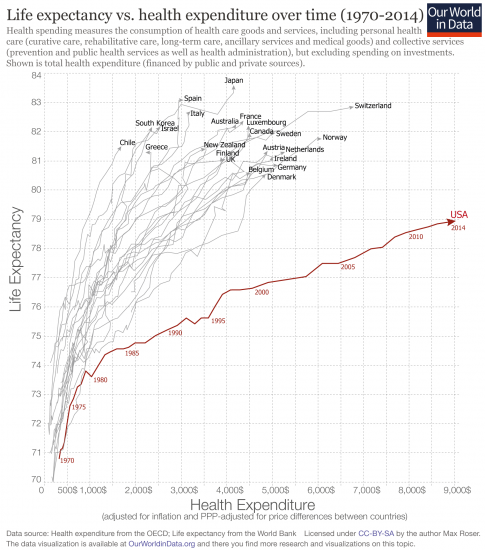
US healthcare is famous for three things, Ben Southwood notes:

It’s expensive, it’s not universal, and it has poor outcomes. The US spends around $7,000 per person on healthcare every year, or roughly 18% of GDP; the next highest spender is Switzerland, which spends about $4,500. Before Obamacare, approx 15% of the US population were persistently uninsured (8.6% still are). And as this chart neatly shows, their overall outcome on the most important variable — overall life expectancy — is fairly poor.

But some of this criticism is wrongheaded and simplistic: when you slice the data up more reasonably, US outcomes look impressive, but being the world’s outrider is much more expensive than following behind. What’s more, most of the solutions people offer just don’t get to the heart of the issue: if you give people freedom they’ll spend a lot on healthcare.

The US undoubtedly spends a huge amount on healthcare. One popular narrative is that because of market failures and/or extreme overregulation in healthcare, prices are excessively high. So Americans with insurance (or covered by Medicare, the universal system for the elderly, or Medicaid, the government system for the poor) get the same as other developed world citizens, but those without get very poor care and die younger. A system like the NHS solves the problem, according to this view, with bulk buying of land, labour, and inputs, better incentives, and universal coverage.

But there are some serious flaws in this theory. Firstly, extending insurance to the previously-uninsured doesn’t, in America, seem to have large benefits. For example, a recent NBER paper found no overall health gains from the massive insurance expansion under Obamacare.* A famous RAND study found minuscule benefits over decades from giving out free insurance to previously uninsured in the 1970s. In fact, over and above the basics, insuring those who choose not to get insurance doesn’t ever seem to have large gains. Indeed, there is wide geographic variation in the life expectancy among the low income in the US, but this doesn’t even correlate with access to medical care! This makes it unlikely that the gap between the US and the rest is explained by universality.

To find the answer, consider the main two ingredients that go into health outcomes. One is health, and the other is treatment. If latent health is the same across the Western world, we can presume that any differences come from differences in treatment. But this is simply not the case. Obesity is far higher in the USA than in any other major developed country. Obviously it is a public health problem, but it’s unrealistic to blame it on the US system of paying for doctors, administrators, hospitals, equipment and drugs.

In fact in the US case it’s not even obesity, or indeed their greater pre-existing disease burden, that is doing most of the work in dragging their life expectancy down; it’s accidental and violent deaths. It is tragic that the US is so dangerous, but it’s not the fault of the healthcare system; indeed, it’s an extra burden that US healthcare spending must bear. Just simply normalising for violent and accidental death puts the USA right to the top of the life expectancy rankings.

One of our cultural problems, Arnold Kling adds, is that we spend too much on health care and not enough on public health.