A Great, Horn-Crowned Hog

Thursday, February 12th, 2009

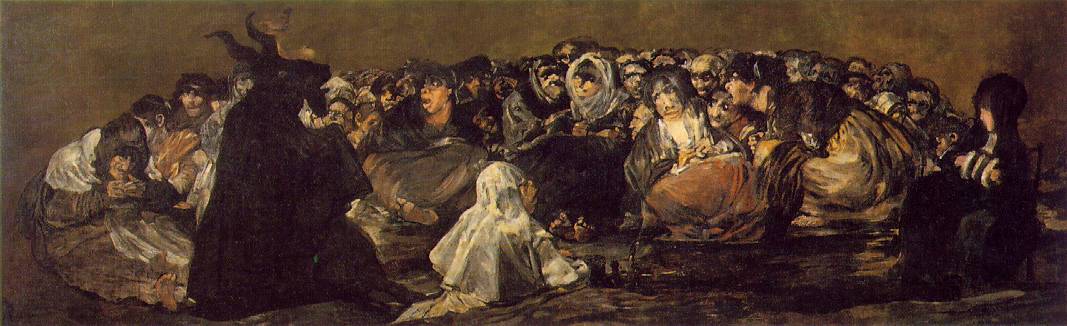
Mencius Moldbug has some fun with the works of a bitter, old artist and the government’s response to our current economic crisis:

Goya left no captions for his Black Paintings, so we have no way of knowing whether or not he meant to call this one Democracy. Events of the last week, however, have shown that Goya got one thing wrong. The black-robed figure is no goat at all — but a great, horn-crowned hog.

Here comes the e-book revolution

Sunday, February 8th, 2009

Here comes the e-book revolution, Mike Elgan says:

At what temperature do electronic books catch fire? We’re going to find out sometime this year. E-book sales are about to ignite.

On Monday, Amazon.com is expected to unveil a new version of its Kindle reader. It will probably be a lot better and a little cheaper than the first version. But the real news already broke this week: A company spokesman announced that Amazon plans to offer Kindle books on cell phones.

This news countered Google’s announcement that the 1.5 million public domain books available on its Google Book Search offering will soon be available (free, of course) via a new cell phone application.

He lists six trends driving this growth, but I have to wonder about his very first trend:

1. The economy. The economy is in the tank, and people are looking to cut costs any way they can. An Amazon Kindle pays for itself after the purchase of 20 or 30 books, then starts paying dividends.

In a bad economy, people are going to make a big up-front expenditure that will pay back after they buy 20 to 30 books?

I found this analysis amusing:

The blog did the math and determined that the New York Times could buy every single subscriber an Amazon Kindle e-book reader, and it would still cost them half as much as it will cost them to send paper newspapers for just one year.

The Trials of J. Robert Oppenheimer

Friday, February 6th, 2009

I suppose I first learned about Oppenheimer — beyond that he was the “father of the bomb” — a few years back, when I read E=mc2: A Biography of the World’s Most Famous Equation.

Born into a wealthy family, he was a frail but precocious boy, pampered and socially awkward, who grew up to be an arrogant and even cruel young man — but somehow he ended up running the Manhattan Project and running it well.

The latest episode of PBS’s American Experience, The Trials of J. Robert Oppenheimer, gives an extremely sympathetic portrayal of his life and the infamous loss of his security clearance years after the war.

I feel a great deal of sympathy for Oppenheimer, but I’m amazed how shocked — shocked! — we’re supposed to be that the military would not trust a man who almost married one (crazy) Communist, did marry another (crazy) Communist, had a brother who was a Communist, had good friends who were Communists, including one who asked him to pass along secrets, etc., especially after the Communists had already developed an atomic bomb using technical secrets stolen from Americans.

How dare they take away his security clearance!?

Can’t we admit that both sides were reasonable? Oppenheimer knew he wasn’t handing over atomic secrets, but the military had good reason to believe he might?

Anyway, watch the whole thing yourself online.

(Hat tip à mon père.)

Terrorists Love Action Movies

Friday, February 6th, 2009

From reading Christopher Dickey’s Securing the City, Dwight Garners learned the comical and scary degree to which terrorists (and would-be terrorists) have been in thrall to American action movies:

The scenes of Godzilla stomping across New York City, crushing everything in its path, were mesmerizing and inspiring. One captured terrorist later warned of an attack against “the bridge in the Godzilla movie.” Interrogators had to go rent Mr. Emmerich’s film to find out what he meant: the Brooklyn Bridge.
[...]
Richard Reid, the failed shoe bomber, used the pseudonym Van Damme, after the B-grade martial arts star Jean-Claude Van Damme. Another terrorist was obsessed with “Air Force One,” the Harrison Ford president-in-peril film.

Weirdest of all, Khalid Sheikh Mohammed — the pudgy 9/11 plotter who will be forever remembered for his disheveled mug shot — was supposedly an amusing guy when he attended an agricultural state university in North Carolina. His nickname? “B’lushi.”

The Decline of Text

Tuesday, February 3rd, 2009

Marti Hearst suspects that the decline of text will change everything:

As an academic I am of course loathe to think about a world without reading and writing, but with the rapidly increasing ease of recording and distributing video, and its enormous popularity, I think it is only a matter of time before text and the written word become relegated to specialists (such as lawyers) and hobbyists.

Movies have already replaced books as cultural touchstones in the U.S. And most Americans dislike watching movies with subtitles. I assume that given a choice, the majority of Americans would prefer a video-dominant world to a text-dominant one. (Writing as a technologist, I don’t feel I can speak for other cultures.) A recent report by Pew Research included a quote from a media executive who said that emails containing podcasts were opened 20% more often than standard marketing email. And I was intrigued by the use of YouTube questions in the U.S. presidential debates. Most of the citizen-submitted videos that were selected by the moderators consisted simply of people pointing the camera at themselves and speaking their question out loud, with a backdrop consisting of a wall in a room of their home. There were no visual flourishes; the video did not add much beyond what a questioner in a live audience would have conveyed. Video is becoming a mundane way to communicate.

Note that I am not predicting the decline of erudition, in the tradition of Allan Bloom. Nor am I arguing that video will make us stupid, as in Niel Postman’s landmark “Amusing Ourselves to Death.” The situation is different today. In Postman’s time, the dominant form of video communication was television, which allowed only for one-way, broadcast-style interaction. We should expect different consequences when everyone uses video for multi-way communication. What I am espousing is that the forms of communication that will do the cultural “heavy lifting” will be audio and video, rather than text.

James Bobin on NPR

Thursday, January 29th, 2009

NPR’s Fresh Air interviews James Bobin — who, you may not have realized, co-created Flight of the Conchords and helped create Sacha Baron Cohen’s characters (Ali G, Borat, and Bruno).

Furry, Proud, and Red

Wednesday, January 28th, 2009

One of the well-known “secrets” of Sesame Street‘s enduring success is that it is not aimed purely at its pre-literate, toddler audience. Many of the skits have a sly sense of humor aimed at any adults in the room.

The Muppet Show took this a step further, with many (fairly) contemporary acts performing. After The Muppet Show‘s successful run, it looks like Sesame Street moved further in that direction.

For instance, even though I can’t say I was a fan of the Goo Goo Dolls in their heyday, I really enjoyed their Sesame Street performance of Pride, a reworking of their hit single Slide:

It’s amazing how earnest the lead singer is — especially in contrast to the other members of the band, who are clearly acting like they’re playing with a toddler (Elmo).

I can’t say I was ever a fan of Hootie and the Blowfish either, but I love the notion of turning Hold My Hand into a traffic-safety song:

Incidentally, these videos remind you why the front man is the front man. Darius seems perfectly comfortable singing to a red puppet. The other guys? Not so much.

Lastly, Norah Jones turns Don’t Know Why into Don’t Know Y — and really performs a part:

Euhemerism

Monday, January 19th, 2009

I had never heard of Euhemerus, until a friend mentioned Gaiman‘s American Gods, and I stumbled across a reference to Euhemerism, while reading up on Baldr, the Norse god:

In the 12th century, Danish accounts by Saxo Grammaticus and other Danish Latin chroniclers recorded a euhemerized account of his story. Compiled in Iceland in the 13th century, but based on much older Old Norse poetry, the Poetic Edda and the Prose Edda contain numerous references to the death of Baldr as both a great tragedy to the Æsir and a harbinger of Ragnarök.

So, who was Euhemerus, and what is Euhemerism?

Euhemerus (????????, Euh?meros) (working late fourth century B.C.) was a Greek mythographer at the court of Cassander, the king of Macedon. Euhemerus’ birthplace is disputed, with Messina in Sicily or Messene in the Peloponnese as the most probable locations, while others champion Chios, or Tegea.

He is chiefly known for a rationalizing method of interpretation, known as Euhemerism, that treats mythological accounts as a reflection of actual historical events shaped by retelling and traditional mores. In the skeptic philosophical tradition of Theodorus of Cyrene and the Cyrenaics, Euhemerism forged a new method of interpretation for the contemporary religious beliefs. Though his work is lost, the reputation of Euhemerus was that he believed that much of Greek mythology could be interpreted as natural events subsequently given supernatural characteristics. Living at court in the generation following the superhuman feats of Alexander the Great and Alexander’s subsequent deification, with the contemporaneous “pharaoization” of the Ptolemies in a fusion of Hellenic and native Egyptian traditions, Euhemerus was trained in the rational philosophizing current of Hellenistic culture; the two strains meet in his materialist rationalizing of Greek myth. “Euhemerus may be credited as the writer who systematized and explained an ancient and widely accepted popular belief, namely that the dividing line between gods and men is not always clear,” S. Spyridakis, among others, has observed.

Again, this was in the late fourth century B.C.

Commercials I Wish Had Toy Tie-Ins

Monday, January 19th, 2009

Laura McMullan of Toy Whimsy shares two commercials that she wished had toy tie-ins — one with cute li’l kaiju (not-so-giant monsters) and a second with a Gossamer-inspired hunger beast:

Saturn’s Titan: A Giant Organics Factory

Sunday, January 18th, 2009

According to new data from NASA’s Cassini spacecraft, Saturn’s orange moon Titan has hundreds of times more liquid hydrocarbons than all the known oil and natural gas reserves on Earth.

This reminded me of Isaac Asimov’s The Martian Way — from 1952, reprinted in The Science Fiction Hall of Fame, Volume Two B — in which Martian colonists outwit a demagogue from Earth, who cuts off their water supply. The Martians use water not only to support life on the planet’s surface but also as reaction mass for their spacecraft — not fuel per se, but close.

The Martians, who are much better acclimated to space travel than their Earthling counterparts, make the long trek to Saturn’s rings, where they harness a chunk of the rings, a cubic mile block of ice, to bring back.

A block of solid methane or ethane probably wouldn’t be so convenient to transport.

Ni Hao, Kai-lan

Sunday, January 18th, 2009

If you go back and watch, say, the first season of Sesame Street as an adult, you can immediately see the overt social agenda of its creators — who clearly cared about inner-city children and folk music.

In fact, children’s shows seem to provide an excellent guide to what white people like, which changes subtly from generation to generation.

Now even Dora has been one-upped by Ni Hao, Kai-lan:

Ni Hao, Kai-lan is the next generation of preschool television programming that introduces the psychology of biculturalism. If Dora and Diego popularized bilingualism, Kai-lan will weave together being bilingual and bicultural. Ni Hao, Kai-lan reinforces the idea that being bicultural and bilingual is being American.

The show will familiarize the viewing audience with elements of Chinese and Chinese American cultures to promote multicultural understanding in the next generation and goes beyond featuring “culture” as only ethnic food and festivals. Instead, it celebrates growing up in an intergenerational family, having friends from diverse backgrounds, and “habits of the heart” that are Chinese American. These values include:

Mind-body connection Typically, television portrays excitement as the good emotion to feel. In many Chinese-American communities, the good thing to feel is often calmness and contentment. Feeling excited and feeling calm can both be happy feelings, but they differ in how aroused the body is.

Perspective-taking In many Chinese and other East Asian families, children are encouraged to take the perspective of others to maintain harmony in relationships with other people.

Being a good member of the group Ni Hao, Kai-lan also emphasizes the Chinese and Chinese American value of being a good member of a group.

Social & Emotional Goals Highlight cause-and-effect thinking about social and emotional issues germane to preschoolers and to support preschooler’s social and emotional development.

Customer trust is hard won, easily lost

Saturday, January 17th, 2009

Jason Kilar, CEO of Hulu, recognizes that customer trust is hard won and easily lost:

On January 9, we removed nearly 3 seasons of full episodes of ”It’s Always Sunny in Philadelphia.” We did this at the request of the content owner. Despite Hulu’s opinion and position on such content removals (which we share liberally with all of our content partners), these things do happen and will continue to happen on the Hulu service with regards to some television series. As power users of Hulu have seen, we’ve added a large amount of content to the library each month, and every once in a while we are required to remove some content as well.

This note, however, is not about the fact that episodes of ”It’s Always Sunny in Philadelphia” were taken down. Rather, this note is to communicate to our users that we screwed up royally with regards to how we handled this specific content removal and to apologize for our lack of strong execution. We gave effectively no notice to our users that these ”Sunny” episodes would be coming off the service. We handled this in precisely the opposite way that we should have. We believe that our users deserve the decency of a reasonable warning before content is taken down from the Hulu service. Please accept our apologies.

Given the very reasonable user feedback that we have received on this topic (we read every twitter, email and post), we have just re-posted all of the episodes that we had previously removed. I’d like to point out to our users that the content owner in this case — FX Networks — was very quick to say yes to our request to give users reasonable advance notice here, despite the fact that it was the Hulu team that dropped the ball. We have re-posted all of the episodes in the interest of giving people advance notice before the episodes will be taken down two weeks from today. The episodes will be taken down on January 25, 2009. Unfortunately we do not have the permission to keep the specific episodes up on Hulu beyond that. We hope that the additional two weeks of availability will help to address some of the frustration that was felt over the past few days.

The team at Hulu is doing our best to make lemonade out of lemons on this one, but it’s not easy given how poorly we executed here. Please know that we will do our best to learn from this mistake such that the Hulu user experience benefits in other ways down the road.

Evolver Album Cover

Sunday, January 11th, 2009

I must admit, I was amused by Olly Moss‘s Evolver album cover:

‘Atlas Shrugged’: From Fiction to Fact in 52 Years

Saturday, January 10th, 2009

Stephen Moore notes that Ayn Rand’s Atlas Shrugged has gone from fiction to fact in the 52 years since its publication:

Many of us who know Rand’s work have noticed that with each passing week, and with each successive bailout plan and economic-stimulus scheme out of Washington, our current politicians are committing the very acts of economic lunacy that Atlas Shrugged parodied in 1957, when this 1,000-page novel was first published and became an instant hit.

Rand, who had come to America from Soviet Russia with striking insights into totalitarianism and the destructiveness of socialism, was already a celebrity. The left, naturally, hated her. But as recently as 1991, a survey by the Library of Congress and the Book of the Month Club found that readers rated “Atlas” as the second-most influential book in their lives, behind only the Bible.

For the uninitiated, the moral of the story is simply this: Politicians invariably respond to crises — that in most cases they themselves created — by spawning new government programs, laws and regulations. These, in turn, generate more havoc and poverty, which inspires the politicians to create more programs… and the downward spiral repeats itself until the productive sectors of the economy collapse under the collective weight of taxes and other burdens imposed in the name of fairness, equality and do-goodism.

In the book, these relentless wealth redistributionists and their programs are disparaged as “the looters and their laws.” Every new act of government futility and stupidity carries with it a benevolent-sounding title. These include the “Anti-Greed Act” to redistribute income (sounds like Charlie Rangel’s promises soak-the-rich tax bill) and the “Equalization of Opportunity Act” to prevent people from starting more than one business (to give other people a chance). My personal favorite, the “Anti Dog-Eat-Dog Act,” aims to restrict cut-throat competition between firms and thus slow the wave of business bankruptcies. Why didn’t Hank Paulson think of that?

These acts and edicts sound farcical, yes, but no more so than the actual events in Washington, circa 2008. We already have been served up the $700 billion “Emergency Economic Stabilization Act” and the “Auto Industry Financing and Restructuring Act.” Now that Barack Obama is in town, he will soon sign into law with great urgency the “American Recovery and Reinvestment Plan.” This latest Hail Mary pass will increase the federal budget (which has already expanded by $1.5 trillion in eight years under George Bush) by an additional $1 trillion — in roughly his first 100 days in office.

The current economic strategy is right out of “Atlas Shrugged”: The more incompetent you are in business, the more handouts the politicians will bestow on you. That’s the justification for the $2 trillion of subsidies doled out already to keep afloat distressed insurance companies, banks, Wall Street investment houses, and auto companies — while standing next in line for their share of the booty are real-estate developers, the steel industry, chemical companies, airlines, ethanol producers, construction firms and even catfish farmers. With each successive bailout to “calm the markets,” another trillion of national wealth is subsequently lost. Yet, as “Atlas” grimly foretold, we now treat the incompetent who wreck their companies as victims, while those resourceful business owners who manage to make a profit are portrayed as recipients of illegitimate “windfalls.”

When Rand was writing in the 1950s, one of the pillars of American industrial might was the railroads. In her novel the railroad owner, Dagny Taggart, an enterprising industrialist, has a FedEx-like vision for expansion and first-rate service by rail. But she is continuously badgered, cajoled, taxed, ruled and regulated — always in the public interest — into bankruptcy. Sound far-fetched? On the day I sat down to write this ode to “Atlas,” a Wall Street Journal headline blared: “Rail Shippers Ask Congress to Regulate Freight Prices.”
Olly Moss’s Movie Posters

Saturday, January 10th, 2009

Apparently Olly Moss has done some design work to show off his skills, creating posters for old movies: