The Simple Anarchist

Monday, July 7th, 2008

Mencius Moldbug notes that the most common species of antinomian — his term for Leftist — is the simple anarchist:

The most bloodthirsty and intrusive states of the 20th century were based on a philosophy — Marxism — which saw itself as fundamentally opposed to government. People really did believe that the socialist paradise would be something other than a state.

Near where I live, on one of the most fashionable shopping streets in the world, is an anarchist bookstore. On its side wall is a mural.


The mural contains two slogans:
History remembers 2 kinds of people, those who kill and those who fight back.

Anarchism strives toward a social organization which will establish well-being for all.

I am flabbergasted by how revealing these slogans are. History, at least when written by honest historians, remembers one kind of people: those who kill. It also notes that those who kill always conceive of themselves as “fighting back.” As for “a social organization,” it is simply our old friend, the State.

Thus, anarchism defines itself: it is an attempt to capture the state, and its juicy revenues, through extortion, robbery and murder. When it succeeds, it will distribute the loot among its accomplices, and “establish well-being for all.” At least in theory.

As we’ve seen, the one thing an antinomian cannot abide is a formal and immutable distribution of the revenues of state. He must constantly redistribute, he must wash his hands on the stream of cash, giving to Peter and taking from Paul, or his supporters have no reason to support him. In other words, he is basically a criminal.
Ghoti out of Water

Monday, July 7th, 2008

English is famous for it poor phonemic orthography — spelling and pronunciation have little to do with each other. This has led to all kinds of reform movements and unusual alphabets.

You may have seen ghoti presented before as an alternative spelling for “fish” — and as evidence of our dire need for spelling reform:

  • gh, pronounced /f/ as in tough /t?f/;
  • o, pronounced /?/ as in women /?w?m?n/; and
  • ti, pronounced /?/ as in nation /?ne??n/.

Although the first known published reference to ghoti credits one William Ollier (born 1824), the clever misspelling is often attributed to George Bernard Shaw.

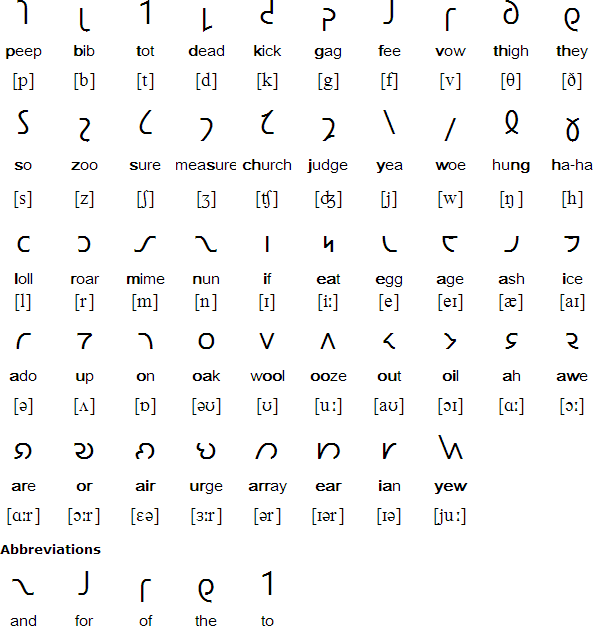
Here’s where it gets weird. Shaw did indeed consider English spelling a mess, and that led him to hold a competition for a new writing system. The competition took place in 1958, and Kingsley Read’s Shavian alphabet was chosen as the winner out of the 467 entries.


Shaw’s play Androcles and the Lion was printed in the winning alphabet, but, as you might imagine, not much else was.

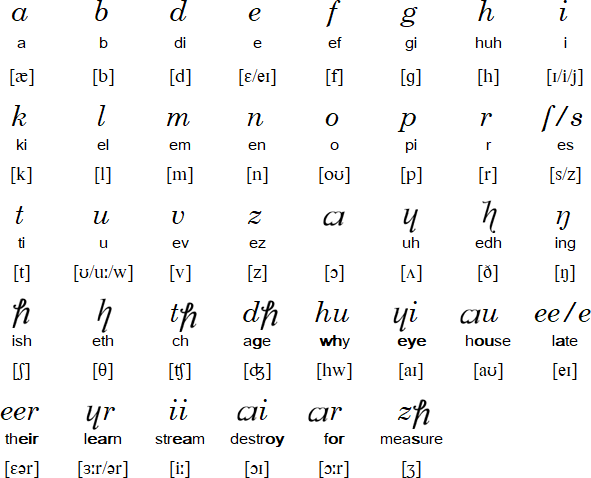
Well before Shaw held his competition, Benjamin Franklin toyed with a new phonetic alphabet, which dropped redundant consonants — c, j, q, w, x, and y — and added six new letters:


Frankly — pardon the pun — I find many of his added characters ugly and unintuitive — although the n with a tail for ng works and has found its way into more modern systems.

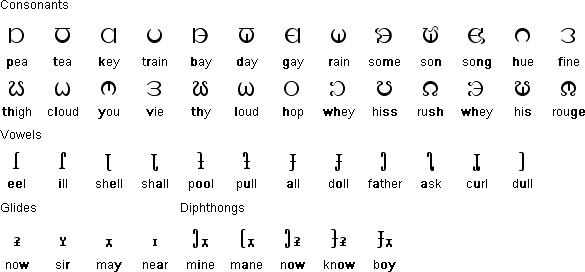
Franklin was obviously trying to create a system fairly close to the one in use, just cleaner. I don’t think he succeeded, but I understand the aim. In 1867, Alexander Graham Bell’s father, Alexander Melville Bell, went in the opposite direction and devised a physiological alphabet based on the positions of the organs of speech for articulating various sounds. Melville Bell was a teacher of the deaf, and he intended his visible speech system to help deaf students learn spoken language:


You can easily imagine visible speech as some obscure elven written language from Tolkien’s Middle Earth, which points to an obvious problem: current English readers can’t even guess at what visible-speech text might mean. If we could start from scratch though, it would make sense to go with a physiological alphabet.

Of course, in a sense, we all start from scratch in childhood, and children who start with a language like Spanish, where the spelling is almost perfectly phonetic, pick up reading much, much sooner than children who have to learn all the crazy rules and exceptions of English spelling.

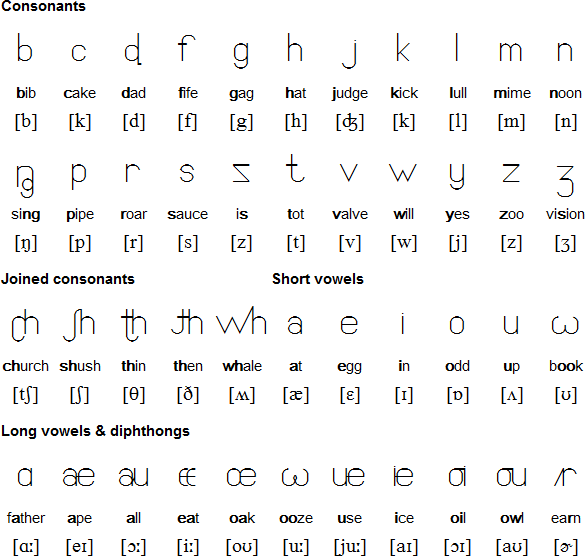
Sir James Pitman, grandson of the inventor of Pitman shorthand, thought it made sense to teach English-speaking children a phonetic writing system, and then to switch them over to real English writing later. His Pitman Initial Teaching Alphabet (i.t.a.) has some elements that really appeal to me — and some that really don’t:


I love the ligatures — combined symbols — for ch, sh, and both forms of th. I also love the two symbols for oo. The vowel+e ligatures make a certain sense for English, but I find them jarring, since they match neither English (with the intervening consonant removed) nor most other languages. Anyway, it’s a fascinating little alphabet.

Of course, what we really use when we need to know a pronunciation is the International Phonetic Alphabet.

Businessman who grabbed a thug for smashing a window is charged with assault

Monday, July 7th, 2008

I’ve heard enough stories like this to find it plausible. Businessman who grabbed a thug for smashing a window is charged with assault:

Mr Kink was sitting in his wife’s town centre bar in Weymouth, Dorset, when he heard a security alarm go off.

He went outside and confronted two men stood near to the Phone Zone store which had a smashed window.

Mr Kink, who is registered disabled following a motorcycle accident 20 years ago, said he was met with a volley of abuse from the pair before being hit.

He said: ‘”I accused one of them of smashing the window and he said “‘what the f*** has it got to do with you?”

‘He then took a swing at me and punched me just under my left eye. I grabbed hold of him and managed to sweep one of his legs from under him and I held him there by putting the toe of my shoe on his shoulder blade.

‘There were lots of other people around at this stage and somebody had hold of the other bloke he was with. When the police arrived I stepped back and he kicked off at them. When he was put in the police car he tried to kick in the windows.’

A few days later police turned up at Mr Kink’s home. ‘There were three police officers and a dog handler there. They told me I was being arrested for assault,’ he said.

Just one more example of Britain slowly destroying itself, I suppose.

Rush Who?

Sunday, July 6th, 2008

Former-Finn Ilkka at The Fourth Checkraise asks, I wonder how many random people outside America, if you asked them, could tell you who Rush Limbaugh is:

Way less than one percent, I’m sure. Which is pretty amazing when you remember that he is currently the highest-paid media personality in America, having just signed a new contract worth $400 million. (How many other media figures well enough known to be household names would you need to add up to get to that?) Yet the media silence about him is absolutely airtight, almost as if he didn’t even exist at all. Every other celebrity or political figure, major and minor, gets at least an occasional nod, but I really have to stretch my memory to remember the last time Rush got anything at all, other than that schadenfreude Oxycontin case. Perhaps this best illustrates the extent that society and media becoming deeply fragmented since those good old times when only the major networks existed and continuously parroted the official party line.

The present state of affairs is unsatisfactory

Sunday, July 6th, 2008

Antinomians — those seeking Change, in Moldbug’s parlance — believe that the present state of affairs is unsatisfactory:

So, of course, do I. The nomos is horribly corroded and encrusted with all sorts of gunk. However, the pronomian’s goal is to discern the real structure of order under this heap of garbage, scrape it down to the bare skeleton, replace any missing bones, and let the healthy tissue of reality grow around it.

To the pronomian, this structure is arbitrary. Weirdly-shaped borders? Leave them as they are. High taxes? All that tax revenue is paid to someone, who probably thinks of it as his property. Who am I to say it isn’t? There are some property structures, notably patent rights, which I (like most libertarians) find very unproductive. If so, the government needs to print money and buy them back. Fortunately, it has a large, high-speed intaglio press.

The pronomian seeks to restore the nomos, whose outlines are clear under the mountain of byzantine procedure, wholesale makework and vote-buying, criminal miseducation, and other horrors of the liberal-democratic state. The antinomian sees many of the same horrors. But he does not share the pronomian’s goal: minimizing the reallocation of property and authority. Where the pronomian simply wants to replace the management, reorganize the staff, and discard the inscrutable volumes of precedent that have absconded with the name of law, the antinomian wants to destroy power structures that he conceives as illegitimate.

And, of course, he wants to rebuild them according to his ideals. Unless he is a complete nihilist, which of course some are. But it is the destructive tendency that makes antinomianism so successful. The utopia is never constructed, or if it is it is not a utopia. Success is a precondition to utopia, and success involves achieving the power to destroy.

Creating Alien Life on Earth

Sunday, July 6th, 2008

Al Fin notes that Japanese chemists have succeeded in creating alien life on earth — or at least alien DNA:

The researchers used high-tech DNA synthesis equipment to stitch together four entirely new, artificial bases inside the sugar-based framework of a DNA molecule. This resulted in unusually stable, double-stranded structures resembling natural DNA. Like natural DNA, the new structures were right-handed and some easily formed triple-stranded structures. The unique chemistry of these structures and their high stability offer unprecedented possibilities for developing new biotech materials and applications, the researchers say.

Science Writer Jim Holt Explores Why We Laugh

Sunday, July 6th, 2008

Science Writer Jim Holt Explores Why We Laugh:

V. S. Ramachandran, the brain researcher, has a theory about the origin of laughter — that when you’re in the jungle and there’s an apparent threat, the first member of the kinship group to notice that it’s not a real threat emits this stereotyped vocalization. And it’s contagious, so everyone starts laughing. That’s also the basis of the relief theory of humor, that there’s a release of the energy you had summoned up to solve some puzzle. Kant said that the essence of humor is a strained expectation dissolving into nothing.

Who invented the joke? We’ve been joking forever, right?

No, the classic joke form — setup with incongruity, punch line that resolves the incongruity — seems to have come out of Greece and Rome. There’s this guy in Greek -mythology called Palamedes who invented practically everything — numbers, currency, lighthouses, breakfast, lunch, and dinner. He also supposedly invented the joke. And, of course, he was stoned to death.

Humans Wore Shoes 40,000 Years Ago, Fossil Suggests

Sunday, July 6th, 2008

Humans Wore Shoes 40,000 Years Ago, Fossil Suggests:

A previous study of anatomical changes in toe bone structure had dated the use of shoes to about 30,000 years ago.

Now the dainty-toed fossil from China suggests that at least some humans were sporting protective footwear 10,000 years further back, during a time when both modern humans and Neandertals occupied portions of Europe and Asia.

The fossils go back further than any sandal remains:

The first forms of protective footwear probably evolved from simple wrappings used to insulate the feet from snow and freezing temperatures, experts say.

The oldest preserved shoe remains, dating to roughly 10,000 years ago from the western United States, are simple sandals woven of plant fibers.
[...]
In a previous study, Trinkaus found that shoe-wearing and barefoot human groups show characteristic differences in the size and strength of their middle toe bones.

Consistent shoe use results in a more delicate bone structure, because footwear reduces the force on middle toes during walking.

In his latest study, this anatomical evidence allowed Trinkaus to date the origin of shoes to a period long before the oldest known shoe remains.

Jefferson Bible

Sunday, July 6th, 2008

I’m not sure why the LA Times would consider this news, but it just published a piece on the so-called Jefferson Bible:

Making good on a promise to a friend to summarize his views on Christianity, Thomas Jefferson set to work with scissors, snipping out every miracle and inconsistency he could find in the New Testament Gospels of Matthew, Mark, Luke and John.

Then, relying on a cut-and-paste technique, he reassembled the excerpts into what he believed was a more coherent narrative and pasted them onto blank paper — alongside translations in French, Greek and Latin.

In a letter sent from Monticello to John Adams in 1813, Jefferson said his “wee little book” of 46 pages was based on a lifetime of inquiry and reflection and contained “the most sublime and benevolent code of morals which has ever been offered to man.”

He called the book “The Life and Morals of Jesus of Nazareth.” Friends dubbed it the Jefferson Bible.

The big question, according to Lori Anne Ferrell, a professor of early modern history and literature at Claremont Graduate University, is this:

“Can you imagine the reaction if word got out that a president of the United States cut out Bible passages with scissors, glued them onto paper and said, ‘I only believe these parts?’” [...]
In Jefferson’s version of the Gospels, for example, Jesus is still wrapped in swaddling clothes after his birth in Bethlehem. But there’s no angel telling shepherds watching their flocks by night that a savior has been born. Jefferson retains Jesus’ crucifixion but ends the text with his burial, not with the resurrection.

The tactical error of the libertarian

Saturday, July 5th, 2008

The tactical error of the libertarian, Mencius Moldbug notes, is to believe that the state can be made smaller and simpler by making it weaker:

Historically, the converse is the case: attempts to weaken [a sovereign] either destroy it, resulting in chaos and death, or force it to compensate by enlarging, resulting in the familiar “red-giant state.” The pronomian prefers a state that is small, simple, and very strong. It respects the rights of its clients not because it is forced to respect them, but because it has a financial incentive to respect them, and it obeys that financial incentive because it is managed responsibly and effectively.

Brilliant or a sham? Questions asked over Ingrid Betancourt rescue

Saturday, July 5th, 2008

Kidnapping is big business and has been for some time, but no one wants to admit that they pay off — and thus encourage — kidnappers.

It didn’t take long for some to wonder, Was the Ingrid Betancourt rescue brilliant or a sham?

Swiss public radio cited an unidentified source “close to the events, reliable and tested many times in recent years” as saying the operation had in fact been staged to cover up the fact that the US and Colombians had paid $20 million for their freedom. [...]
French media have also raised questions about Ms Betancourt’s relatively healthy appearance after her release, compared with the gaunt and haggard look of her last video from captivity. French state radio suggested the hostages may have been given food and medicine to return them to health before their release. There was no suggestion that the hostages knew they were to be released.

Dominique Moisi, one of France’s leading foreign policy experts, said that it was “probable” that the Farc had been paid money as part of the “infiltration” of their command. “They were bought in order to turn them around, like Mafia chiefs,” he said on French state television, as Ms Betancourt’s plane was taxiing up to the terminal in Paris.

This wouldn’t be the first time a Latin American regime faked a rescue operation.

Can a freight train really move a ton of freight 436 miles on a gallon of fuel?

Saturday, July 5th, 2008

American freight trains move a ton of freight 436 miles on a gallon of fuel:

According to our calculations, which match the [Association of American Railroads]‘s tally exactly, the nation’s seven major railroad companies reported the following for 2007:
  • Moving 1,770,545,245,000 ton-miles of freight
  • Consuming 4,062,025,082 gallons of diesel fuel (including freight trains and trains in switching yards, but excluding passenger trains)

The average works out to be 435.88 ton-miles per gallon of fuel.
[...]
The rail industry says its fuel efficiency has increased by 85 percent since 1980. It attributes that to factors that include using new and more efficient locomotives, training engineers to conserve fuel, using computers to assemble trains more efficiently in the yard and to plan trips more efficiently to avoid congestion, and reducing the amount of time engines are idling.

Kyklos

Friday, July 4th, 2008

According to Polybius, the kyklos, or political cycle, rotates through three forms of government — democracy, aristocracy, and monarchy — and the degenerate forms of each of those three — ochlocracy, oligarchy, and tyranny:

Originally society is in anarchy but the strongest figure emerges and sets up a monarchy. The monarch’s descendants, who because of their family’s power lack virtue, become despots and the monarchy degenerates into a tyranny. Because the excesses of the ruler the tyranny is overthrown by the leading citizens of the state who set up an aristocracy. They too quickly forget about virtue and the state becomes an oligarchy. These oligarchs are overthrown by the people who set up a democracy. Democracy soon becomes corrupt and degenerates into mob rule, beginning the cycle anew.

The truth about left and right

Friday, July 4th, 2008

Mencius Moldbug reveals the truth about left and right — or, as he refers to them, pronomian and antinomian, meaning for or against the formal promises — property rights and contracts — already in place in a society:

An antinomian is anyone who seeks, consciously or unconsciously, to disrupt or destroy the nomos. He is a breaker of oaths, a burner of deeds, a mocker of laws — at least, from the pronomian perspective. From his own perspective he is a champion of freedom and justice.

I admit it: I am a pronomian. I endorse the nomos without condition.

Mencius is almost a libertarian, and he considers libertarianism the most refined form of modern antinomianism:

Libertarianism is a fine example of the antinomian form, because the elements of the nomos that it attacks are specified with the elegant design sense that one would expect from the founder of modern libertarianism — probably the 20th century’s greatest political theorist, Murray Rothbard.

Rothbardian libertarianism rejects two aspects of the nomos. First, it rejects the entire concept of [...] sovereignty. Rothbardians are called anarcho-capitalists for a reason: they deny the legitimacy of the state, unless operated according to strict Rothbardian principles. Note that they do not require, say, Disney to operate Disneyland according to libertarian principles. This is because, to a Rothbardian, Disney’s title to Disneyland is legitimate, whereas (say) Iceland’s title to Iceland is not.

Rothbard has an intricate system, borrowed originally from Locke, for determining whether or not a title is legitimate. To say that this system is unamenable to objective interpretation is to put it mildly. But the titles of existing [sovereigns] all appear to be illegitimate. This makes libertarianism a revolutionary ideology. Since its antinomianism is so restricted and its lust for blood is minimal, however, it is not an especially dangerous (or effective) one.

Antinomians who reject sovereignty have two main alternatives. Either they support private, amorphous, and even territorially overlapping “protection agencies” (a design whose military plausibility is, to put it kindly, small), or they believe that government is legitimate if and only if it obeys a set of “natural laws.” Again here we see the proximity to the pronomian. But the Rothbardian concept of natural law misses the Hobbesian fact that in the true nomos, there is no party that can enforce a state’s promises to its clients.

This matters, because legalism without sovereignty has a simple result: the personal rule of judges. The error is to imagine the existence of a superhuman legal authority which can bind a state against itself, enforcing a “government of laws, not men.” As the bizarre encrustations of precedent that history builds up around every written constitution demonstrate, this is simply a political perpetual-motion device. All governments are governments of men. If final decisions are taken by a council of nine, these nine are the nine who rule. Whether you call them a court, a junta or a politburo is irrelevant.

(Emphasis mine.)

Japan Sees a Chance to Promote Its Energy-Frugal Ways

Friday, July 4th, 2008

Japan Sees a Chance to Promote Its Energy-Frugal Ways — which it pursued even when energy prices were low:

With its towering furnaces and clanging conveyer belts carrying crushed rock, Taiheiyo Cement’s factory looks like an Industrial Revolution relic. But it is actually a model of modern energy efficiency, harnessing its waste heat to generate much of its own electricity.
[...]
Kawasaki Heavy Industries, which makes the waste heat generator at the cement factory in Kumagaya, started developing the technology in 1979. But the generators were too expensive to sell outside Japan while energy prices were low. But overseas orders took off three years ago, after energy prices began rising.

Since then, the company has sold 64 units, mainly through a joint venture in China.

“Japan rushed to embrace these technologies back in the 1980s,” said Katsushi Sorida, head of the waste heat plant department at Kawasaki Plant Systems, a subsidiary that markets and installs the units. “Now the rest of the world is finally catching up.”

I suppose the rest of the world is “catching up” because it finally makes sense to spend massive resources to reduce energy waste.

Japan’s forced-conservation regulations led it to use less energy when energy was cheap:

According to the International Energy Agency, based in Paris, Japan consumed half as much energy per dollar worth of economic activity as the European Union or the United States, and one-eighth as much as China and India in 2005. While the country is known for green products like hybrid cars, most of its efficiency gains have been in less eye-catching areas, for example, in manufacturing.

Corporate Japan has managed to keep its overall annual energy consumption unchanged at the equivalent of a little more than a billion barrels of oil since the early 1970s, according to Economy Ministry data. It was able to maintain that level even as the economy doubled in size during the country’s boom years of the 1970s and ’80s.

Japan’s strides in efficiency are clearest in heavy industries like steel, which are the nation’s biggest consumers of power. From 1972 to 2006, the Japanese steel industry invested about $45 billion in developing energy-saving technologies, according to the Japan Iron and Steel Federation.

The results are visible at the Keihin mill on Tokyo Bay, run by Japan’s No. 2 steelmaker, JFE Steel. Massive steel ducts snake from the blast furnaces and surrounding buildings. These capture heat and gases that had previously been released into the air or burned off as waste. Now, they are used to power generators that produce 90 percent of the plant’s electricity. (The plant’s main fuel remains the coal used to heat its huge blast furnaces.)

Such innovations allow the mill to produce a ton of steel using 35 percent less energy than it did three decades ago, said Yoshitsugu Iino, group leader of JFE Steel’s climate change policy group. Mr. Iino calculates that if the global steel industry adopted Japanese conservation measures, it could reduce carbon emissions by some 300 million tons a year.