Saving lives obviously had preference

Monday, September 7th, 2020

This Kind of War by T.R. FehrenbachThe American way of street and town fighting, T. R. Fehrenbach explains (in This Kind of War), did not resemble that of other armies:

To Americans, flesh and blood and lives have always been more precious than sticks and stones, however assembled. An American commander, faced with taking the Louvre from a defending enemy, unquestionably would blow it apart or burn it down without hesitation if such would save the life of one of his men. And he would be acting in complete accord with American ideals and ethics in doing so. Already, in the Korean War, American units were proceeding to destroy utterly enemy-held towns and villages rather than engage in the costly business of reducing them block by block with men and bayonets, as did European armies. If bombing and artillery would save lives, even though they destroyed sites of beauty and history, saving lives obviously had preference. And already foreign observers with the United States Army — not ROK’s — were beginning to criticize such tactics.

Observers from France and Britain, realizing that war was also highly possible in their own part of the world, were disturbed at the thought of a ground defense of their homelands. For the United States Army, according to its history and doctrine, would choose the lives of its men over the continued existence of storied cathedrals. These observers wrote news releases — and soon Frank Muñoz could get no artillery on the enemy assembling in plain sight in the villages below him. When he asked Battalion to fire on the village, and burn it down, Battalion replied it could not. Fortunately, such orders in Korea were soon changed.

I saw an opportunity and I took it

Sunday, September 6th, 2020

Officer Ellifritz got a call about a stolen bicycle:

While I was speaking with my prisoner during the arrest process, I recognized that most of you will never be in such a position to talk candidly with a thief (who also had past arrests for felonious assault, kidnapping, rape, and a host of other crimes). Since I get this “honor” quite regularly, I’m happy to share the what I learn with you all.

Our thief today is homeless. He’s 32 years old and overweight. He’s a regular consumer of crack cocaine. He has no job and no place to live. He sometimes stays at friends’ apartments, but his permanent address is a local homeless shelter. The sum total of his possessions consisted of a change of clothes, a broken phone, and less than $4 cash.

When I asked the man why he stole the bike, his comment was enlightening:

“I took it because I have the chance to stay at my friend’s place tonight instead of the shelter. My friend lives in (the next town over) and it would be about a four hour walk to get there. It rained all day yesterday and it looks like it’s going to rain some more today. I just didn’t want to spend four hours walking in the fucking rain and getting soaking wet again. I figured a bike would be faster.”

He continued by saying: “I knew it was wrong to steal the bike, but I just don’t care. I didn’t want to get wet no more. I saw an opportunity and I took it. I’d do the same thing all over again if I got the chance. Biking is just faster than walking.”

The guy wasn’t rude or trying to play the role of a badass. He was just describing the daily realities for someone who lives in a world very different from the one in which you and I reside.

He wasn’t mentally ill. He knew right from wrong. But he had absolutely no remorse about taking a bike from some girl who probably needs it as just badly as he did. The thought of what the victim would experience didn’t even register in his mind. He “saw an opportunity” and took it. He took a college girl’s only means of transportation, because he didn’t want to be inconvenienced by a long walk.

This is what most folks don’t understand about serious criminals. The fact that the victim of the crime would be affected in a negative manner is not even an afterthought. Your feelings and concerns mean absolutely NOTHING to the criminal. He doesn’t care if you live or die, let alone how “inconvenienced” you will be if he takes all of your stuff or beats you within an inch of your life. If you literally had ZERO concern about the well being of your neighbors and fellow humans, what kind of atrocities would you be capable of committing? That’s something that few people consider.

They now had to play the game the way most American soldiers had learned it

Saturday, September 5th, 2020

This Kind of War by T.R. FehrenbachDuring the early days of the war, T. R. Fehrenbach explains (in This Kind of War), the North Korean People’s Army never varied its tactics:

It never had any need to do so. Its general maneuver was to press the ROK or American forces closely, engage with them by means of a frontal holding attack, while at the same time turning the enemy flank and infiltrating troops to the enemy rear. Against both ROK’s and United States troops, who were never able to establish a firm battle line, this tactic was ruinous.

But during August 1950, the NKPA tried the same tactics against the Pusan Perimeter, and failed. The U.N. flanks now rested firmly against the Sea of Japan, and the U.N. line, while thin, had no significant gaps.

[...]

In short, they now had to play the game the way most American soldiers had learned it. And frontal assault against American troops, from Breed’s Hill to New Orleans to the Pacific Islands of World War II, has always proved both bitter and bloody.

In pushing the Americans into a corner, the NKPA probably made its greatest tactical error, for, more lightly armed than the Americans, it had poor odds of smashing the American forces with direct hammer blows.

The one group of people who really took fighting seriously were the foreigners

Friday, September 4th, 2020

Americans and other Westerners have an understanding of warfare that does not match most people’s understanding throughout human history:

Americans come from a land of mass literacy and mass politics, a country where even the country rube has received a strong education in his duties, rights, and membership in the American nation. American soldiers go into battle as part of a rigid hierarchy with officers inserted deep into their ranks and receive elaborate training designed to instill in them both discipline and an overwhelming espirit de corps. They also are heirs to a political culture that has never seen a coup nor suffered from a serious military challenge to civilian leadership in its history.

Because of all of this, one has trouble imagining a possible timeline where the Third Army abandons its posts to join the Wehrmacht, Pershing’s American Expeditionary Forces devolve into a patchwork of hostile war-bands, or Ulysses Grant turns his guns on Washington and declares himself America’s new leader. Yet most wars in most places for most of our civilized history were running catalogues of just these sorts of sordid happenings! The conquests of every Chinese conqueror right up to the Communists, the wars of Medieval Europe and the early Renaissance, the conflicts of ‘feudal’ Japan, most of the fighting and in-fighting seen on the Eurasian steppe, the squabbles of the Greek city states, the terrific civil wars of the Roman empire, and the greater part of Arab warring right up to the present day looked more like Filkins’ Afghanistan than the Western Front.

The Filkins that T. Greer mentions there is Dexter Filkins, author of The Forever War, who gives this account of the dynamics of warlord fighting in the Afghanistan of 2001:

People fought in Afghanistan, and people died, but not always in the obvious way. They had been fighting for so long, twenty-three years then, that by the time the Americans arrived the Afghans had developed an elaborate set of rules designed to spare as many fighters as they could. So the war could go on forever. Men fought, men switched sides, men lined up and fought again. War in Afghanistan often seemed like a game of pickup basketball, a contest among friends, a tournament where you never knew which team you’d be on when the next game got under way. Shirts today, skins tomorrow. On Tuesday, you might be part of a fearsome Taliban regiment, running into a minefield. And on Wednesday you might be manning a checkpoint for some gang of the Northern Alliance. By Thursday you could be back with the Talibs again, holding up your Kalashnikov and promising to wage jihad forever. War was serious in Afghanistan, but not that serious. It was part of everyday life. It was a job. Only the civilians seemed to lose.

Battles were often decided this way, not by actual fighting, but by flipping gangs of soldiers. One day, the Taliban might have four thousand soldiers, and the next, only half that, with the warlords of the Northern Alliance suddenly larger by a similar amount. The fighting began when the bargaining stopped, and the bargaining went right up until the end. The losers were the ones who were too stubborn, too stupid or too fanatical to make a deal. Suddenly, they would find themselves outnumbered, and then they would die. It was a kind of natural selection.

One of the Afghan militia commanders with whom I traveled, Daoud Khan, was a master of this complicated game. He was portly and well dressed, and he ate very well. The Afghans spoke of him in reverent tones, but he didn’t seem like much of a warrior to me. He’d never fought for the Taliban himself, but thousands of his former soldiers were now in the Taliban ranks. Why kill them when he could just bring them back to his side? Khan captured his first city, Taloqan, without firing a single shot. He did it by persuading the local Taliban leader, a man named Abdullah Gard, to switch sides. Gard was no dummy; he could see the B-52s. I guessed that Khan had probably used a lot of money, but he never allowed me to sit in as he worked the Taliban chieftains on the radio. The day after Taloqan fell, I found Gard in an abandoned house, seated on a blue cushion on the floor, warming himself next to a wood-burning stove. His black Taliban turban was gone, and he had replaced it with a woolen Chitrali cap just like that of Ahmad Shah Massoud. “All along, I was spying on the Taliban,” Gard said, his eyes darting. No one believed him, but no one seemed to care.

On the first night of the long-awaited offensive against the Taliban, carried out at the urging of the Americans, the Alliance commanders bombarded the Taliban lines and then, as night fell, sent their men forward. Yet when I arrived the next morning, the Alliance soldiers stood more or less where they had the day before. They’d run, and then they’d run back. No one seemed surprised. “Advancing, retreating, advancing, that’s what you do in war,” Yusef, a twenty-year-old Alliance soldier, told me with a shrug. He was sitting in a foxhole. It wasn’t that the Afghans were afraid to fight, it was that they’d fought too much. And now, given the opportunity, they wanted to avoid it if they could.

“My dear, I am your brother, you know how much affection I have for you, there is really no point in resisting anymore,” Mohammad Uria, a Northern Alliance commander, said into his radio to a Taliban commander a few miles away. Of course, there were plenty of Taliban soldiers who wanted to fight forever. Fight to the death. They were the Pashtuns from Kandahar, for the most part, a different breed. “I’ve seen them run right into the minefields — they want to die,” Pir Mohammed said, shaking his head in awe. But where I was, in northern Afghanistan, many if not most of the Taliban soldiers weren’t from Kandahar, they were from the north — Tajiks and Uzbeks who’d switched sides when the fearsome Kandaharis rolled in. Now the northerners wanted to quit. The one group of people who really took fighting seriously were the foreigners — that is, the Americans and Al-Qaeda. They came to kill.

Men accustomed to torture and summary execution could not be expected to behave with nicety

Thursday, September 3rd, 2020

This Kind of War by T.R. FehrenbachCounterattacking on Hill 303 near Waegwan, the 5th Cavalry Regiment came across a group of American soldiers, T. R. Fehrenbach explains (in This Kind of War), twenty-six mortarmen of the Heavy Weapons Company, who had been captured earlier by the NKPA:

These men lay packed shoulder to shoulder, their feet, bare and covered by dried blood, thrust out stiffly. They had been shot in the back by Russian-made submachine guns. Each man’s hands were bound tightly behind his back with cord or telephone wire.

And along the Perimeter front, as the battle increased in intensity and bitterness, worse atrocities were discovered. American soldiers were found who had been burned and castrated before they were shot; others had their tongues torn out. Some were bound with barbed wire, even around the head and mouth.

[...]

Men accustomed to torture and summary execution all their lives, both from Japanese and Communist rulers, could not be expected to behave with nicety toward foreign captives. Nor did they.

Most of the Marine troop leaders knew what war was like

Tuesday, September 1st, 2020

This Kind of War by T.R. FehrenbachWhen the Korean War broke out, T. R. Fehrenbach explains (in This Kind of War), somewhat less than 10 percent of the small United States Marine Corps had seen combat:

But fortunately for the Corps, the percentage was highly concentrated within officer and key NCO grades; most of the Marine troop leaders knew what war was like.

And the Marines, who had always been largely a volunteer organization, had escaped the damaging reforms instituted within the United States Army at the end of World War II. The public clamor rose against the Army, during the war twenty times the small, parochial Corps’ size, and ignored the Marines.

In 1950 a Marine Corps officer was still an officer, and a sergeant behaved the way good sergeants had behaved since the time of Caesar, expecting no nonsense, allowing none. And Marine leaders had never lost sight of their primary — their only — mission, which was to fight.

The Marine Corps was not made pleasant for men who served in it. It remained the same hard, dirty, brutal way of life it had always been.

The Marines may take little credit, either for courage or foresight, in remaining the way they were. The public pressure simply never developed against them in the years after the war, pushing their commanders into acquiescence with the ideals of society. Not long after the end of the Korean conflict, after an unfortunate incident one night at a place called Ribbon Creek, the commandant of the Corps showed no more ability to stand up for his rights in front of a congressional committee than had the generals of the Army.

It is admittedly terrible to force men to suffer during training, or even sometimes, through accident, to kill them. But there is no other way to prepare them for the immensely greater horror of combat.

In 1950 the Marines, both active and reserve, were better prepared to die on the field of battle than the Army.

[...]

Except in holy wars, or in defense of their native soil, men fight well only because of pride and training—pride in themselves and their service, enough training to absorb the rough blows of war and to know what to do. Few men, of any breed, really prefer to kill or be killed. These Marines had pride in their service, which had been carefully instilled in them, and they had pride in themselves, because each man had made the grade in a hard occupation. They would not lightly let their comrades down. And they had discipline, which in essence is the ability not to question orders but to carry them out as intelligently as possible.

Marine human material was not one whit better than that of the human society from which it came. But it had been hammered into form in a different forge, hardened with a different fire. The Marines were the closest thing to legions the nation had. They would follow their colors from the shores of home to the seacoast of Bohemia, and fight well either place.

You used to be able to fly into a country on one name and have meetings in another

Monday, August 31st, 2020

Modern technology is putting an end to traditional spying:

The beginning of the CIA’s cover and tradecraft crisis dates back to at least February 2003, when a Muslim cleric known as Abu Omar disappeared off the street in Milan. He didn’t resurface until 2004, when he called his wife from Cairo to tell her about his kidnapping, detention and torture at the hands of the CIA.

Italian investigators, eager to get to the bottom of the audacious abduction on their streets, were later able to track a web of cellphones communicating only with each other in close proximity to the disappearance, leading them to a series of hotel bills, credit card statements and other identifying indicators, according to a 2007 investigation unveiled at an annual hacker conference in 2013. Italian authorities charged 23 Americans, including the CIA’s former Milan station chief, for their roles in the scheme — most in absentia.

While Omar was just one target of the CIA’s aggressive post-9/11 antiterrorism campaign, several former intelligence officials described the Milan operation’s aftermath as a “come to Jesus” moment that revealed just how vulnerable the agency’s operators were to technology. At the time, some undercover officials naively believed that methods like using potato chip bags would mask cellphone signals, and operatives were generally “freewheeling,” according to one former senior intelligence official. In the space of a few short years, the rapid advance of technology, including nascent international surveillance systems, increasingly endangered the CIA’s traditional human intelligence gathering.

Singapore was one example, recall three former intelligence officials. By the early 2000s, the agency ceased running certain types of operations in the Southeast Asian city-state, because of the sweeping digital surveillance there. The Singaporeans had developed a database that incorporated real-time flight, customs, hotel and taxicab data. If it took too long for a traveler to get from the airport to a hotel in a taxi, the anomaly would trigger an alert in Singaporean security systems. “If there was a gap, they’d go to the hotel, they could flip on the TVs and phones and monitor what was going on” in the room of the suspicious traveler, says the same former senior intelligence official. “They had everything so wired.”

“You used to be able to fly into a country on one name and have meetings in another,” recalls this person. “It limited a lot of capabilities.”

Those concerns spread to other places, like London, where CCTV cameras are omnipresent, and the United Arab Emirates, where facial recognition is ubiquitous at the airport. Today there are “about 30 countries” where CIA officers are no longer followed on the way to meetings because local governments no longer see the need, given that surveillance in those countries is so pervasive, said Dawn Meyerriecks, the CIA’s deputy director for science and technology, in a 2018 speech.

In the 2000s, the explosion in biometrics — such as fingerprints, facial recognition and iris scans — propelled the conversation forward, according to multiple former intelligence officials. U.S. intelligence agencies concluded that in many parts of the world, within a short time, all alias work would likely become impossible.

These fears were largely borne out, say former CIA officials — especially in “hard target” countries like China and Iran. But this trend also affected CIA operations in friendlier countries. By 2012, recalls one former official, some officers were temporarily forbidden to travel for missions in the European Union over fear of exposure, due to widespread sharing of airport biometric data between EU member states. “Facial recognition and biometrics make it very difficult to travel in alias,” says Mike Morell, former acting CIA director and host of the “Intelligence Matters” podcast.

The rise in popularity of consumer DNA kits, which allow people to send in samples of their own DNA, is a growing part of the biometrics problem. Even if an undercover operative hasn’t used a consumer DNA kit, it’s highly likely, say experts, that one of their close relatives has. The Pentagon’s Dec. 20 warning to members of the military not to use these kits appears to be partly in response to that threat.

Greg Hampikian, a biologist at Boise State University and a leading DNA expert, says that with the advent of commercial genetic databases, exposing a spy or other covert operative could be as easy as taking a saliva sample from a cigarette butt or a drinking cup. A suspicious foreign government could send the sample in and potentially find out if the person has been operating under an assumed name.

“It’s right out of a spy novel,” he says.

For spy services, biometric data has become a highly valued currency — leading to a widespread and ongoing campaign by the U.S. and its allies, as well as hostile states, to hack into biometric databases from important airports worldwide. The U.S. has spearheaded breaches of its own, successfully hacking biometric data from the Dubai and Abu Dhabi airports, says a former official. Stealing biometric databases is an attractive strategy for other countries as well. In one case, Chinese intelligence successfully hacked into the biometric data from Bangkok’s airport. “The Chinese have consistently extracted data from all the major transit hubs in the world,” says another former senior official.

If you read the official documents that go out to the Party’s 90,000 members, you get a world view that’s surprisingly similar to The Pentagon’s New Map

Sunday, August 30th, 2020

T. Greer (of The Scholar’s Stage) recently spoke with ChinaTalk. Most modern “takes” on China are biased, he notes, by the easy access “China hands” have to Westernized Chinese who don’t take Marxism seriously. If you read the official Party documents that go out to the Party’s 90,000 members though, you get a world view that’s surprisingly similar to The Pentagon’s New Map.

For an overview of Chinese history, Greer strongly recommends F.W. Mote’s Imperial China 900-1800 and laments that Mote never wrote a similar volume on earlier Chinese history.

He recommends the usual Chinese classics — and a satirical novel called The Scholars.

Readers of this blog might be interested in The Chinese Invasion Threat: Taiwan’s Defense and American Strategy in Asia. Taiwan could defend itself militarily, with its favorable terrain, but the will to do so is almost completely lacking.

They had no interest in fighting a half-ass war like this one

Sunday, August 30th, 2020

This Kind of War by T.R. FehrenbachFrank Muñoz, commanding officer of G Company, realized he had too few men to do the job, T. R. Fehrenbach explains (in This Kind of War), and he also had a morale problem:

Almost all of the riflemen, dug in along the rear slope of the hill, had jumped in their holes and pulled the zipper. They didn’t want to come out even to shoot.

[...]

Some of the men told him they didn’t mind fighting a big war. Americans, he found, tend to take pride in doing things in a big way. But they had no interest in fighting a half-ass war like this one.

Then they started taking mortar fire:

The instant he understood the mortar fire had finished, Frank Muñoz jumped from his hole and ran up to the top of the ridge, where he could see across the rice paddies to the front. Quick as he was, he was too late.

At the top of the ridge, he made eyeball to eyeball contact with a North Korean soldier. Muñoz moved first. His .45 slug killed the Korean at a range of inches. As he shot, he could see two waves of enemy infantry, bayonets fixed, charging up the slope, firing from the hip.

He went into the nearest hole, which was already occupied by a man with a BAR. “Fire to your right front!” he snapped at the BAR man.

The enemy boiled up over the hill and ran at George’s thin line of holes. George Company met them with a blast of fire, stopping them only yards away. The first wave fell apart a few feet in front of Frank’s own position.

[...]

Then the second wave of charging Koreans swarmed over the crest. In a wild melee, some of the Inmun Gun jumped into foxholes with Muñoz’s men, bayonets flashing.

Muñoz yelled at his Artillery forward observer to bring fire down on the hill. The FO, Lieutenant Hartman, yelled back, “No! I don’t want to do it!”

But Frank grabbed a field phone and reached Battalion. He got the Artillery liaison officer there, and he got action — two salvos of 105’s, to be put down on his own position.

Seconds later, the shells screamed down, bursting with ear-shattering noise. They caught most of the attacking Inmun Gun still swarming down the ridge.

Dug in, Muñoz’s boys suffered no harm. The enemy, in the open, died. And, as suddenly as they had been attacked, George’s men were all alone on the hill.

Somebody give me a white phosphorous grenade

Friday, August 28th, 2020

This Kind of War by T.R. FehrenbachT. R. Fehrenbach (in This Kind of War) shares the story of an officer coming across a T-34 that had just been disabled with a well-placed bazooka shot:

Pointing to the tank, Schmitt wanted to know, “What’s with that?”

“The crew is still inside — won’t give up,” Frank said.

“Hell,” Schmitt said. He stood out in the open and began to yell at the tank in the Korean he had picked up during the Occupation. “Ede wha!” Come out!

The tank stayed quiet, even when Schmitt went up beside it and banged on the turret with his hand. Then Schmitt climbed up on the sponson and tried to pull open a hatch. Suddenly, then, there was movement inside. A crewman partly opened the hatch, thrust a pistol through, and fired point-blank at the Weapons Company commander.

Unhurt, Schmitt jumped down. “You son of a bitch, we’ll fix you!” he said. “Somebody give me a white phosphorous grenade—”

Pulling the pin, Schmitt dropped the incendiary grenade on the tank’s back deck, over the air intake.

The North Koreans never did come out, though they made a number of unpleasant noises as they stayed inside and burned.

These bridges were invisible

Wednesday, August 26th, 2020

This Kind of War by T.R. FehrenbachThe NKPA built underwater bridges across the Naktong at the ferry site, T. R. Fehrenbach explains (in This Kind of War), employing an old Russian trick:

These bridges were invisible and therefore invulnerable to air attack.

Magnetometer readings are much less easy to jam than GPS signaling

Tuesday, August 25th, 2020

The U.S. Air Force is looking into using Earth’s magnetic field as an alternative to GPS:

Magnetic fields emanating from the earth’s surface vary in intensity, just like topography, and so-called magnetic anomaly maps of those fields have existed for years. Back in 2017, Aaron Canciani, an assistant professor of electrical engineering at the Air Force Institute of Technology, set out to see if magnetic sensors (magnetometers) affixed to aircraft could measure the intensity of those magnetic fields and, thus, locate the plane based on where it was in relation to those “landmarks.” His paper (and this video) shows how to outfit a Cessna plane with magnetometers in the rear and the front. Forty flight-hours worth of data and a lot of work reducing noise from the readings proved the idea viable.

But swapping magnetic fields for GPS isn’t easy. Unlike a crisp clear signal from space, factors such as the electrical operations of the plane itself can interfere with a sensor’s ability to detect the strength of the field. This is where artificial intelligence comes in, canceling out the noise from the sensor readings to allow for a better signal and more accuracy.

Researchers in the Air Force’s-MIT Artificial Intelligence Accelerator. community, working with scientists at MIT, continued to work on the problem, publishing their own paper in July. They showed that magnetic field readings can be accurate to ten meters, only slightly inferior to GPS, which is accurate down to three meters. But magnetometer readings are much less easy to jam than GPS signaling. GPS readings rely on a signal sent along a specific wavelength across vast distances. Magnometers just have to read the magnetic environment around the vehicle.

Revolution and terror are synonymous

Monday, August 24th, 2020

This Kind of War by T.R. FehrenbachThe Communists had infiltrated South Korea to a great extent, T. R. Fehrenbach explains (in This Kind of War), and as the Inmun Gun captured city after city, Communist cadres were ready to assume control:

The North Korean rulers had absolutely no interest in the merchants of the towns, or the middle classes, except eventually to get rid of them. Generally, these people were left alone or arrested, for later attention. But other groups received immediate attention. Former officials of the Republic, down to clerks, were jailed or killed. People such as moneylenders and prominent landowners were executed at once for political capital. Few, in any land, love the rich. The North Korean State acted on the assumption that men and women who could not be easily controlled or assimilated into a Communist state must be killed.

What happened in Seoul and Taejon was typical. In Seoul, every man or woman who had worked for the Americans in any capacity was executed if found, and the American Embassy had conveniently left their personnel files behind. All former government employees were killed or jailed. Steps were taken immediately to induct many of the youth of the city into NKPA, and others in labor forces.

Outside Taejon, after the city had been scoured for possible enemies to a Communist regime, shivering hordes of unfortunates, in groups of one hundred or more, were led to mass graves, hands bound, wired to each other. Then the shooting began. When the United States Army came back through in September, a burial trench containing more than 7,000 bodies, including those of 40 American soldiers, was uncovered.

[...]

The killing was not sheer savagery. The regime was ridding itself of people it could never trust, for the the best of political reasons.

Revolution and terror are synonymous; only with the passage of time does any revolution become respectable. After the military triumph of the American Revolution the hard-core adherents of the Crown — more than a quarter-million out of a population of three million — were stripped of their property and forced into exile in Canada and elsewhere. Much of the success of the United States in early days was due to the lack of organized dissent within the Republic.

After the French Revolution, thousands of aristocrats and others who fought the revolution were permitted to return to France, where their descendants have not accepted the principles of the revolution to this day, causing perpetual instability.

In a hideously practical way the Communists knew what they were doing.

The Korean terror exceeded that of now respectable Western social upheavals only in degree, and in brutal Communist efficiency.

But while it was shooting the officials and anti-Communists, the regime made every effort to cater to the poorer masses. Asian Communists have always realized that in nations largely peasant, the peasantry alone is of any real political value. Land was redistributed. It would be taken back later, when the regime was consolidated — but first, it was a necessary step, as in China, to secure the backing of the millions of the poor.

The middle classes, so vital to Western democracy, do not exist in most of Asia. Where they do exist, they are more of a political liability with the mass of people than an asset, for they are regarded with envy and hatred by men who break their backs on the soil. The peasant feels he can live without them.

While the proscribed classes were being wiped out, the Inmun Gun showed every courtesy to the workers of the soil. When the Inmun Gun required food or lodging of the poor, these were paid for — in worthless currency, but paid for none the less. In Seoul, the Inmun Gun had captured the South Korean Government mints, and the printing presses ran off all the currency the Inmun Gun could ever use.

In a country where 90 percent of the people are peasants, the Communist regime had every expectation of success — because peasants they understood. From the first, the peasantry saw little to lose through Communist rule, and perhaps much to gain. Only much later, when the land is collectivized and the iron hand shows through the paternal glove, and when it is too late, does the peasant who has been Communized realize his loss. Communized, he ceases to be an individual man, losing an identity that even the most abject poverty could not take from him before.

[...]

Americans, in turn, have been slow to understand the peasant, let alone mix with him.

Americans, who cannot understand or even communicate with peasantry, are growing lonelier in a world where the great majority of men are peasants.

The invasion of Japan might have resembled the Okinawa campaign

Sunday, August 23rd, 2020

The US dropped two atomic bombs on Japan 75 years ago, but what would an actual Allied invasion of Japan have looked like?

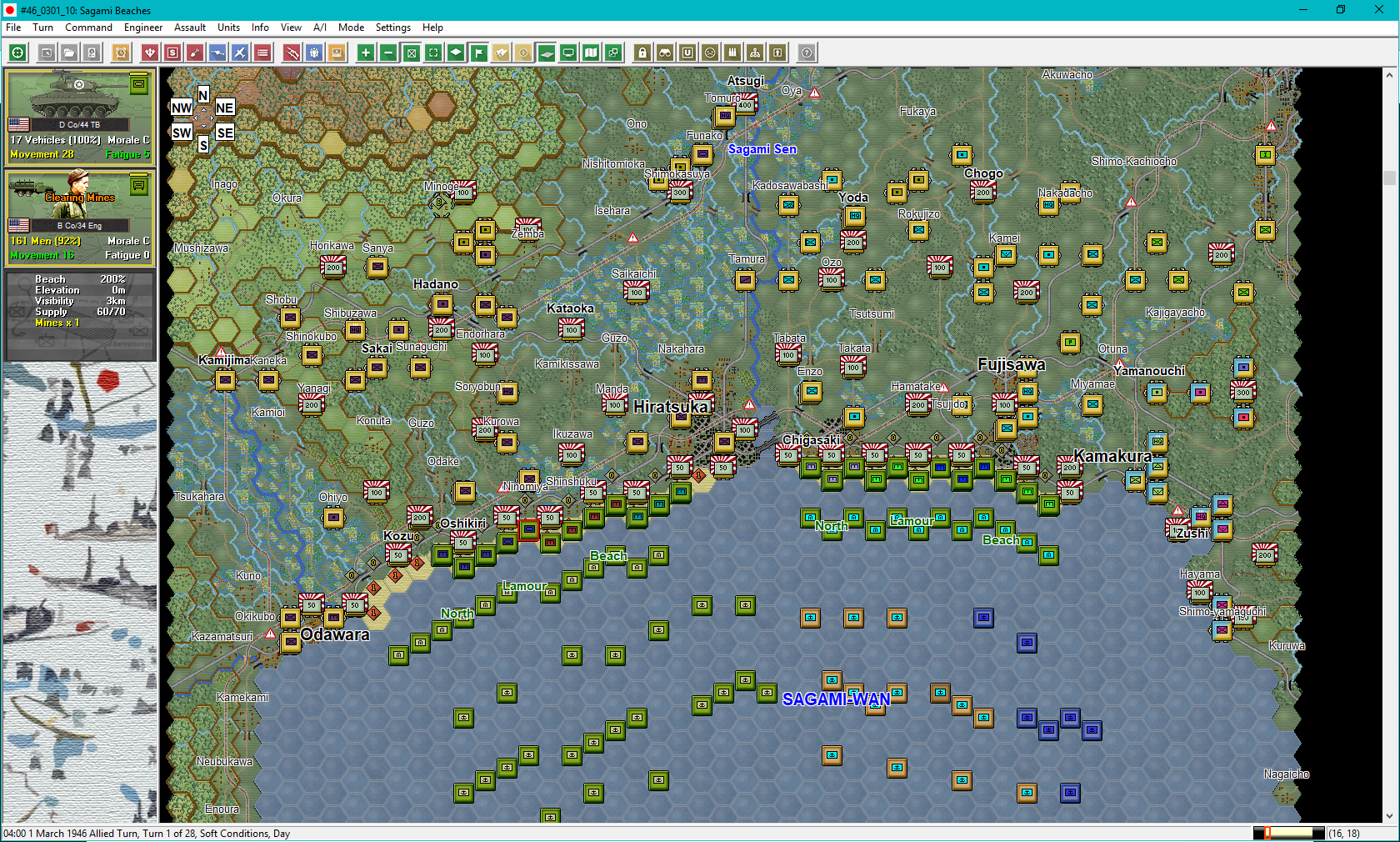
A clue can be found in Japan ’45, from John Tiller Software, a hobby wargame that depicts Operation Olympic (a sequel, Japan ’46, covers Operation Coronet). Japan ’45 is a battalion-level simulation involving thousands of U.S. Army and Marine, Japanese, British and French units maneuvering over a 2-D map of Kyushu.

At first glance, the Allies appear to be an unstoppable juggernaut. They field a staggering array of units, including tanks, armored cars, infantry (foot and mechanized), paratroopers, commandos, artillery (towed and self-propelled) and anti-tank guns, backed by fighters, bombers, battleships and destroyers. They enjoy far more firepower and mobility than the Japanese, whose army is mostly a First World War-style force of foot infantry and artillery.

But the unstoppable Allied war machine soon clanks to a halt. For starters, the terrain is not friendly to a mechanized army. In Japan ’45, the map of Kyushu is studded with rice paddies, forests, hills, villages, rivers and streams. The terrain restricts movement to a crawl, and provides natural defensive cover for the defenders. Despite all those Allied Sherman tanks, there will be no dashing Patton-esque blitzkriegs on Kyushu.

And what nature can’t provide, Japanese shovels will. The invasion beaches on Kyushu are studded with minefields, trenches, bunkers and pillboxes. The Allied player can only gnash his teeth as bombs, napalm and one-ton shells from battleships barely scratch Japanese troops embedded deep in their fortifications.

Finally, there is the Japanese soldier to contend with. The core of the Imperial Army was its legendarily tough infantry, which could withstand the hardest privations, and preferred to fight hand-to-hand with the bayonet. Even if their weapons aren’t quite as good or plentiful as Allied equipment, they’re good enough to inflict massive casualties on the invaders.

Playing Japan ’45, as the Allies against the AI-controlled Japanese side, graphically demonstrates that Operation Olympic would have been a meat grinder. U.S. Army and Marine assault troops splashing ashore suffer heavy losses from minefields, artillery and machine guns. Pinned down on the exposed beaches, the riflemen and engineers advance inch-by-inch. Eventually the Japanese are dislodged from their entrenchments, and once in the open, they are vulnerable to Allied air and naval firepower.

But then what? The terrain on Kyushu is too rough and restricted to allow an Allied breakthrough. Once the Japanese defenders are pushed off the bushes, they just regroup inland among the hills and woods, and the Allies have to dig them out again.

The game suggests the invasion of Japan might have resembled the Okinawa campaign, where U.S. troops had to battle through multiple Japanese defensive lines in a grinding battle of attrition that cost 50,000 American casualties — and 400 ships sunk or damaged by kamikazes — before Okinawa was conquered. Like Okinawa, the question is not whether the Allies will capture Kyushu, but what price they will pay for it.

The United States would have to take to the mud, too

Saturday, August 22nd, 2020

This Kind of War by T.R. FehrenbachThe enemy never seriously attempted to strike at American bases or lifelines beyond Korea, T. R. Fehrenbach explains (in This Kind of War), vulnerable as the bases continued to be:

An air or sea strike — and both planes and submarines were available in quantity within the Communist bloc — might have wreaked havoc with American reinforcement of Korea, but it would also have exposed the enemy to even more serious retaliation.

[...]

A French minister of state, in the days when Bourbon France was the land power par excellence of the world, once respectfully pointed out to his government that if France seriously intended to challenge Britain, a sea power, she must first have a navy. Two hundred years later the United States was in the same position. If it seriously desired to check the Communist advance on the ground, the United States would have to take to the mud, too.