In Defense of Teasing

Tuesday, December 9th, 2008

Dacher Keltner (Born to Be Good: The Science of a Meaningful Life) speaks out In Defense of Teasing:

The reason teasing is viewed as inherently damaging is that it is too often confused with bullying. But bullying is something different; it’s aggression, pure and simple. Bullies steal, punch, kick, harass and humiliate. Sexual harassers grope, leer and make crude, often threatening passes. They’re pretty ineffectual flirts. By contrast, teasing is a mode of play, no doubt with a sharp edge, in which we provoke to negotiate life’s ambiguities and conflicts. And it is essential to making us fully human.

The centrality of teasing in our social evolution is suggested by just how pervasive teasing is in the animal world. Younger monkeys pull the tails of older monkeys. African hunting dogs jump all over one another, much like pad-slapping, joking football players moments before kickoff. In every corner of the world, human adults play peekaboo games to stir a sulking child, children (as early as age 1) mimic nearby adults and teenagers prod one another to gauge romantic interest. In rejecting teasing, we may be losing something vital and necessary to our identity as the most playful of species.

If you’re going to study teasing, and you need student volunteers, there’s only one place to go:

To examine the role nicknames play in helping a community to function, Erin Heerey, now a professor at Bangor University in Wales, and I invited members of a University of Wisconsin fraternity to the laboratory one October, just after what is known as rush week, when pledges angle to gain acceptance at the frat of their choice. We divided the fraternity brothers into groups of four — two high-status “actives,” or established members of the group, and two new low-status “pledges.” We gave each participant two randomly generated initials — “A. D.” or “T. J.” or “H. F.” or “L. I.” — and asked them to generate a nickname and story for each of the other three.

Our participants came up with nicknames like “human fly,” “another drunk,” “turkey jerk,” “little impotent,” “anal duck” and “heffer fetcher.” Each tease turned out to be a 30-second morality play. One low-status pledge was known as Taco John. The story behind the nickname was this: The pledge had gotten drunk on 18 shots of Bacardi during a late-night feast at Taco John’s; he then disappeared and was found passed out on the toilet, with his pants around his ankles, holding his genitals. Among other things, the fraternity members were notifying one another about moral boundaries: don’t get too drunk, and keep your private parts to yourself.

In the content and tones of the teases, we uncovered a familiar status dynamic. High-status “actives” teased the “pledges” in sharper, more provocative fashion, putting them in their place. Each “pledge” went after the other low-status pledges with edgy provocations, no doubt jousting for an edge. But when it came to their new high-status brothers, the pledges used teasing to praise. The most popular “pledges” proved to be the more playful teasers and were themselves teased in more flattering fashion: within a couple of weeks of the group’s formation, 30-second teases were demarcating rank.

For all the put-downs, the teasing among frat brothers and pledges did not appear to do any lasting damage. In studying transcripts of these teasing contests, you might expect to find a thrown punch or two. Instead, the fraternity members became better friends after their playful humiliations. Frame-by-frame analyses of the videos of these status contests revealed how this happened. At the punch line of a particular tease, the four brothers would actually burst into laughter (the target, not surprisingly, more quietly). Thanks to the scientific study of laughter, we know that when friends laugh, they laugh in unison, their fight-flight response (e.g., increased blood pressure) is calmed and mirror neurons fire; shared laughter becomes a collective experience, one of coordinated action, cooperative physiology and the establishing of common ground.

Perhaps surprisingly, the momentary pain of being teased can lead to pleasure. During their 15 seconds of humiliation, the targets of teasing displayed common signs of embarrassment — gaze aversion; a coy, nervous smile; a hand touching the face; a head bowed submissively so as to expose the neck; and blushing. These gestures are ancient signs of appeasement that trigger a reconciliation response in most mammals, as they did in our study. The more targets showed these evanescent signs of embarrassment, the more the teasers liked them.

Teasing isn’t just for frat guys:

Romantic teasing provides a way of negotiating the conflicts that send many couples to the therapist’s couch. To explore how playful teasing shores up marital bonds, I asked couples to tease each other using the same nickname paradigm used in the fraternity study. The nicknames they invented drew on the metaphors of love documented by the Berkeley linguistics professor George Lakoff: they made references to each other as food objects (“apple dumpling”) or small animals (“adorable duckling”). The more satisfied the couple, the more the teasing was filled with off-record markers. And in a separate study, partners who managed to tease each other during a conflict — for example, over money or an infidelity — felt more connected after the conflict than those couples who resorted to the earnest criticism many therapists recommend. Teasing actually serves as an antidote to toxic criticism that might otherwise dissolve an intimate bond. Teasing is a battle plan for what Shakespeare called “the merry war.”

Google Tasks

Tuesday, December 9th, 2008

Google has added a to-do list tool to Gmail. Expect productivity to jump.

Combat Shotgun

Monday, December 8th, 2008

Soldiers had been shooting buck shot — often in addition to a full-size musketball, as “buck and ball” — from smoothbores for centuries when the rifle, which accurately shot a single projectile, finally took over the battlefield, but the combat shotgun made an unexpected comeback during the Great War:

The conventional bolt-action infantry rifle was too long and lacked the firepower needed to overcome the interlocking trenches and determined German defenders carrying machine guns. The Winchester Model 97 — firing a modern 12-gauge shell — with pump action; six-round magazine capacity; and short, 18-inch barrel was brought over by American military police and infantrymen and rapidly became known as the “trench sweeper.” The infantryman breaking into a trench could sweep both sides of it (to the depth of a passageway) with multiple buckshot rounds. Once leaders understood the 50-meter range of this weapon, they employed it with skill. A soldier with a shotgun, exceptionally fast to pump and fire, could quickly suppress German trench assaults and clear suspicious dugouts with devastating effectiveness.

Out of the trenches, the Model 97 cleared Germans out of farmhouses and buildings in French villages with equal effectiveness. On 27 September 1918, Sergeant Fred Lloyd, using a Model 97, advanced alone into a German-held village and began methodically clearing the village, rapidly pumping and firing the shotgun as he moved. He finally collapsed with exhaustion after flushing and routing thirty German soldiers.

John Schaefer shares some numbers to illuminate just how effective a shotgun can be at short range:

The table below shows the average results of firing at fifty and seventy-five yards at a full-length human silhouette with typical standard (non-premium) rounds of #4, #1, 00, and 000 buck from cylinder-bored, rifle-sighted, riot gun. Note: most of the hits at 75 yards were very “marginal.”

Loading Average Number of Hits
(Full sized humanoid target)
50 Yards 75 Yards
27 pellet 4 buck   10     3
34 pellet 4 buck     6     2
16 pellet 1 buck     6     2
20 pellet 1 buck     7     4
9 pellet 00 buck     3     1
12 pellet 00 buck     4     2
8 pellet 000 buck     1     0

This gives the shotgun a higher hit probability than any alternative weapon:

British examination of its Malaya experience determined that, to a range of thirty yards (27.4 meters), the probability of hitting a man-sized target with a shotgun was superior to that of all other weapons. The probability of hitting the intended target with an assault rifle was one in eleven. It was one in eight with a submachine gun firing a five-round burst. Shotguns had a hit probability ratio twice as good as rifles.

How the financial sector affects the real economy

Monday, December 8th, 2008

Arnold Kling explains how the financial sector affects the real economy:

The nonfinancial sector wants to hold risk-free short-term assets and issue risky long-term liabilities. To accommodate this, the financial sector does the opposite. If the financial sector suddenly contracts, the nonfinancial sector gets stuck with an asset mix that is riskier and more long-term than it wants and a liability mix that is less risky and shorter term than it wants. The reaction to this unwanted mix can cause a recession. That is how the financial sector affects the real economy.

He then explains in more detail, using a fruit-tree example.

What would happen if Steve Jobs were put in charge of any of the Big Three car companies?

Monday, December 8th, 2008

Cringely asks, What would happen if Steve Jobs were put in charge of any of the Big Three car companies? Well, first he’d kill any unprofitable product lines. Then he’d really shake things up:

He’d look at the car market and conclude a number of things: 1) it’s a no-brainer to embrace dramatic design (no boring cars); 2) performance sells, and; 3) safety and fuel economy are co-equal secondary goals. So Steve’s goal for his car company would be to make a limited line of vehicles that were dramatically styled with visibly different technologies from the competitors and were uniformly 20+ percent safer and 20+ percent more fuel-efficient.
[...]
But embracing these ideas requires the companies do something else that Jobs came to embrace with Apple’s products — stop building most of their own cars.
[...]
In this scenario, Chrysler becomes a design, marketing, sales, and service organization. What’s wrong with that? They can change products more often and more completely because of their dramatically lower investment in production capital. They can pit their various suppliers against each other more effectively than could a surviving car manufacturer. It’s what Steve would do.

And Steve would also embrace one dramatic new technology, whether it is electric, hydrogen, natural gas, whatever, but he’d do it in a very Steveian fashion, which is to say exactly the way he did the iPod and iTunes. That is, he’d sell you the car and then sell you whatever is required to fill up the car. This has always been a barrier for the car companies because they couldn’t imagine themselves in the business of running electric/hydrogen/LPG stations, while Steve would imagine his company making a profit running just those stations.

Steve would take an existing operation that already had an ideal geographic distribution like McDonald’s restaurants. He buy McDonald’s or seduce the company into a deal. Then he’d embrace a propulsion technology like advanced electric capacitors — batteries that could be recharged in less than a minute — and put charging stations on the drive-through lanes. By the time the electric models were ready for sale he’d have 12,000 charging stations in place to serve them. Would you like fries with that charge?

Bear Down

Monday, December 8th, 2008

Bear Grylls, of Man vs. Wild fame, has been cruising across Antarctica to promote Ethanol Ventures, but things have not gone well:

Sorry for the radio silence over the last 24 hours — but I have had a bit of an accident. We were all flying across the ice using the kite skis, which is when you use the big flexi-foil kites on long lines attached to your harness that propels you across the snow and ice. I was doing speeds of over 50 kilometres an hour when I hit a patch of blue ice, lost a ski and got catapulted into the air, crashing down very hard. There is no doubt my helmet saved my life, but I smashed my shoulder and hands and was badly winded. I knew at once I had done something bad to my shoulder and was in absolute agony, my shoulder was drooped down and a bone was sticking out at a weird angle. I am safe at our expedition basecamp now and the shoulder is all strapped up tight, but is very painful. The bottom line is I am lucky.

We spoke on the satellite phone to a surgeon in the UK, who tried to diagnose the injury. But there is no doubt that I have snapped the main ligament and will require an operation on it. Weirdly Gilo had a similar accident some years ago and snapped the same ligament and looking at his 8″ massive scar across his shoulder isn’t very inspiring. We’ve called for medical repatriation but all of that is easier said than done. The weather is an ever present issue and not many planes or pilots can fly this far and land on the ice. But the priority needs to be to get back to get some proper medical attention and surgery.

One of the Ballsiest Moves

Monday, December 8th, 2008

Radley Balko says that this is one of the ballsiest moves he’s ever seen:

KopBusters rented a house in Odessa, Texas and began growing two small Christmas trees under a grow light similar to those used for growing marijuana. When faced with a suspected marijuana grow, the police usually use illegal FLIR cameras and/or lie on the search warrant affidavit claiming they have probable cause to raid the house. Instead of conducting a proper investigation which usually leads to no probable cause, the Kops lie on the affidavit claiming a confidential informant saw the plants and/or the police could smell marijuana coming from the suspected house.

The trap was set and less than 24 hours later, the Odessa narcotics unit raided the house only to find KopBuster’s attorney waiting under a system of complex gadgetry and spy cameras that streamed online to the KopBuster’s secret mobile office nearby.

Occupy, resist, produce

Sunday, December 7th, 2008

In the socialist New Statesman, Naomi Klein (The Shock Doctrine) and Avi Lewis note that Argentinian workers have been taking over bankrupt businesses and reopening them under “democratic worker” management, under the borrowed slogan, “Occupy, resist, produce“:

The movement in Argentina is frustrating to some on the left who feel it is not clearly anti-capitalist, those who chafe at how comfortably it exists within the market economy and see worker management as merely a new form of auto-exploitation. Others see co-operativism, the legal form chosen by the vast majority of the recovered companies, as a capitulation in itself — insisting that only full nationalisation by the state can bring worker democracy into a broader socialist project.

You have to love the left-wing rhetoric. Auto-exploitation? Anyway, I can see why anti-capitalists might be upset — there’s nothing anti-capitalist about handing over the reins of a bankrupt company to the people who can run it profitably — especially if they’re also debt-holders, owed back wages and massive pensions.

How gun legislation turned me into One of Them™

Sunday, December 7th, 2008

Dr. Faulken — who grew up in Oklahoma, where hunting rifles and shotguns are common — explains how gun legislation turned him into One of Them™:

Our rifles were used to hunt deer or shoot predators on our property. Our shotguns were used to hunt ducks and other birds. Oh yeah, and milk jugs. Them’s dangerous.

So why is it, with the exception of the .22 rifle given to me by my father, are all of my guns people-hunting related? I have no inclination to hunt animals, unless we fall into an apocalypse and I’m forced to shoot cats or mongeese for food. The same types of guns I grew up with are in my house: shotgun, rifle, pistol, but they are designed for person-to-person combat. What happened?

By the time I was old enough firearms of my own, and had enough financial wherewithal to afford them, the political landscape of the United States had changed. Sparked partially by the shooting of White House press secretary Jim Brady, firearms and gun ownership was different than in the days of my childhood. Some of the laws, such as a seven day waiting period, hadn’t changed since the 60s, but the Brady Bill, coupled with the Violent Crime Control and Law Enforcement Act of 1994, placed strict regulations on the type of firearms a private citizen could own. By the time I was old enough to buy my own handgun — 1996 — I was restricted to a firearm that could hold no more than ten rounds in a detachable magazine.
[...]
Prior to all of this legislation, the gun industry was concentrated on making the biggest, baddest, most awesomest Hollywood style weapons it could. [...] The Striker, and the idea of Bigger, Badder, Badass guns were soon slain outright or in principle by the one-two punch of the Brady Bill and the Violent Crime Control and Law Enforcement Act. [...] The gun industry began to shift away from the 3Bs and gravitate towards smaller, more concealable weaponry. Why make a full size pistol or rifle if you don’t need a larger frame to accommodate more than 10 rounds? Handguns shrank, and then shrank some more. By the time I was 21, gun manufacturer Glock was about to break open the concealed carry market with the first sub-compact handgun that fired “full size” ammunition.

The Glock 26/27 (9mm and .40 caliber, respectively) was the very first semiautomatic pistol made by a major manufacture with concealability in mind. Sure, there were cheaply made “Saturday Night Specials” that fired .22 or .25 caliber cartridges, but unless you were a mafia hit man or a jealous wife you couldn’t rely on either of those calibers to take down an assailant. There was also the Walther .380 PPK guns made famous by James Bond, but even those guns shrank during this period of time. Anyway, the Glock 27 was my first handgun purchase, and I bought it strictly because if I couldn’t carry more than ten rounds, I might as well get the smallest gun I could carry.

That last part is important. It’s the direct tie between the then-current legislation and my decisions in buying a firearm. I lived in Virginia at the time, and I was eligible for a concealed-carry permit. I specifically and purposefully bought a handgun that was easier to conceal and carry because I couldn’t buy a high capacity larger-frame gun like my brother’s 10mm or my uncle’s Beretta 92F.

It’s almost small enough to fit in my hand. In fact, when I hold it, my pinky finger won’t fit on the grip. To put this much firepower in a such a small handgun runs counter to the spirit of the laws that produced it. The spirit of the Brady Bill and the Violent Crime Control bill was to keep lethal weapons off the street. One of the byproducts of those laws was to create more portable weaponry, which allowed lethal weapons to be carried more easily on the street than ever. Proof in the pudding? I wore two handguns to work every day in Virginia for almost five years and no one ever knew. I even packed to a wedding once, but that was mostly by accident. Try that with a Striker 12.

The Law of Unintended Consequences strikes again:

The purpose of the legislation was to reduce person on person crime. However, the effect of the bill was to spawn lightweight, concealable handguns that resulted in the demand and sale of more lethal ammunition than ever offered to the civilian market. In a twist of irony, citizens were carrying bullets originally designed for law enforcement and the military because of a law created to ban paramilitary style weaponry.

It goes well beyond handguns, of course:

Fear of current guns being banned also spurred my firearm purchases. I never, ever thought I would buy an AK-47 or other paramilitary rifle until I heard that the Bill Clinton was going to ban their importation in 1998. I bought one for $300, a 100% increase in price before the ban was announced, I also bought five thirty-round magazines made and imported before the 1994 ban on high capacity magazines. I bought a thousand rounds of Russian military-grade ammunition, and they are mostly stockpiled in a tupperware bin in my house to this day. Compared to my Glock, I hardly ever shoot the AK. I have put well over 2000 rounds through my Glock, but the AK has probably been fired less than 300 times, mostly by friends interested to see what an AK-47 shoots like. The AK a curiosity and a specialized tool in my firearms toolbox. I didn’t buy it because I wanted to shoot up a mall. I bought it because I was afraid I wouldn’t be able to buy one ever again. Just like my desire to own a small-framed handgun, other gun owners felt the same way about buying a potentially banned weapon. AK sales soared right before the ban.

So instead of buying a foot-long hand cannon for fun at the range and a lever-action 30.06 rifle for hunting, gun legislation guided me towards two easily concealed handguns and a rifle solely designed to kill other people.

Let’s End Drug Prohibition

Friday, December 5th, 2008

Today is the 75th anniversary of the ratification of the 21st amendment, which repealed the 18th amendment and ended Prohibition. Ethan Nadelmann says, Let's End Drug Prohibition, too:

The Americans who voted in 1933 to repeal prohibition differed greatly in their reasons for overturning the system. But almost all agreed that the evils of failed suppression far outweighed the evils of alcohol consumption.

The change from just 15 years earlier, when most Americans saw alcohol as the root of the problem and voted to ban it, was dramatic. Prohibition’s failure to create an Alcohol Free Society sank in quickly. Booze flowed as readily as before, but now it was illicit, filling criminal coffers at taxpayer expense.

Some opponents of prohibition pointed to Al Capone and increasing crime, violence and corruption. Others were troubled by the labeling of tens of millions of Americans as criminals, overflowing prisons, and the consequent broadening of disrespect for the law. Americans were disquieted by dangerous expansions of federal police powers, encroachments on individual liberties, increasing government expenditure devoted to enforcing the prohibition laws, and the billions in forgone tax revenues. And still others were disturbed by the specter of so many citizens blinded, paralyzed and killed by poisonous moonshine and industrial alcohol.

Supporters of prohibition blamed the consumers, and some went so far as to argue that those who violated the laws deserved whatever ills befell them. But by 1933, most Americans blamed prohibition itself.

When repeal came, it was not just with the support of those with a taste for alcohol, but also those who disliked and even hated it but could no longer ignore the dreadful consequences of a failed prohibition. They saw what most Americans still fail to see today: That a failed drug prohibition can cause greater harm than the drug it was intended to banish.

Let’s repeat that last point: a failed drug prohibition can cause greater harm than the drug it was intended to banish. For instance:

500,000 people incarcerated in U.S. prisons and jails for nonviolent drug-law violations; 1.8 million drug arrests last year; tens of billions of taxpayer dollars expended annually to fund a drug war that 76% of Americans say has failed; millions now marked for life as former drug felons; many thousands dying each year from drug overdoses that have more to do with prohibitionist policies than the drugs themselves, and tens of thousands more needlessly infected with AIDS and Hepatitis C because those same policies undermine and block responsible public-health policies.

And that’s before we consider what drug prohibition has done to Mexico, Afghanistan, Columbia, etc.

The Quivering Upper Lip

Friday, December 5th, 2008

In The Quivering Upper Lip, Theodore Dalrymple describes how British society has changed from the days of his youth:

Gradually, but overwhelmingly, the culture and character of British restraint have changed into the exact opposite. Extravagance of gesture, vehemence of expression, vainglorious boastfulness, self-exposure, and absence of inhibition are what we tend to admire now — and the old modesty is scorned. It is as if the population became convinced of Blake’s fatuous dictum that it is better to strangle a baby in the cradle than to let a desire remain unacted upon.

Certainly, many Britons under the age of 30 or even 40 now embrace a kind of sub-psychotherapeutic theory that desires, if not unleashed, will fester within and eventually manifest themselves in dangerous ways. To control oneself for the sake of the social order, let alone for dignity or decorum (a word that would either mean nothing to the British these days, or provoke peals of laughter), is thus both personally and socially harmful.

I have spoken with young British people who regularly drink themselves into oblivion, passing first through a prolonged phase of public nuisance. To a man (and woman), they believe that by doing so, they are getting rid of inhibitions that might otherwise do them psychological and even physical harm. The same belief seems universal among those who spend hours at soccer games screaming abuse and making threatening gestures (whose meaning many would put into practice, were those events not policed in military fashion).

Lack of self-control is just as character-forming as self-control: but it forms a different, and much worse and shallower, character. Further, once self-control becomes neither second nature nor a desired goal, but rather a vice to avoid at all costs, there is no plumbing the depths to which people will sink. The little town where I now live when in England transforms by night. By day, it is delightful; I live in a Queen Anne house that abuts a charming Elizabethan cottage near church grounds that look as if they materialized from an Anthony Trollope novel. By night, however, the average age of the person on the street drops from 60 to 20, with few older people venturing out. Charm and delight vanish. Not long ago, the neighborhood awoke to the sound of a young man nearly kicked to death by other young men, all of whom had spilled forth from a pub at 2 am. The driver of a local car service, who does only prearranged pickups, tells me that it is now normal (in the statistical sense) for young women to emerge from the bars and try to entice him to drive them home by baring their breasts, even pushing them against his windows if for some reason he has to stop in town.

I laughed when hearing this, but in essence it is not funny. The driver was talking not about an isolated transgressor of customs but about a whole manner of cultural comportment. By no means coincidentally, the young British find themselves hated, feared, and despised throughout Europe, wherever they gather to have what they call “a good time.” They turn entire Greek, Spanish, and Turkish resorts into B-movie Sodoms and Gomorrahs. They cover sidewalks with vomit, rape one another, and indulge in casual drunken violence. In one Greek resort, 12 young British women were arrested recently after indulging in “an outdoor oral sex competition.”

No person with the slightest apprehension of human psychology will be surprised to learn that as a consequence of this change in character, indictable crime has risen at least 900 percent since 1950. In the same period, the homicide rate has doubled — and would have gone up ten times, had it not been for improvements in trauma surgery and resuscitation techniques. And all this despite the fact that the proportion of the population in the age group most likely to commit crimes has fallen considerably.

Man uses candy cane to subdue attacker with knife

Thursday, December 4th, 2008

Man uses candy cane to subdue attacker with knife — sort of:

A man using a candy cane lawn ornament fended off a knife-wielding neighbor who had been attacking holiday guests at a Sacramento home. Police spokesman Sgt. Norm Leong said the man used the two-foot-tall plastic ornament to subdue the attacker until officers arrived.

He said the 49-year-old suspect became intoxicated, went over to a neighbor’s home on Thanksgiving and began waving a kitchen knife at people gathered on the lawn.

He cut several peoples’ clothing before one of them decided to fight back.

Police said the man with the knife was arrested on suspicion of assault with a deadly weapon. The guest who took up the candy cane was not arrested because police determined he acted in self-defense.

Avoid the Bucket

Thursday, December 4th, 2008

Avoid the Bucket, advises James Rummel:

US law enforcement was rocked in the 1950’s by a string of what was then termed “Mad Dog Killers”. They were people who couldn’t take their dull and dreary lives any more, so they geared up with a gun and went on a murder spree until killed by the cops. What was really alarming is how many police officers these losers were taking with them.

Investigations after the fact turned up some surprising trends. When faced with a madman who didn’t care if he lived or died, officers would shoot their revolvers empty and then never get around to reloading. Most of them were found, shot dead by the perp, with six empty cases in one hand and their gun in the other with the cylinder open. Most of the officers never even tried to reload from the extra rounds riding on their belt.

But wait, it gets weirder. Witnesses would report that a few officers would even break cover and wander around in the open, staring at their feet. They, too, would have a handful of spent brass and an open gun.

It was a mystery until a smart FBI agent thought to visit a few police pistol ranges that were operated by departments that lost men in shootouts. He found that most of them were modern facilities that were well maintained. But it was that same care lavished on the property that was reducing the chances of coming out the other end of a gun fight in one piece.

Most departments will find an easy administrative job for older officers who are nearing retirement age, and it was the same for the firing ranges. Sweeping up loose cartridges is a pain, so the most common practice was to place a bucket at the feet of every officer who would go out on the firing line. Everyone would take special care to place their brass in the bucket before reloading in order to avoid a tongue lashing from their respected and aged colleague.

So that was what those officers were doing when they would just sit there with some empties and an open gun, or when they would leave cover and wander around in the open. They were looking for the bucket!

The bottom line is that when the bullets are shrieking around you and it feels like terror will stop your heart, it is almost impossible to think. In the extreme stress of combat you will do what you have done a thousand times before. If you always put your empties in a bucket then you will hesitate and look for that bucket before you reload.

Michelin reinvents the wheel

Thursday, December 4th, 2008

In 1895, André and Edouard Michelin reinvented the wheel by introducing the inflatable tire. Now Michelin reinvents the wheeltheir PR team tells us — by introducing the Active Wheel, which integrates an electric drive motor, suspension, and brakes.

This isn’t the first time electric motors have been put in a car’s wheels, but it may be when it finally catches on.

The Capitalism Distribution: Fat Tails in Motion

Thursday, December 4th, 2008

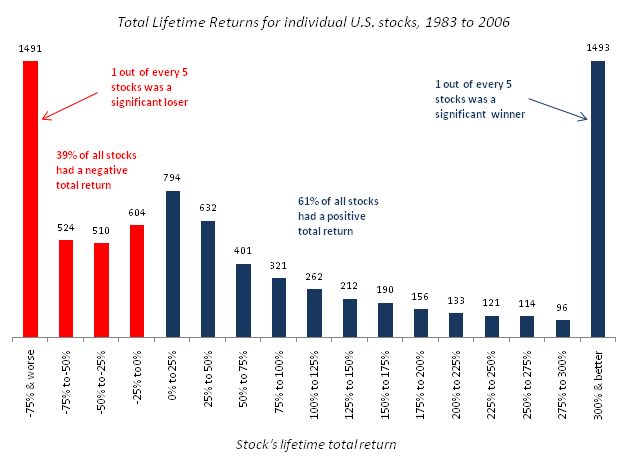
Mebane Faber opens The Capitalism Distribution: Fat Tails in Motion with three questions:

  1. What percentage of stocks beat their benchmark index over their lifetime?
  2. What percentage of stocks have a negative return over their lifetime?
  3. What percentage of stocks lose essentially all of their value?

Try to answer those three questions before reading the answers from Eric Crittenden and Cole Wilcox of BlackStar Funds:

  1. What percentage of stocks beat their benchmark index over their lifetime?

    64% of stocks underperformed the Russell 3000 during their lifetime.
    (Most stocks can’t keep up with a diversified index.)

  2. What percentage of stocks have a negative return over their lifetime?

    39% of stocks had a negative lifetime total return.
    (2 out of every 5 stocks are money losing investments.)

  3. What percentage of stocks lose essentially all of their value?

    18.5% of stocks lost at least 75% of their value.
    (Nearly 1 out of every 5 stocks is a really bad investment.)

The flip side should be clear:

A small minority of stocks significantly outperformed their peers.
(Capitalism yields a minority of big winners that all have something in common.)