Why Pygmies Are Small

Wednesday, October 21st, 2009

A new study, published in the October Current Anthropology, explains why pygmies are small:

“We provide the first evidence that pygmy body sizes vary considerably over time, that they correlate strongly with mortality rates and that increasing mortality rates lead to even greater reductions of body size,” says Jay Stock of the University of Cambridge in England.

Stock and Andrea Migliano, both anthropologists at the University of Cambridge, say that their findings support a scenario in which most females are able to reproduce at relatively young ages, probably in response to high mortality rates, This physical trait then becomes more common from one generation to the next. Early-maturing bodies divert physiological resources away from growth, yielding small bodies as a side effect, the researchers hypothesize.

Laboriously achieved but only precariously defended

Tuesday, October 20th, 2009

Rudyard Kipling was “representative of a cast of mind which later generations came to deplore,” John Derbyshire notes, but his “larger political views need to be seen in the context of the great social disturbances that roiled his country in the years before World War One”:

Female suffrage: Irish republican agitation: the rising power of labor unions and the first stirrings of the welfare state: none of it made sense to Kipling and he expressed his feelings in public speeches, and in poems like “The City of Brass”:
They said: “Who has hate in his soul? Who has envied his neighbour? / Let him arise and control both that man and his labour.”
They said: “Who is eaten by sloth? Whose unthrift has destroyed him? / He shall levy a tribute from all because none have employed him.”

Evelyn Waugh said it exactly: “[Kipling] was a conservative in the sense that he believed civilization to be something laboriously achieved which was only precariously defended. He wanted to see the defences fully manned and he hated the liberals because he thought them gullible and feeble, believing in the easy perfectibility of man and ready to abandon the work of centuries for sentimental qualms.”

Next Stop: Ultracapacitor Buses

Tuesday, October 20th, 2009

Ultracapacitors are like superbatteries: super-efficient, quick to charge and discharge, long-lasting — and holding very, very little energy. Now a Chinese company and its U.S. partner have found a clever way to deploy ultracapacitor buses:

There’s just one catch: the best ultracapacitors can only store about 5 percent of the energy that lithium-ion batteries hold, limiting them to a couple of miles per charge. This makes them ineffective as an energy storage medium for passenger vehicles. But what ultracapacitors lack in range they make up in their ability to rapidly charge and discharge. So in vehicles that have to stop frequently and predictably as part of normal operation, energy storage based exclusively on ultracapacitors begins to make sense.
[...]
The trick is to turn some bus stops along the route into charge stations, says Dan Ye, executive director of Sinautec. Unlike a conventional trolley bus that has to continually touch an overhead power line, Sinautec’s ultracapacitor buses take big sips of electricity every two or three miles at designated charging stations, which double as bus stops. When at these stations, a collector on the top of the bus rises a few feet and touches an overhead charging line. Within a couple of minutes, the ultracapacitor banks stored under the bus seats are fully charged.
[...]
The buses can also capture energy from braking, and the company says that recharging stations can be equipped with solar panels (although this is mainly to further the perception that the vehicles have a lower carbon footprint). Ye says the buses use 40 percent less electricity compared to an electric trolley bus, mainly because they’re lighter and have the regenerative braking benefits. They’re also competitive with conventional buses based on fuel savings over the vehicle’s 12-year life, based on current oil and electricity prices. Sinautec estimates that one of its buses has one-tenth the energy cost of a diesel bus and can achieve lifetime fuel savings of $200,000.

“The ultracapacitor bus is also cheaper than lithium-ion battery buses,” says Ye. “We used the Olympics (lithium-ion) bus as a model and found ours about 40 percent less expensive with a far superior reliability rating.”
[...]
The ultracapacitors are made of activated carbon and have an energy density of six watt-hours per kilogram. (For comparison, a high-performance lithium-ion battery can achieve 200 watt-hours per kilogram.)
[...]
There are some other important limitations. The 41-passenger buses, based on current technology, lose 35 percent of their range when air conditioning is turned on, and have weak acceleration. But even under these conditions, they could still prove practical for municipal, campus, airport, and tourist buses.

Sacrificing Cunning

Tuesday, October 20th, 2009

Arnold Kling cites Dan Klein’s Resorting to Statism to Find Meaning, which tries to explain three different political dispositions — progressive, conservative, and libertarian — and summarizes the conservative view:

The role of the state, in the conservative view, is to enforce norms and laws that have a prior origin. For religious conservatives, that origin is divine. In theory, a secular conservative could find the roots of those norms in tradition, or cultural evolution.

Tradition is usually the best guide, because, while clever innovations can improve on tradition, they generally don’t. That’s what makes open-minded intellectuals into Bruce Charlton’s clever sillies:

[A]n increasing relative level of IQ brings with it a tendency differentially to over-use general intelligence in problem-solving, and to over-ride those instinctive and spontaneous forms of evolved behaviour which could be termed common sense. Preferential use of abstract analysis is often useful when dealing with the many evolutionary novelties to be found in modernizing societies; but is not usually useful for dealing with social and psychological problems for which humans have evolved ‘domain-specific’ adaptive behaviours. And since evolved common sense usually produces the right answers in the social domain; this implies that, when it comes to solving social problems, the most intelligent people are more likely than those of average intelligence to have novel but silly ideas, and therefore to believe and behave maladaptively.

One commenter added his thoughts — which Kling saw as a proposal for Robin Hanson to do fieldwork:

The real reason people with high IQs lack common sense is neurological. You can’t be cerebral without sacrificing cunning. It takes real live brain matter to support each. Unless you’ve got a second brain hidden somewhere, you can’t get around this tradeoff. The extreme form of this can be seen in the autistic brain. While autism is just a behavioral profile at present, the brains of high-functioning autistic people have been studied enough to reveal a pattern of early abnormal overgrowth in areas implicated in the things autistic people do well: art, music, mathematics, etc. The price they pay is a corresponding undergrowth of the white matter linking the neocortex to the rest of the brain. (There are other abnormalities as well.) The neocortex is responsible for executive function, working memory, and generalization, among other things. Generalization is how we acquire biases. Autistic people are bad at this. That means they lack prejudice, which is what we call the biases we don’t like. The ones we like, we call common sense. If you want to get some idea of what the world would look like if we overcame bias, go to a group home for autistic adults.

The Evils of Colonialism

Tuesday, October 20th, 2009

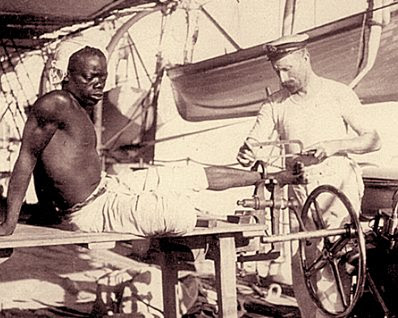
Behold the evils of Colonialism:

The photo above was taken in about 1907, and shows a British sailor sawing the shackle off the leg of an African slave.

Where was that slave bound before he was freed by the British?

In 1907 there was no longer any market for slaves among white people anywhere in the world. In fact, there was probably no market at all for slaves except in black Africa or among the Arabs. In all likelihood that slave was going to be sold on the Arabian Peninsula or perhaps to African Muslims.

Who captured the slave?

He was probably captured by another black African from a neighboring tribe, either in warfare or as a part of a deliberate slave-taking raid. The Arabs rarely captured black slaves themselves, and this slave might have been brokered several times by African traders before arriving at his final owner.

In any case, both the slave-taker and the customer were almost certainly Muslims.

Football is a mysterious thing

Monday, October 19th, 2009

Football is a mysterious thing to those not raised in these United States:

I have attended just one football game in my life. It was a college game, and furthermore was in the South, where, if you try out the cliché about college ball being a religion down there, people tell you, without smiling, that it is much more serious than that. What a spectacle that game was! The colors; the chants; the erotic prancing of the cheerleaders; the masked and padded players, their size grotesquely exaggerated, like Polynesian warriors; the guttural war cries; the fenced-off areas of the stands with strange and distinctive populations — one contained nothing but young men in blazers. I felt like an anthropologist watching the Ghost Dance of the Sioux. If a foreigner should tell you that a nation as young as this one has had no time to develop a unique culture, take him to a college football game.

The ferocity of the coaches took John Derbyshire by surprise:

From exposure to the sensitized, feminized, sissified, litigation-whipped culture of the public schools, I had come to suppose that the sterner kinds of pedagogic verbal chastisement had gone the way of switch and tawse. Not here at junior-league football practice. The coaches barked and roared like Marine Corps drill instructors. Inattentive boys had their inattention terminated with great prejudice, often with a set of push-ups or a lap around the field added to drive the point home. When Coach got tired of yelling, the whole team was sent off to do laps, marking pace with military-style antiphons in which the word “kumbaya” seemed not to figure at all. It was wonderful to see, especially from the comfort of a folding chair in the shade, with a cup of iced coffee close at hand.

Diagnostics and Therapeutics in Political Economy

Monday, October 19th, 2009

Alex Tabarrok says that there are excellent writers, and there are excellent economists, and in that intersection there are none better than Bob Higgs:

Until more people come to a more realistic, fact-based understanding of the government and the economy, little hope exists of tearing them away from their quasi-religious attachment to a government they view with misplaced reverence and unrealistic hopes. Lacking a true religious faith yet craving one, many Americans have turned to the state as a substitute god, endowed with the divine omnipotence required to shower the public with something for nothing in every department – free health care, free retirement security, free protection from hazardous consumer products and workplace accidents, free protection from the Islamic maniacs the U.S. government stirs up with its misadventures in the Muslim world, and so forth. If you take the government to be Santa Claus, you naturally want every day to be Christmas; and the bigger the Santa, the bigger his sack of goodies.

A 21st Century Full of 19th-Century Disasters

Monday, October 19th, 2009

Let’s suppose we see a 21st century full of natural disasters — like the 19th century:

How do we start out? Well, I’m going to ignore the Little Ice Age that spanned centuries and didn’t end until 1850 because obviously we aren’t already in a mini Ice Age. So lets start with the first big unique natural event of the 19th century.

A geologically calamitous 21 century might start in December 2011 when along the Mississippi river in the center of the United States an earthquake equivalent to the December 16, 1811 New Madrid earthquake would begin a series 8.1 and 8.2 earthquakes over a period of a few months that would cause rivers to run backward, the Mississippi to change course (with far more calamitous results given much higher population densities) and church bells would again ring as far away as Boston. Picture bridges across the Mississippi collapsing with freight trains halted and river freight shipping blocked. A repeat of the New Madrid Missouri earthquakes would cause far more devastating damage than they when when that area was sparsely populated and the Mississippi was not used to move huge amounts of agricultural and other freight.

Of course, the most massive devastating earthquake of the 21st century might hit New York City or Tokyo or perhaps some other densely populated region (and the world has many more densely populated regions than it did in the 19th century). Even a repeat of the August 10, 1884 magnitude 5.5 quake near NYC would cause a lot of damage. A Big One will hit Los Angeles in the 21st century. The city of angels is overdue for The Big One. We are overdue for an earthquake that could go to near 8.0 similar to the 1857 SoCal quake which was about 7.9 on the Richter scale. But we’ll also witness earthquakes in places where they occur less often. Perhaps Shanghai? Hong Kong? Jakarta? Or how about New Zealand and with a volcanic eruption thrown in that requires lots of people to evacuate?

What next? A VEI (Volcanic Explosivity Index) 7 volcano. Likely location: Indonesia. Now the 4th most populated country in the world. On April 10th 1815 Mount Tambora erupted with VEI 7 intensity.. The eruption so reduced solar radiation reaching the surface that snow fell in New England and the Canadian Maritime provinces in June. You can imagine what that did to crop yields. People went hungry, causing the biggest famine of the 19th century. And get this: 1816 had even worse cold weather and bigger crop failures. So imagine 2015 and 2016 with worldwide crop failures in a world with 7 billion people, all due to a very plausible VEI 7 volcanic eruption.

What would 2016 be like? Food prices would be very high, too high for the poorest to afford. We’d see civil unrest and rioting in many nations. Revolutions would be likely. The cold weather would increase demand for heating oil, natural gas, coal, and wood for heating. So energy commodity prices would soar along with agricultural commodities. Many countries (possibly including the United States) would ban the export of grains.

No doubt 1815 and 1816 were difficult years for many other mammalian species as well. But a VEI 7 eruption in the early 21st century would cause much bigger problems for orangutans, gorillas, big cats, and other threatened species for a couple of reasons. First off, their numbers have already fallen in the last couple of centuries by orders of magnitude. So they already are living close to the edge of extinction. Pretty small disruptions to their food supply run much greater risks of wiping them out. Second, with much larger numbers of humans living near them now they face much greater risk of being hunted to extinction by hungry humans.

So at least one big earthquake and a pretty big volcano with two lost growing seasons. The century is still young. What’s next? On September 2, 1859 an unusually large coronal mass ejection by the Sun cause intense magnetic fields on Earth which if they happened today would cause a large fraction of the big electric power transformers to fail in large electric grids. Large areas of industrialized countries would be without electric power for months. Picture cities evacuated due to lack of power to operate water pumps. Picture massive computer server farms sitting dark. Banks would fail.

The 19th century also featured a VEI 6 volcano, the well known Krakatoa eruption in 1883. This wasn’t as severe as the 1815 eruption. But it would cause a global cooling and crop losses.

The 20th century was a relatively mild, wet, and calm century as compared to the 19th century. We would make a mistake to expect the 21st century will be as calm as the 20th. The current low level of sun spot activity could continue and we could go thru a cooler period in spite of our CO2 emissions. Or we could have severe cooling periods caused by large volcanic eruptions. Also, earthquakes could hit major cities or cause tsunami damage. Do not be shocked if a severe turn of events happens. Even the early 20th century had a dramatic event in 1908 with the Tunguska asteroid explosion over a large swath of Siberia.

Epictetus the Life Coach

Monday, October 19th, 2009

Marcus Aurelius, not EpictetusEric Falkenstein turns to Epictetus the Life Coach, because optimism has one glaring deficiency:

The problem with optimism is that it’s blatantly incorrect: we aren’t all above average in everything, things do not always get better, and we can’t always get what we want. The problem with realism is that by itself it is depressing, a demotivator that does not elevate.

He summarizes Marcus Aurelius’s stoic advice from his Meditations as don’t sweat mean people:

But this is actually quite important, because frustrations with people, not nature, causes most of our grief. Most of what causes people angst are not exogenous constraints of no one’s fault, but rather, when people do things that seemingly are intended to harm you: someone cuts you off in traffic, privately belittles your contributions to colleagues. Recognize there are things you can control, and those you can’t, and this include other people’s actions: learn the difference, and don’t worry about things you can’t control (aka the Serenity Prayer).

Old School Tie

Sunday, October 18th, 2009

John Derbyshire confesses to a certain cynical fatalism about his children’s public-school education:

Having beggared ourselves to buy a house in a decent school district, I feel we have done most of what we can do. The kids will learn, or not, according mainly to their own inclinations and abilities. The teachers, when we meet them, seem like decent types, but a child needs to be well-nigh homicidal before the teacher will say anything negative about him.

At our children’s level — intermediate and middle school — education is a caucus race, in which every child is wonderful and all will get prizes. Somewhat later they will take an IQ test (it is called the SAT, but IQ and SAT scores correlate at around the 0.82 level), then be decanted into precisely the appropriate tier of the great American meritocracy as indicated by the result of that test. For the time being, though, everyone is equal and No Child will be Left Behind.

Thus are reconciled two cherished, but unfortunately contradictory, American ideals: the first, that ability should be fully employed and fairly rewarded, and the second, that all are metaphysically equal in ability, the observed differences being mere illusions, most likely arising from some malign intent on the part of the observer.

I sometimes wonder to myself, quietly, what will be the psychological effect on my kids of this faux-egalitarianism. Cynicism, or double-think?

Enforced Belief

Sunday, October 18th, 2009

As Porphyrogenitus explains, enforced belief may have started with State Theistic Religion, but it soon moved on:

In [the American colonists'] experience, government-enforced belief came in the form of a State Theistic Religion. So they enshrined within the Constitution the Establishment Clause, as part of the Amendment intended to guarantee that liberty of thought and expression would be respected (note today that “freedom of expression” is commonly described to be one of the things protected by the First Amendment; there is some double-think here, because it extends only to certain kinds of expression). This was to prove a profound mistake.

No sooner had the Constitution been ratified than the first non-theistic State Religion was created, in Revolutionary France, complete with its own calendar, holidays, ideology, and a non-theistic inquisition in the form of revolutionary terror aimed at enforcing this belief on those deemed unsuitably enthusiastic about it, including inevitably supporters who weren’t seen as fanatical enough (thus the end of Robespierre, hoisted on his own petard).

Enforced belief is nothing if not as jealous of rivals as Hera, so during the French Revolution Christianity was driven from the public square. That revolution foundered as a result of the bloodbath it produced, but its legacy lived on, and it would not be the last non-theistic (as opposed to atheistic, though some are) State Religion. What was Fascism and Nazism if not enforced beliefs? Or Communism in the Soviet Union and Maoist China (and even now, potential rival religions are kept to state-tamed/approved versions, or driven underground).

Today America has a set of enforced beliefs, increasingly fanatical and intolerant of rival views (ironic from a belief set that ostensibly teaches tolerance, but in reality is only tolerant of differences it itself claims are superficial — race, sex, sexual orientation). Its roots, the roots of Progressivism, are tied to a branch of Christianity, and indeed it’s origins are from New England’s Puritan Roots (thus it’s popularity on Harvard). Ethnic Studies Departments and the like are nothing if not Faith-Based Initiatives, valued not for their scholarly worth but as ideological proving grounds. Similarly, ethnic organizations (on campii and outside of it) serve not merely as social organizations, but as enforcers working in collusion with administrative power to punish those who stray into heresy.

Coincident with the Warren Court decisions on “Separation of Church and State”, a balderization of the First Amendment that gets us what we have now, this belief-set dropped its explicitly Religious ties and “secularized” (though it is still widespread among many mainline Protestant churches — such as the ones I went to — the “Liberation Theology” branch of Catholicism, Trinity United/Black Nationalist theology &c). This was not a conscious move, but a subconscious one, to give Progressives a tool to which to hound their still-Theistic rivals and initiate what amounts to a wave of (relatively mild, but still powerful) persecution, and also introduce the sort of religious indoctrination the 1st Amendment was intended to prohibit into schools, universities, workplaces, &c. Any time you receive “diversity counseling” or are taught multiculturalism (I have nothing against other cultures — as a historian, how could I? But in reality, “Multiculturalism” ends up meaning not having to know anything about other cultures, simply projecting Progressive beliefs upon them and describing them all as communal, consensus-based, peace-loving, &c &c. Scratch the surface of 95% of Multiculturalists, and they know next to nothing beyond the superficial about any actual civilization).

Ski for Pleasure

Saturday, October 17th, 2009

The skill of skiing comes quickly back:

Skiing is one of those pastimes — like ten-pin bowling or skeet shooting, but unlike swimming or tennis — that is pleasurable even at a low level of ability. A sedentary and ill-coordinated person, I can ski for pleasure, but swim only for survival.

Buy one take ten

Saturday, October 17th, 2009

When a society has been told for years that it can have something for nothing, as the UK has, its entire mentality is crippled:

What is disturbing is that the British people seem unwilling to face minimal belt-tightening. Even professors in higher education are balloting to strike, demanding a continuation of boom-time pay raises. “You have the best minds in the country planning to go on strike for 8pc. People are miles away from understanding what is needed.”

Polling data shows that 48pc of the public are against any spending cuts and only 20pc see the need for retrenchment. Britons appear to assume that the “fantastic growth in public spending” over the last decade has become an entitlement.

It’s laughable, Richard Fernandez says, but look at this:

A woman arrived at the [Burlington Coat Factory] store in a Hummer limo, announcing that she’d won the lottery and offering to cover tabs totaling up to $500…. Before the hoax was even revealed, two dozen police officers were called in to quell the unrest sparked by the woman…

As cashiers rang sale after sale, Brown left in her limo to withdraw funds to cover the large scale shopping spree — but returned empty handed. The situation predictably worsened, with the large crowds expecting free things and not willing to leave empty handed. Shoppers began throwing merchandise on the floor and looting.

It’s not too different from how health-care “reform” will play out:

A careful reading of the evidence suggests that the Baucus bill will add as much as $376 billion to the federal deficit through 2019. And that figure understates the full impact of the bill on the budget. If the big-spending parts of the proposal started next year rather than in 2014, the fiscal damage would be much greater.

At face value, the Baucus bill seems to be close to what the president ordered. According to the CBO, the bill gives coverage to 29 million uninsured Americans for less than $900 billion while simultaneously reducing the deficit. The problem is that the bill counts as savings large cuts to Medicare providers that will almost certainly never happen.

The most blatant example is the annual cut in fees paid by Medicare to physicians. The cuts started out small, about 5% a year, but even that was unsustainable. To “solve” the political problem without having to admit to a big increase in the deficit, Congress has given doctors a series of one-year fixes. The foregone payment reductions add up, and next year Medicare is supposed to slash doctor’s fees 21%. Clearly, that will not happen.

Does the sty make the pig?

Friday, October 16th, 2009

New York Times reporter Deborah Solomon interviewed Charles Murray (Real Education), and they disagreed on some things:

DS: Europeans have historically defined themselves through inherited traits and titles, but isn’t America a country where we are supposed to define ourselves through acts of will?

CM: I wonder if there is a single, solitary, real-live public-school teacher who agrees with the proposition that it’s all a matter of will. To me, the fact that ability varies — and varies in ways that are impossible to change — is a fact that we learn in first grade.

DS: I believe that given the opportunity, most people could do most anything.

CM: You’re out of touch with reality in that regard.

John Derbyshire recalls his own experience teaching boys in England in the 1960s:

The stories we heard from the school nurse (who went to boys’ homes) and the local police station’s Juvenile Liaison Officer (frequently at the school) were grim. Was it really the case, in prosperous late-1960s England, that a father would supplement the family’s supply of firewood by removing alternate boards from the stairs? Or that a twelve-year-old boy should not know the function of toilet paper? My colleagues, the nurse, and our policeman, assured me that such things were quite normal.

Though rough, the boys were surprisingly easy to handle. In part this was because, as my colleagues said bluntly, they were so slow-witted, it was easy to outfox them. They were given tests every year, including a frank IQ test, on which most scored in the 70s or low 80s. There was nothing wrong with any of them, and many were cheerful and pleasant boys, but there was no mistaking the fact of their being … dim. Dimness also helped weed out the really hard cases, who would embark on a criminal career at age 13 or 14. Too clueless to evade detection, they would be caught at once and whisked off to Juvenile Hall to be someone else’s problem.

Why were they so dim, though? We discussed this endlessly in the staff room. A young idealist, I very much wanted it to be nurture. Such awful environments! And missing so much primary schooling, as most of them had! My colleagues — dedicated men all, and a couple of them close to saintly in their determination to find what could be found in these lads, and to do what could be done for them — were pretty solidly for nature. In the pungent Liverpool manner, the topic was discussed as: “Does the pig make the sty; or the sty, the pig?”

It was depressing work, with little to show for months of effort. Perhaps the most depressing thing of all was that none of the boys was very capable at anything. To play soccer, for example, needs a modicum of thought as well as some minimal physical fitness. Our boys could not rise to it. The masters-boys soccer match was a rout of them, strapping 15- and 16-year-olds, by us, wheezy desk-wallahs with a median age around 40. Up to that point I had assumed that even seriously un-intellectual people must have some ability at something. That this is not necessarily the case, is one of the saddest true things I ever learned.

Charles Murray is right. Ability varies, and not much can be done to change it.

Ferrari 312 PB replica scale model

Friday, October 16th, 2009

This Ferrari 312 PB replica scale model is amazing, but I cringe when I think about someone spending 15 years building what amounts to a one-off toy car: