Democracy has genuine virtues

Monday, February 16th, 2009

Democracy has genuine virtues, Mencius Moldbug concedes:

Perhaps Froude wrote the best epitaph for the system:
Democracies are the blossoming of the aloe, the sudden squandering of the vital force which has accumulated in the long years when it was contented to be healthy and did not aspire after a vain display. The aloe is glorious for a single season. It progresses as it never progressed before. It admires its own excellence, looks back with pity on its earlier and humbler condition, which it attributes only to the unjust restraints in which it was held. It conceives that it has discovered the true secret of being ‘beautiful for ever,’ and in the midst of the discovery it dies.

In the arts of decadence — sex, drugs and rock ‘n’ roll — democracies excel. If only for these, the second half of the twentieth century will never be forgotten. We need not imagine the level of punitive austerity and reeducation that would need to be inflicted on Western society to make it forget the Rolling Stones and everything after. Possible, surely, but hard to recommend.

Another way to state Froude’s thesis is to describe democracies as obtaining their energy by breaking the strong molecular bonds of their authoritarian predecessors. Similarly, fire obtains its energy by breaking the strong molecular bonds of wood. You’ll note that the democracies do not seem to have much energy left, and indeed there is not much left of the wood.

Acton was exactly wrong

Sunday, February 15th, 2009

Mencius Moldbug points out that the fish in the sea — he’s not really talking about fish, by the way — would be better off owned by a single King of the Fishermen than by no one in particular — but all the fishermen agree that fragmentation of authority is good:

Consider the incentives of the fishermen in an ocean under fractured authority. They are not friends. Each strives to strip the sea before his neighbor arrives. But there is one principle they can agree on: that fragmentation of authority is good.

Why? Because any consolidation of authority must involve stripping at least one player of the power to fish. Any consensus that this is undesirable is a basis for cooperation among all, and is likely to achieve social popularity, regardless of truth. Hominids have been living in tribal societies for the better part of ten million years. They are very good at cooperation games.

For example: if political power is split between Commons, Lords, and Crown, it is easy to construct a settlement in which each of Commons, Lords, and Crown acknowledges the division of authority and promises not to infringe it. While each party will of course struggle to evade this settlement and gain absolute power — note that we don’t hear much from the Lords or the Crown these days — the doctrine of benign fragmentation is one all can endorse, even though it is the converse of truth.

Acton was exactly wrong: it is not absolute, but partial power that corrupts. More precisely, it is partial authority not formally matched with partial responsibility.

Owned by a King of Fishermen

Saturday, February 14th, 2009

Mencius Moldbug describes the fundamental engineering flaw in what he calls the modern structure of government:

This bug is so easy to see that even the New York Times can see it. Of course, our columnist is addressing the governance of fish, not hominids, but note that nothing in his logic depends on scales, gills, or fins:
Since the mid-’50s, economists who study fisheries have basically understood the fate that has befallen these waters. They call it the tragedy of the commons.

If a fish population is controlled by a single, perfectly rational agent — an idealized entity economists refer to as “the sole owner” — he or she will manage it to maximize its total value over time. For almost every population, that means leaving a lot of fish in the water, where they can continue to make young fish. The sole owner, then, will cautiously withdraw the biological equivalent of interest, without reducing the capital — the healthy population that remains in the sea.

But if the fish population is available to many independent parties, competition becomes a driving concern. If I don’t extract as much as I can today, there’s no guarantee you won’t take everything tomorrow. Sure, in a perfect world, you and I would trust each other, exercise restraint, and in the long run, grow wealthier for it, but I’d better just play it safe and get those fish before you do. The race for fish ensues, and soon, the tragedy of the commons has struck.

Ie: if you are a fish, you want all fish to be owned by a King of Fishermen. So long as our fisher king is rational, this “single owner” will govern his fisheries with a strong and kindly hand, maximizing returns over an infinite time horizon, bringing peace, freedom and prosperity to cod, pollock, and sea-bass alike.

But if we fracture this coherent authority into two competing authorities, each can gain by stealing fish from the other. The more authority is fractured, the more predatory it becomes. Thus, the infallible recipe for a sadistic and predatory state: internal competition for power. (Hominids, unlike fish, respond well to fences, so geographical fragmentation is not inconsistent with coherent authority —  the ocean partitioned, as it were, into artificial lakes.)

Either Superfluous or Deceptive

Friday, February 13th, 2009

Mencius Moldbug declares our written Constitution either superfluous or deceptive:

Britain, of course, is famous for its unwritten constitution — a phrase which strikes the worm-gnawed American brain as oxymoronic. In fact, unwritten constitution is a tautology. It is our written constitution — or large-C Constitution — which is a concept comical, impossible, and fundamentally fraudulent. Please allow me to explain.

England had a constitution well before America had a Constitution, and De Quincey (whose political journalism is remarkably underrated) defines the concept succinctly:

…the equilibrium of forces in a political system, as recognised and fixed by distinct political acts…

In other words, a government’s constitution (small c) is its actual structure of power. The constitution is the process by which the government formulates its decisions. When we ask why government G made decision D1 to take action A1, or decision D2 not to take action A2, we inquire as to its constitution.

Thus the trouble with these written constitutions. If the Constitution is identical to the constitution, it is superfluous. If the Constitution is not identical to theconstitution, it is deceptive. There are no other choices.

It’s easy to show that the latter is the case for [the United States government]. For example, the two-party system is clearly part of [the United States government]‘s constitution. But not only does the Constitutionnot mention political parties, the design notes indicate an intention to preclude them. Obviously this was not successful.

For another example, American law schools teach something called constitutional law, a body of judicial precedent which purports to be a mere elucidation of the text of the Constitution. Yet no one seriously believes that an alien, reading the Constitution, would produce anything like the same results. Moreover, the meta-rules on which constitutional law rests, such as stare decisis, are entirely unwritten, and have been violated in patterns not best explained by theories of textual interpretation. Thus the small ‘c’ in constitutional law is indeed correct.

In retrospect, the written-constitution design is another case of the pattern of wishful thinking that appears over and over again in the democratic mind.

A Great, Horn-Crowned Hog

Thursday, February 12th, 2009

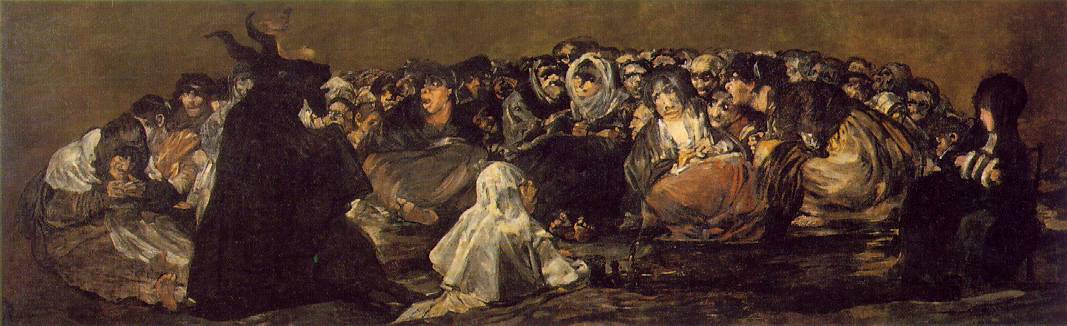
Mencius Moldbug has some fun with the works of a bitter, old artist and the government’s response to our current economic crisis:

Goya left no captions for his Black Paintings, so we have no way of knowing whether or not he meant to call this one Democracy. Events of the last week, however, have shown that Goya got one thing wrong. The black-robed figure is no goat at all — but a great, horn-crowned hog.

‘Dictators’ to the Right of me, ‘Presidents’ to the Left

Saturday, January 31st, 2009

There are 'Dictators' to the Right of me, 'Presidents' to the Left, Humberto Fontova notes — at least according to the mainstream media:

From the AP to Reuters and from the New York Times to the Washington Post the MSM stories on the Cuban Revolution’s 50th anniversary all mention a “dictator” — but his name is Batista. The Castro brothers invariably appear as “Presidents.” Fidel Castro has ruled (unelected) longer than Hitler and Stalin combined and mandates what his subjects, read, say, earn, eat (both substance and amount), where they live, travel or work. No matter. He’s a “president”

You will search these stories in utter vain for any mention of mass-murder and jailings or torture — on the part of the Castros that is. Yet mass-repression started on day one of the Castroite triumph and kicked into highest gear in the mid 60′s, precisely at the apex of the Castro/Che popularity with western politicians, celebrities and “intellectuals.”

In April 1959, three months after his triumph, Castro toured the US to thunderous acclaim. At the time of his delirious, deafening, foot-stomping receptions at Harvard Law School and the National Press Club (most of whose members oppose capital punishment), his firing squads had slaughtered 1,168 men — and boys, some as young as 15.

By the time Norman Mailer (another opponent of capital punishment) was hailing Fidel Castro as “the greatest hero to appear in the Americas!” his hero’s firing squads had piled up 4,000 corpses and one of 18 Cubans was a political prisoner, an incarceration rate that surpassed Stalin’s.

By 1975, when George McGovern (another opponent of capital punishment) was calling Castro as “very shy and sensitive, a man I regard as a friend,” the bullet-riddled bodies of over 10,000 Cubans lay in unmarked graves, and Cuba still held the most political prisoner as a percentage of population on earth, easily surpassing Nazi Germany’s prewar rate. But this record does not besmirch, as evidenced by the following tributes:

“Viva Fidel! Viva Che! Long Live our cry of Freedom!” — Jesse Jackson.

“Castro is very selfless and moral. One of the world’s wisest men.” — Oliver Stone.

“Cuba’s Elvis.” — Dan Rather.

One Helluva Guy! — Ted Turner

“If you believe in freedom, if you believe in justice, if you believe in democracy, you have no choice but to support Fidel Castro!” — Harry Belafonte.

“A genius.” — Jack Nicholson.

“Fidel, I love you. We both have beards. We both have power and want to use it for good purposes.” — Francis Ford Coppola.

“Socialism works. I think Cuba might prove that.” — Chevy Chase.

“Castro has done some good things for Cuba” — Colin Powell

(Hat tip to Mencius Moldbug.)

A New Order of Hereditary Nobility

Saturday, January 31st, 2009

Mencius Moldbug asks us to imagine a new order of hereditary nobility. What would it take to make it happen?

First, we need to define noble status. Our rule is simple: if either of your parents was a noble, you’re a noble. While this is unusually inclusive for a hereditary order, it is the 21st century, after all. We can step out a little. And nobility remains a biological quality — a noble baby adopted by common parents is noble, a common baby adopted by noble parents is common.

Fine. What are the official duties and privileges of our new nobility? Obviously, we can’t really call it a noble order unless it has duties and privileges.

Well, privileges, anyway. Who needs duties? What’s the point of being a noble, if you’re going to have all these duties? Screw it, it’s the 21st century. We’ve transcended duties. On to the privileges.

The basic quality of a noble is that he or she is presumed to be better than commoners. Of course, both nobles and commoners are people. And people do vary. Individual circumstances must always be considered. However, the official presumption is that, in any conflict between a noble and a commoner, the noble is right and the commoner is wrong. Therefore, by default, the noble should win. This infallible logic is the root of our system of noble privilege.

For example, if a noble attacks a commoner, we can presume that the latter has in some way provoked or offended the former. The noble may of course be guilty of an offense, but the law must be extremely careful about establishing this. If there is a pattern of noble attacks on commoners, there is almost certainly a problem with the commoners, whose behavior should be examined and who may need supplemental education.

If a commoner attacks a noble, however, it is an extremely serious matter. And a pattern of commoner attacks on nobles is unthinkable — it is tantamount to the total breakdown of civilization. In fact, one way to measure the progress that modern society has made is that, in the lifetime of those now living, it was not at all unusual for mobs of commoners to attack and kill nobles! Needless to say, this doesn’t happen anymore.

This intentional disparity in the treatment of unofficial violence creates the familiar effect of asymmetric territorial dominance. A noble can stroll anywhere he wants, at any time of day or night, anywhere in the country. Commoners are advised not to let the sun set on them in noble neighborhoods, and if they go there during the day they should have a good reason for doing so.

One of the main safeguards for our system of noble authority is a systematic effort to prevent the emergence of commoner organizations which might exercise military or political power. Commoners may of course have friends who are other commoners, but they may not network on this basis. Nobles may and of course do form exclusive social networks on the basis of nobility.

Most interactions between commoners and nobles, of course, do not involve violence or politics. Still, by living in the same society, commoners and nobles will inevitably come into conflict. Our goal is to settle these conflicts, by default, in favor of the noble.

For example, if a business must choose whether to hire one of two equally qualified applicants, and one is a noble while the other is a commoner, it should of course choose the noble. The same is true for educational admissions and any other contest of merit. Our presumption is that while nobles are intrinsically, inherently and immeasurably superior to commoners, any mundane process for evaluating individuals will fail to detect these ethereal qualities — for which the outcome must therefore be adjusted.

Speaking of the workplace, it is especially important not to let professional circles of commoner resistance develop. Therefore, we impose heavy fines on corporations whose internal or external policies or practices do not reflect a solid pro-noble position. For example, a corporation which permits its commoner employees to express insolence or disrespect toward its noble employees, regardless of their relationship in the corporate hierarchy, is clearly liable. Any such commoner must be fired at once if the matter is brought to the management’s attention.

This is an especially valuable tool for promoting the nobility: it literally achieves that result. In practice it makes the noble in any meeting at the very least primus inter pares. Because it is imprudent for commoners to quarrel with him, he tends to get what he wants. Because he tends to get what he wants, he tends to advance in the corporate hierarchy. The result, which should be visible in any large business without dangerous commonerist tendencies, will be a predominance of nobles in top executive positions.

And, of course, this should be especially the case in government… but enough. We’ve made the point.

And what exactly is that point? Well, three points.

One: this system is profoundly unhinged and bizarre, and completely inappropriate in anything like a sane, civilized society.

Two: it is — save for the change in terminology — a fairly close description of the present legal status of non-Asian minorities (NAMs) in present-day America. (Which is by no means the only modern government to adopt such a system.)
The Art of Modern Crimestop

Friday, January 30th, 2009

Mencius Moldbug looks back — quite sarcastically — at his extremely progressive upbringing and the art of modern crimestop:

Here is a thought I distinctly remember thinking as a teenager, quite possibly after reading one of Stephen Jay Gould’s better essays on the early hominidae: “boy, it’s a good thing Homo erectus went extinct. Because fortunately, racism is a lie, we are all the same under the skin, and once America educates the world all God’s chilluns will go to Harvard. But we’re obviously descended from less-intelligent hominids — and if those guys were still around, we’d have a real race problem.” A testament to the art of modern crimestop, which always finds a way to disable wrongthink by removing some tiny but essential component from one’s picture of reality.

The term crimestop comes from Orwell’s 1984:

…the speculations which might possibly induce a sceptical or rebellious attitude are killed in advance by his early acquired inner discipline. The first and simplest stage in the discipline, which can be taught even to young children, is called, in Newspeak, crimestop. Crimestop means the faculty of stopping short, as though by instinct, at the threshold of any dangerous thought. It includes the power of not grasping analogies, of failing to perceive logical errors, of misunderstanding the simplest arguments if they are inimical to Ingsoc, and of being bored or repelled by any train of thought which is capable of leading in a heretical direction. Crimestop, in short, means protective stupidity.

What Washington wanted to hear

Thursday, January 29th, 2009

We ended up with “new economics” — fiat money, inflation, and “stimulus” spending — because that was what Washington wanted to hear:

The case is the same today: Barack Obama’s “stimulus” proposal involves doubling Federal discretionary spending, ie everyone’s budget. Obviously, this makes quite a few people very happy. And it probably spreads the loot around a little better than if we were just to give it all, up front, to Tony Rezko.

Hence the death of orthodox economics. The orthodox economists of the 19th century, the believers in sound money, were not in general policymakers. They viewed their task as one of describing the economy, not controlling it. But in the ’20s and ’30s, when university men started to move into government, politically palatable solutions were needed. The Austrians and other orthodox historians had nothing of the sort. So they were left out of the pie when all the power got distributed, and today they have no government jobs and only a few marginal academic ones.

How the anthropogenic global warming disaster developed

Tuesday, January 27th, 2009

Mencius Moldbug explains how the entire anthropogenic global warming disaster developed:

First: out of genuine curiosity, people started trying to build climate models, measure CO2, and the like.

Second: since [the U.S. government] is not a charity, they had to apply for grants and describe the importance of their work.

Third: they noticed, consciously or subconsciously, that an easy way to make their work seem more important was to predict disastrous consequences.

Fourth: the same evolutionary feedback process that, in a falsifiable science, eradicates error, operated to promote it. Researchers and fields which produced more alarming results received more funding — because, by definition, their work was more important.

Iterate to the point of sheer insanity, and you have the [anthropogenic global warming] research community we have today.

Robbery under Law

Monday, January 26th, 2009

Lawrence Auster asks, Where is Moldbug really at?, and Mencius replies with a brief discussion of Evelyn Waugh’s Robbery under Law (available in Waugh Abroad):

Maybe one way to answer is to quote the closing words of Evelyn Waugh’s Robbery under Law, written about Mexico in 1939. Waugh describes the destruction, already apparent by 1939 but trivial in comparison to the chaos of Mexico today, that American secular liberalism wreaked on Mexico’s old Catholic polity. Since WWII this tragedy has been replicated around the planet, creating the horror we now know as the Third World.

Waugh concludes:

A conservative is not merely an obstructionist who wishes to resist the introduction of novelties; nor is he, as was assumed by most 19th-century parliamentarians, a brake to frivolous experiment. He has positive work to do, whose value is particularly emphasized by the plight of Mexico. Civilization has no force of its own beyond what is given it from within. It is under constant assault and it takes most of the energies of civilized man to keep going at all. There are criminal ideas and a criminal class in every nation and the first action of every revolution, figuratively and literally, is to open the prisons. Barbarism is never finally defeated; given propitious circumstances, men and women who seem quite orderly, will commit every conceivable atrocity. The danger does not come merely from habitual hooligans; we are all potential recruits for anarchy. Unremitting effort is needed to keep men living together at peace; there is only a margin of energy left over for experiment however beneficent. Once the prisons of the mind have been opened, the orgy is on. There is no more agreeable position than that of dissident from a stable society. Theirs are all the solid advantages of other people’s creation and preservation, and all the fun of detecting hypocrisies and inconsistencies. There are times when dissidents are not only enviable but valuable. The work of preserving society is sometimes onerous, sometimes almost effortless. The more elaborate the society, the more vulnerable it is to attack, and the more complete its collapse in case of defeat. At a time like the present it is notably precarious. If it falls we shall see not merely the dissolution of a few joint-stock corporations, but of the spiritual and material achievements of our history. There is nothing, except ourselves, to stop our own countries becoming like Mexico. That is the moral, for us, of her decay.

While obviously I agree with this and I suspect you do as well, it has little to do with the word “conservative” as used by most Americans today. Even Waugh in this passage is trying, obviously without success, to redefine “conservative.” Therefore I prefer the word “reactionary,” meaning one who hopes to see the decay not just stop but reverse.

The American Rebellion

Monday, January 26th, 2009

Rather than discuss the American Revolution, in which good triumphed over evil, Mencius Moldbug prefers to discuss the American Rebellion, in which evil triumphed over good:

Let’s call our first witness. His name is Thomas Hutchinson, and he is the outstanding Loyalist figure of the prerevolutionary era. His Strictures upon the Declaration of the Congress at Philadelphia is here. It is not long. Please do him the courtesy of reading it in full, then continue below.

Now: what do you notice about Hutchinson’s Strictures? Well, the first thing you notice is: before today, you had never read it. Or even heard of it. Or probably even its author. What is the ratio of the number of people who have read theDeclaration to the number who have read the Strictures? 105? 106? Something like that. Isn’t that just slightly creepy?

The second thing we notice about the Strictures is its tone — very different from the Declaration. The Declaration shouts at us. The Strictures talk to us. Hutchinson speaks quietly, with just the occasional touch of snark. He adopts the general manner of a sober adult trapped in an elevator with a drunk, knife-wielding teenager.
[...]
What we learn from the Strictures is that, as in the rest of American history, there is absolutely no guarantee that a detailed and rational argument about a substantive factual question will prevail, whether through means military, political, or educational, over a meretricious tissue of lies [like the Declaration].

Atheistic Theocracy

Sunday, January 25th, 2009

Mencius Moldbug considers our modern government an atheistic theocracy:

You see, the problem is not just that our present system of government — which might be described succinctly as an atheistic theocracy — is accidentally similar to Puritan Massachusetts. As anatomists put it, these structures are not just analogous. They are homologous. This architecture of government — theocracy secured through democratic means — is a single continuous thread in American history.

An excellent historical description of this continuity is George McKenna’s Puritan Origins of American Patriotism — it gets a little confused in the 20th century, but this is to be expected. However, as a demonstration, I am particularly partial to one particular primary source — this article from 1942, which I found somehow in Time Magazine’s wonderful free archive.

The nice thing about reading a primary source from 1942 is that you are assured of its “period” credentials, unless of course someone has hacked Time’s archive. The author cannot possibly know anything about 1943. If you find a text from 1942 that describes the H-bomb, you know that the H-bomb was known in 1942. One such text is entirely sufficient.

What’s great about the “American Malvern” article is that, while it describes a political program you will place instantly, it describes it in a very odd way. You are used to thinking of this perspective, which is obviously somewhere toward the left end of your NPR dial, as representative of a political movement. Instead, the anonymous Time reporter describes it as a religious (“super-protestant,” to be exact) program. Isn’t that just bizarre?

We have caught the worm in the act of turning. The political program and perspective that we think of as progressive is, or is at least descended from, the program of a religious sect. Unsurprisingly, this sect, best known as ecumenical mainline Protestantism, is historically the most powerful form of American Christianity — and happens to be the direct, linear descendant of Professor Staloff’s Puritans. (You can also see it in abolitionism, the Social Gospel, the Prohibitionists, and straight on down to global warming. The mindset never changes.)

For a brief snapshot of where it is today, try this article. Note that Congregationalist and Puritan are basically synonyms, and American Unitarianism is a spinoff of Congregationalism. Of course, these belief systems have evolved since the time when these labels meant anything. Since the 1960s they have merged into one warm, mushy, NPR-flavored whole, which we here at UR sometimes refer to as Universalism. Michael Lerner is perhaps the ultimate Universalist.

Thus we see the whole, awful picture merge together. It is Cthulhu. We don’t just live in something vaguely like a Puritan theocracy. We live in an actual, genuine, functioning if hardly healthy, 21st-century Puritan theocracy.

What this means is that you can trust hardly any of your beliefs. You were educated by this system, which purports to be a truth machine but is clearly nothing of the sort. Since the US is not the Soviet Union, hard scientific facts — physics, chemistry, and biology, are unlikely to be wrong. But the Soviet Union actually did pretty well with hard science.

Other than that, you have no rational reason to trust anything coming out of the Cathedral — that is, the universities and press. You have no more reason to trust these institutions than you have to trust, say, the Vatican. In fact, they are motivated to mislead you in ways that the Vatican is not, because the Vatican does not have deep, murky, and self-serving connections in the Washington bureaucracy. They claim to be truth machines. Why wouldn’t they?

The Chomskian Transformation

Saturday, January 24th, 2009

Mencius Moldbug considers his point of view to be roughly the opposite of modern academia’s — he likens the modern university system to the medieval church — and of Noam Chomsky’s in particular. Here he describes the Chomskian transformation:

To the bishops of the Cathedral [the university system and the mainstream media], anything that strengthens their influence is a good thing, and vice versa. The analysis is completely reflexive, far below the conscious level. Consider this comparison of the coverage between the regime of Pinochet and that of Castro. Despite atrocities that are comparable at most — not to mention a much better record in providing responsible and effective government — Pinochet receives the full-out two-minute hate, whereas the treatment of Castro tends to have, at most, a gentle and wistful disapproval.

This is because Pinochet’s regime was something completely alien to the American intellectual, whereas — the relationship between Puritan divines and Bolshevism being exactly as the mad Arab, Abdul Alhazred, says — Castro’s regime was something much more understandable. If you sketch the relative weights of the social networks connecting Pinochet to the Cathedral, versus Castro to the Cathedral, you are comparing a thread to a bicep.

We also see the nature of the blue pill here. After completing the UR treatment, it is interesting to go back and read your Chomsky. What you’ll see is that Chomsky is, in every case, demanding that all political power be in the hands of the Cathedral. The American system is very large and complex, and this is certainly not the case. The least exception or (God forbid) reversal, and Chomsky is in on the case, deploying the old principle of “this animal is very dangerous; when attacked, it defends itself.” The progressive is always the underdog in his own mind. Yet, in objective reality, he always seems to win in the end.

In other words, the Chomskian transformation is to interpret any resistance, by a party which is inherently much weaker, as oppression by a magic force of overwhelming strength. For example, we can ask: which set of individuals exerts more influence over American journalists? American professors, or American CEOs? American diplomats, or American generals? In both cases, the answer is clearly the former. Yet any hint of corporate or military influence over the press is, of course, anathema.

If anyone is in an obvious position to manufacture consent, it is (as Walter Lippmann openly proposed) first the journalists themselves, and next the universities which they regard as authoritative. Yet, strangely, the leftist has no interest whatsoever in this security hole. This can only be because it is already plugged with his worm. The complaint of the Chomskian, in other words, always occurs when the other team is impudent enough to try to manufacture a bit of its own consent. Hence: the blue pill.

Anarchy and Power

Thursday, January 22nd, 2009

In trying to give a gentle introduction to his political thoughts, Mencius Moldbug notes that western civilization has been moving steadily leftward for centuries, away from law and order and toward an odd form of anarchy, all under the influence of intellectuals:

One of the key reasons that intellectuals are fascinated by disorder, in my opinion, is the fact that disorder is an extreme case of complexity. And as you make the structure of authority in an organization more complex, more informal, or both — as you fragment it, eliminating hierarchical execution structures under which one individual decides and is responsible for the result, and replacing them with highly fragmented, highly consensual, and highly process-oriented structures in which ten, twenty or a hundred people can truthfully claim to have contributed to the outcome, you increase the amount of power, status, patronage, and employment produced.

Of course, you also make the organization less efficient and effective, and you make working in it a lot less fun for everyone — you have gone from startup to Dilbert. This is Brezhnevian sclerosis, the fatal disease of organizations in a highly regulated environment. All work is guided by some systematic process, in which each rule was contributed by someone whose importance was a function of how many rules he added. In the future, we will all work for the government. Individually, this is the last thing your average intellectual wants to do, but it is the direction in which his collective acts are pushing us.

In short: intellectuals cluster to the left, generally adopting as a social norm the principle of pas d’ennemis à gauche, pas d’amis à droit, because like everyone else they are drawn to power. The left is chaos and anarchy, and the more anarchy you have, the more power there is to go around. The more orderly a system is, the fewer people get to issue orders. The same asymmetry is why corporations and the military, whose system of hierarchical executive authority is inherently orderly, cluster to the right.