How many vowels does English have?

Monday, September 8th, 2008

If you’re like most English-speakers, you’re an English-reader, and you think that English has five, sometimes six, vowels — a, e, i, o, u, and sometimes y — because the English alphabet has five, sometimes six, vowels.

But if you look at how dictionaries “respell” English words for pronunciation, you quickly realize that English — even if we look only at a single dialect, like General American English — has many, many vowels — including not just monophthongs, or pure vowels, but diphthongs and triphthongs composed of multiple vowel sounds.

International Phonetic Alphabet Examples
æ pat, lad, cat, ran
e? pay, day
??r care, hair, there
?? father, palm
?r arm
? let, head
i? bee, see
? pit, city
a? pie, by, my
??r pier, near, here
? pot, not, wasp
o? toe, no
?? caught, paw, war
?? noise, boy
? took, put
??r tour
u? boot, soon, through
a? out, now
? cut, run, enough
?r urge, term, firm, word, heard, bird
? about, item, edible, gallop, circus
?r butter, winner
ju? pupil
ø, œ feu, oeuf (French), schön, zwölf (German)
y tu (French), über (German)
y?, ? bon (French)

Looking at all those crazy IPA spellings is enough to make you feel like a ghoti out of water.

Ghoti out of Water

Monday, July 7th, 2008

English is famous for it poor phonemic orthography — spelling and pronunciation have little to do with each other. This has led to all kinds of reform movements and unusual alphabets.

You may have seen ghoti presented before as an alternative spelling for “fish” — and as evidence of our dire need for spelling reform:

  • gh, pronounced /f/ as in tough /t?f/;
  • o, pronounced /?/ as in women /?w?m?n/; and
  • ti, pronounced /?/ as in nation /?ne??n/.

Although the first known published reference to ghoti credits one William Ollier (born 1824), the clever misspelling is often attributed to George Bernard Shaw.

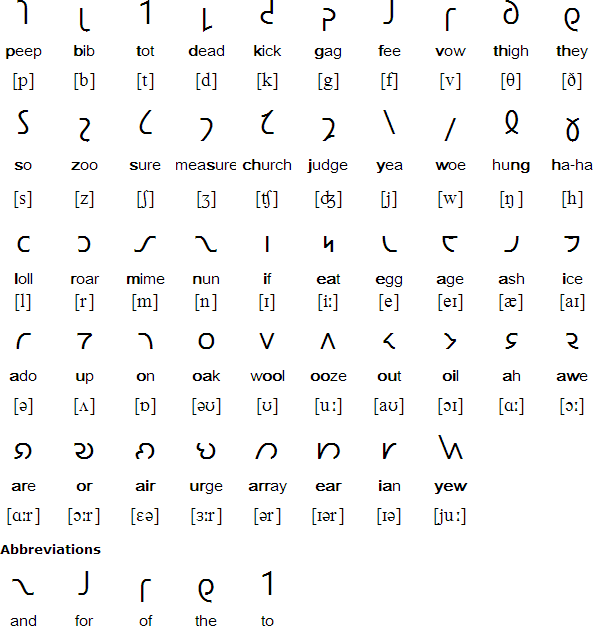
Here’s where it gets weird. Shaw did indeed consider English spelling a mess, and that led him to hold a competition for a new writing system. The competition took place in 1958, and Kingsley Read’s Shavian alphabet was chosen as the winner out of the 467 entries.


Shaw’s play Androcles and the Lion was printed in the winning alphabet, but, as you might imagine, not much else was.

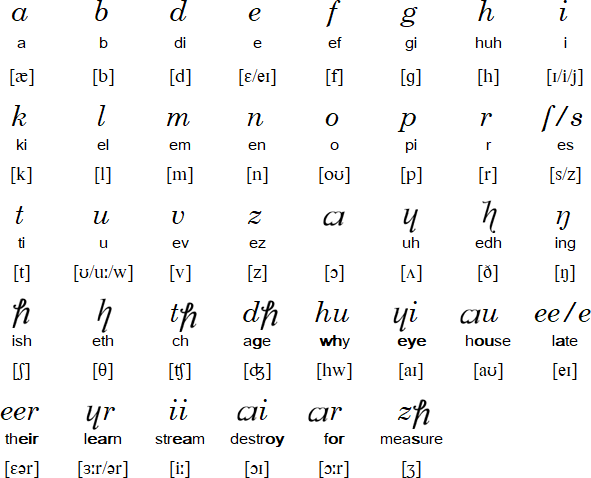
Well before Shaw held his competition, Benjamin Franklin toyed with a new phonetic alphabet, which dropped redundant consonants — c, j, q, w, x, and y — and added six new letters:


Frankly — pardon the pun — I find many of his added characters ugly and unintuitive — although the n with a tail for ng works and has found its way into more modern systems.

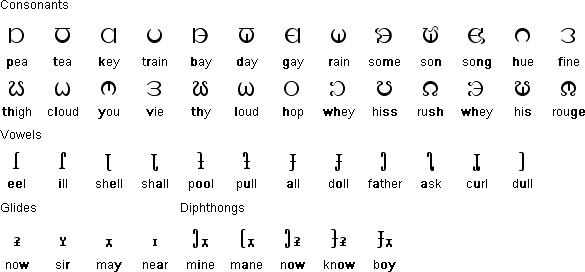
Franklin was obviously trying to create a system fairly close to the one in use, just cleaner. I don’t think he succeeded, but I understand the aim. In 1867, Alexander Graham Bell’s father, Alexander Melville Bell, went in the opposite direction and devised a physiological alphabet based on the positions of the organs of speech for articulating various sounds. Melville Bell was a teacher of the deaf, and he intended his visible speech system to help deaf students learn spoken language:


You can easily imagine visible speech as some obscure elven written language from Tolkien’s Middle Earth, which points to an obvious problem: current English readers can’t even guess at what visible-speech text might mean. If we could start from scratch though, it would make sense to go with a physiological alphabet.

Of course, in a sense, we all start from scratch in childhood, and children who start with a language like Spanish, where the spelling is almost perfectly phonetic, pick up reading much, much sooner than children who have to learn all the crazy rules and exceptions of English spelling.

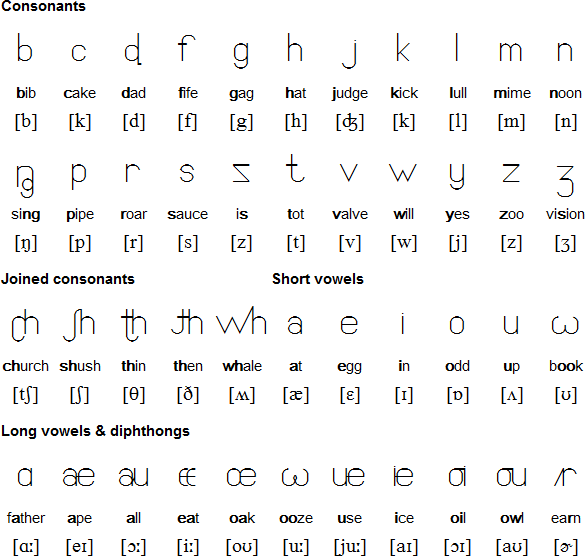
Sir James Pitman, grandson of the inventor of Pitman shorthand, thought it made sense to teach English-speaking children a phonetic writing system, and then to switch them over to real English writing later. His Pitman Initial Teaching Alphabet (i.t.a.) has some elements that really appeal to me — and some that really don’t:


I love the ligatures — combined symbols — for ch, sh, and both forms of th. I also love the two symbols for oo. The vowel+e ligatures make a certain sense for English, but I find them jarring, since they match neither English (with the intervening consonant removed) nor most other languages. Anyway, it’s a fascinating little alphabet.

Of course, what we really use when we need to know a pronunciation is the International Phonetic Alphabet.
How the Brain Learns to Read Can Depend on the Language

Saturday, May 3rd, 2008

How the Brain Learns to Read Can Depend on the Language:

Dyslexia, in which the mind scrambles letters or stumbles over text, is twice as prevalent in the U.S., where it affects about 10 million children, as in Italy, where the written word more closely corresponds to its spoken sound. “Dyslexia exists only because we invented reading,” said Tufts University cognitive neuroscientist Maryanne Wolf, author of “Proust and the Squid: The Story and Science of the Reading Brain.”

Among children raised to read and write Chinese, the demands of reading draw on parts of the brain untouched by the English alphabet, new neuroimaging studies reveal. It’s the same with dyslexia, psychologist Li Hai Tan at Hong Kong Research University and his colleagues reported last month in the Proceedings of the National Academy of Sciences. The problems occur in areas not involved in reading other alphabets.

Words in code

Sunday, June 3rd, 2007

Words in code notes that “speakers of tonal and non-tonal languages have genetic differences”:

First, Dr Dediu and Dr Ladd checked that their two genes of interest really are unusual. They combined a database of 983 alleles that are known to vary across human groups with another enumerating how 26 discrete linguistic features (such as whether consonants aggregate at the beginnings and ends of words) are either used or not used in conversation by 49 populations. Picking apart a thicket of possible correlations, Dr Dediu and Dr Ladd found no general links between human genetic and linguistic characters.

But one feature — whether a language uses pitch as well as vowels and consonants to convey word meanings — stood apart. Those, such as Chinese, that encipher meaning in pitch are called “tonal languages”. Those that do not, like English, are “non-tonal”. And it was versions of Dr Dediu’s and Dr Ladd’s two microcephaly-related genes that matched the 49 populations along tonal and non-tonal lines.

Dr Dediu and Dr Ladd believe the evolution of tonal and non-tonal languages interacted with the evolution of these genes.

Culture Flows Through English Channels

Tuesday, April 10th, 2007

Culture Flows Through English Channels, according to Rüdiger Wischenbart:

Worldwide, he said, between 50 percent and 60 percent of all translations of books originate from English originals. It’s sometimes higher: 70 percent of all books translated into Serbian, for instance, have English originals. In return, only 3 percent to 6 percent of all worldwide book translations are from foreign languages into English. English speakers, it seems, are talking a lot but listening very little. If this were the airline industry, we’d be talking about the kind of world where you can’t fly from Moscow to Berlin without changing in London.

Non-Anglo cultures are also listening less and less to each other, more and more to us. “In 2005,” Wischenbart reported, “a mere 9.4 percent of all translations into German came from French originals…. Yet, this still brings French comfortably to second place in the overall translation statistics in Germany, as compared to 2.7 percent for Italian (number 3), or Dutch (2.5 percent, number 4) or Spanish (2.3 percent, number 5). Sixty-two percent of all translations were of English originals. All other languages and cultural in-roads seem like peanuts in comparison, and no politically well-intentioned process will ever mend this imbalance…. Centrifugal forces are working against globalization, resulting in culturally fragmented islands and regions, with few cohesive lines in between.”

Why do pilots say "roger" on the radio?

Wednesday, February 28th, 2007

Why do pilots say “roger” on the radio?:

Pilots and other military types say “roger” to acknowledge receipt of a message or instructions. “Roger” at one time was the phonetic designation for the letter R, which in turn stood for “received.” Why not just say “received”? From a safety perspective, it makes sense to use standardized language, particularly when dealing with international operations. An American pilot may not understand German, but they both understand aviation terminology. The International Civil Aviation Organization oversees this standardization and disseminates it accordingly.

The use of “roger” isn’t all that old. In the military’s phonetic alphabet, “roger” didn’t become the designation for R until 1927. (Previously the designation had been “rush.”) The first citation given by the Oxford English Dictionary for “roger” in the sense of “received” dates from 1941, coinciding with U.S. entry into WWII. The term made the big time in 1943, when the Army Signal Corps incorporated it into one of its procedural manuals.

In 1957 “roger” was replaced by “romeo,” the current designation, but by then “roger” = “received” was so entrenched that the brass knew better than to try and change it.

Jidaigeki

Friday, January 12th, 2007

Listen, padawan, and learn:

The term “Jedi” from the Star Wars saga was derived from jidaigeki [Japanese for "period drama"] by George Lucas, as he was heavily influenced by Akira Kurosawa.

Cá Bhfuil Na Gaeilg eoirí?

Friday, January 5th, 2007

Manchán Magan asks, Cá Bhfuil Na Gaeilg eoirí?Where are all the Gaelic speakers?:

There is something absurd and rather tragic about setting out on a journey around a country, knowing that if you speak the language of that country you will not be understood. It is even more absurd when the country is your native one and you are speaking its native language.

Irish (Gaelic) is the first official language of Ireland. We have been speaking it for 2,500 years, right up until the British decided it would be easier to govern us if we spoke their language (and then outlawed the use of Gaelic in schools) in the 19th century. We, in turn, soon realised that our only hope of advancement was through English, and we — or at least the half of the population that survived the Famine — jettisoned Irish in a matter of decades. Had it not been for the Celtic Revival that accompanied Ireland’s fi ght for independence in the early 20th century, the language would have probably died out by now. Today, a quarter of the population claim they speak it regularly. I have always suspected this figure and to test its accuracy I decided to travel around the country speaking only Irish to see how I would get on.

His first mistake was trying to find Irish-speakers in Dublin:

I chose Dublin as a starting point, confident in the knowledge that in a city of 1.2 million people I was bound to find at least a few Irish speakers. I went first to the Ordnance Survey Office to get a map of the country. (As a semi-state organisation it has a duty to provide certain services in Irish.) “Would you speak English maybe?” the sales assistant said to me. I replied in Irish. “Would you speak English?!” he repeated impatiently. I tried explaining once again what I was looking for. “Do you speak English?” he asked in a cold, threatening tone. “Sea,” I said, nodding meekly. “Well, can you speak English to me now?” I told him as simply as I could that I was trying to get by with Irish.

“I’m not talking to you any more,” he said. “Go away.”

Dublin is perhaps the least Irish and most English location within Ireland:

Language experts claim that the figure of fluent Irish speakers is closer to 3% than the aspirational 25% who tick the language box on the census, and most of these are concentrated on the western seaboard, in remote, inaccessible areas where one would not naturally find oneself.

Spies fashioned messages in drawings of models

Tuesday, September 5th, 2006

During WWII, German spies fashioned messages in drawings of models:

German spies hid secret messages in drawings of models wearing the latest fashions in an attempt to outwit Allied censors during World War Two, according to British security service files released on Monday.

Nazi agents relayed sensitive military information using the dots and dashes of Morse code incorporated in the drawings.

They posted the letters to their handlers, hoping that counterespionage experts would be fooled by the seemingly innocent pictures.

But British secret service officials were aware of the ruse and issued censors with a code-breaking guide to intercept them.

The book — part of a batch of British secret service files made public for the first time — included an example of a code hidden in a drawing of three young models.

“Heavy reinforcements for the enemy expected hourly,” reads a message disguised as a decorative pattern in the stitching of their gowns, hats and blouses.

That wasn’t the only way they tried to hide messages, of course:

The files reveal other ingenious ways spies tried to send coded notes through the post.

Invisible ink, pinpricks and indentations on letters were all used to convey details of troop movements, bombing raids and ship-building.

Codes were hidden in sheet music, descriptions of chess moves and shorthand symbols disguised as normal handwriting. Postcards were spliced in half, stuffed with wafer-thin notes and resealed.

Agents also used secret alphabets and messages that could only be read by taking the first letter of certain words.

The capture of two German agents in 1942 uncovered two such codes that British intelligence had repeatedly failed to crack, the declassified files reveal.

Britain’s wartime spy chief David Petrie described the failure as “somewhat disturbing”.

The code was used in a letter from “Hubert” to “Aunt Janet” to conceal the message: “14 Boeing Fortresses arrived yesterday in Hendon [London]. Pilots expect to raid Kiel [Germany].”

As the war went on, counterespionage officials developed ways of spotting suspicious letters.

Telltale signs of a spy’s handiwork included rambling letters with no apparent point, often sent to neutral countries with too many stamps.

Clumsy or awkward phrases could be a sign that words were being forced to fit a code template.

Lists of numbers and long messages about games of bridge also aroused suspicion.

Fewer characters being used in written Chinese

Tuesday, May 23rd, 2006

Fewer characters being used in written Chinese:

The Chinese media is using fewer characters and to understand 90 percent of the content in publications you need only to know about 900 of the thousands of pictographs that make up the script, state media said on Tuesday.

The findings of a survey conducted by the education ministry and language commission were based on 900 million characters used in more than 8.9 million files chosen from newspapers, magazines, the Internet and television, the Xinhua news agency said.
[...]
Written Chinese is made up of around 50,000 individual characters, whose main function is to represent meaning, not pronunciation.

The average university graduate, however, may know only about 6,000, as many characters are archaic and some found only once in the whole history of the written language, often describing the names of people, places or mythical beasts.

Traditional, or “complex” characters are still used in Hong Kong, Taiwan and many overseas Chinese communities, though simplification is gradually creeping in as mainland China’s economic clout grows and more Chinese travel abroad.

Lost in translation

Tuesday, May 23rd, 2006

Lost in translation looks at the differences between English and German humor:

Our attitude to the Germans and their supposed lack of a sense of humour is best understood through the example of the joke known to comedy professionals such as myself as The German Child. It goes like this. An English couple have a child. After the birth, medical tests reveal that the child is normal, apart from the fact that it is German. This, however, should not be a problem. There is nothing to worry about. As the child grows older, it dresses in lederhosen and has a pudding bowl haircut, but all its basic functions develop normally. It can walk, eat, sleep, read and so on, but for some reason the German child never speaks. The concerned parents take it to the doctor, who reassures them that as the German child is perfectly developed in all other areas, there is nothing to worry about and that he is sure the speech faculty will eventually blossom. Years pass. The German child enters its teens, and still it is not speaking, though in all other respects it is fully functional. The German child’s mother is especially distressed by this, but attempts to conceal her sadness. One day she makes the German child, who is now 17 years old and still silent, a bowl of tomato soup, and takes it through to him in the parlour where he is listening to a wind-up gramophone record player. Soon, the German child appears in the kitchen and suddenly declares, “Mother. This soup is a little tepid.” The German child’s mother is astonished. “All these years,” she exclaims, “we assumed you could not speak. And yet all along it appears you could. Why? Why did you never say anything before?” “Because, mother,” answers the German child, “up until now, everything has been satisfactory.”

The basis for most English-speaking humor is the ambiguity of the English language:

At a rough estimate, half of what we find amusing involves using little linguistic tricks to conceal the subject of our sentences until the last possible moment, so that it appears we are talking about something else. For example, it is possible to imagine any number of British stand-ups concluding a bit with something structurally similar to the following, “I was sitting there, minding my own business, naked, smeared with salad dressing and lowing like an ox … and then I got off the bus.” We laugh, hopefully, because the behaviour described would be inappropriate on a bus, but we had assumed it was taking place either in private or perhaps at some kind of sex club, because the word “bus” was withheld from us. Other suitable punchlines for this set-up would be, “And that was just the teachers”, “I was 28-years-old” and “That’s the last time I attempt to find work as a research chemist in Paraguay.”

There is even a technical term used by those who direct comedy on camera to describe this one-size-fits-all mechanism. Eddie Large is gasping for air as a hot dog falls into the end of his snorkel. The shot widens to reveal Sid Little, whose sausages are flying into the air out of his hot-dog buns because he is using too much ketchup. Pull back and reveal. But German will not always allow you to shunt the key word to the end of the sentence to achieve this failsafe laugh. After spending weeks struggling with the rigours of the German language’s far less flexible sentence structures to achieve the endless succession of “pull back and reveals” that constitute much English language humour, the idea of our comedic superiority soon begins to fade. It is a mansion built on sand.

Some German humor:

On my first night in Hannover I had gone out drinking with some young German actors. “You will notice there are no old buildings in Hannover,” one of them said. “That is because you bombed them all.” At the time I found this shocking and embarrassing. Now it seems like the funniest thing you could possibly say to a nervous English visitor.

Life without numbers in a unique Amazon tribe

Friday, April 28th, 2006

Life without numbers in a unique Amazon tribe describes how the “Piraha apparently can’t learn to count and have no distinct words for colors”:

1 + 1 = 2. Mathematics doesn’t get any more basic than this, but even 1 + 1 would stump the brightest minds among the Piraha tribe of the Amazon.

A study appearing today in the journal Science reports that the hunter-gatherers seem to be the only group of humans known to have no concept of numbering and counting.

Not only that, but adult Piraha apparently can’t learn to count or understand the concept of numbers or numerals, even when they asked anthropologists to teach them and have been given basic math lessons for months at a time.

Their lack of enumeration skills is just one of the mental and cultural traits that has led scientists who have visited the 300 members of the tribe to describe the Piraha as “something from Mars.”

Daniel Everett, an American linguistic anthropologist, has been studying and living with Piraha for 27 years.

Besides living a numberless life, he reports in a separate study prepared for publication, the Piraha are the only people known to have no distinct words for colours.

They have no written language, and no collective memory going back more than two generations. They don’t sleep for more than two hours at a time during the night or day.

Even when food is available, they frequently starve themselves and their children, Prof. Everett reports.

They communicate almost as much by singing, whistling and humming as by normal speech.

They frequently change their names, because they believe spirits regularly take them over and intrinsically change who they are.

They do not believe that outsiders understand their language even after they have just carried on conversations with them.

They have no creation myths, tell no fictional stories and have no art. All of their pronouns appear to be borrowed from a neighbouring language.

Their lack of numbering terms and skills is highlighted in a report by Columbia University cognitive psychologist Peter Gordon that appears today in Science.

Explanations range from inbreeding, to a culture of isolation, to a simple lack of words for numbers.

From the Wikipedia:

  • As far as the Pirahã have related to researchers, their culture is concerned solely with matters that fall within direct personal experience, and thus there is no history beyond living memory.
  • The language is claimed to have no relative clauses or grammatical recursion, but this is not clear. Its seven consonants and three vowels are the fewest known of any language.
  • The culture has the simplest known kinship system, not tracking relations any more distant than biological siblings.
  • The people do not count and the language does not have words for precise numbers. Despite efforts to teach them, researchers claim they seem incapable of learning numeracy.
  • It is suspected that the language’s entire pronoun set, which is the simplest of any known language, was recently borrowed from one of the Tupí-Guaraní languages, and that prior to that the language had no pronouns whatsoever. Many linguists, however, find this claim questionable, noting that there is no historical-comparative evidence indicating the non-existence of pronouns in a previous period of the history of Pirahã; also, the overall lack of Tupi-Guarani loanwords in areas of the lexicon more susceptible to borrowing (such as nouns referring to cultural items, for instance) makes this hypothesis even less plausible.
  • There is a disputed theory that the language has no colour terminology. There are no unanalyzable root words for color; the color words recorded are all compounds like bi3i1sai3, “blood-like”.
  • They have very little artwork. The artwork that is present, mostly necklaces and drawn stick-figures, is crude and used primarily to ward off evil spirits.
  • The Pirahã take short naps of 15 minutes to two hours through the day and night, and rarely sleep through the night. They often go hungry, not for want of food, but from a desire to be tigisái (“hard”).
  • The Pirahã have not related to researchers any fiction or mythology.

Alphabets are as simple as…

Saturday, April 22nd, 2006

Alphabets are as simple as… explains why we have the writing systems we have:

Why did we come up with As, Ms and Zs and the other characters of the alphabet? And is there any underlying similarity between the many kinds of alphabet used on the planet?

To find out, scientists have pooled the common features of 100 different writing systems, including true alphabets such as Cyrillic, Korean Hangul and our own; so-called abjads that include Arabic and others that only use characters for consonants; Sanskrit, Tamil and other ‘abugidas’, which use characters for consonants and accents for vowels; and Japanese and other syllabaries, which use symbols that approximate syllables, which make up words.

Remarkably, the study has concluded that the letters we use can be viewed as a mirror of the features of the natural world, from trees and mountains to meandering streams and urban cityscapes.

The shapes of letters are not dictated by the ease of writing them, economy of pen strokes and so on, but their underlying familiarity and the ease of recognising them. We use certain letters because our brains are particularly good at seeing them, even if our hands find it hard to write them down. In turn, we are good at seeing certain shapes because they reflect common facets of the natural world.
[...]
Remarkably, the study revealed regularities in the distribution of (topological) shapes across approximately 100 phonemic (non-logographic) writing systems, where characters stand for sounds, and across symbols. “Whether you use Chinese or physics symbols, the shapes that are common in one are common in the others,” said Dr Changizi.

For comparison, the team studied the shapes found in the real world, such as the Y shapes seen at the corner of a cube, or the simpler L and T shapes found in the branches of trees, yurts, huts, tepees and simple dwellings and so on.

They analysed the frequency of the shapes in 27 photographs of savannas and tribal life, 40 miscellaneous photographs of rural and small-town life and 40 computer-generated images of buildings. Much to their surprise, whether analysing the shapes in an urban landscape, or those in a leafy wilderness, they had very similar distributions of configurations and shapes.

Most striking of all, the team found a high correlation between the most common contour combinations found in nature and the most common contours found in letters and symbols across cultures. For example, contours resembling an “L” or “X” are more common in both human visual signs and natural scenes than anything resembling an asterisk (*).

When the popularity of each shape was plotted, a wiggly curve emerged that closely matched that of the popularity of the forms and architectures found in nature: the most common letter shapes mirrored common real-world shapes.

What does "OK" stand for?

Monday, March 13th, 2006

According to The Straight Dope “the origin of OK was conclusively established 30 years ago”:

The etymology of OK was masterfully explained by the distinguished Columbia University professor Allen Walker Read in a series of articles in the journal American Speech in 1963 and 1964.

The letters, not to keep you guessing, stand for ‘oll korrect.’ They’re the result of a fad for comical abbreviations that flourished in the late 1830s and 1840s.

Read buttressed his arguments with hundreds of citations from newspapers and other documents of the period. As far as I know his work has never been successfully challenged.

The abbreviation fad began in Boston in the summer of 1838 and spread to New York and New Orleans in 1839. The Boston newspapers began referring satirically to the local swells as OFM, ‘our first men,’ and used expressions like NG, ‘no go,’ GT, ‘gone to Texas,’ and SP, ‘small potatoes.’

Many of the abbreviated expressions were exaggerated misspellings, a stock in trade of the humorists of the day. One predecessor of OK was OW, ‘oll wright,’ and there was also KY, ‘know yuse,’ KG, ‘know go,’ and NS, ’nuff said.’

Most of these acronyms enjoyed only a brief popularity. But OK was an exception, no doubt because it came in so handy. It first found its way into print in Boston in March of 1839 and soon became widespread among the hipper element.

It didn’t really enter the language at large, however, until 1840. That’s when Democratic supporters of Martin Van Buren adopted it as the name of their political club, giving OK a double meaning. (‘Old Kinderhook’ was a native of Kinderhook, New York.)

OK became the warcry of Tammany hooligans in New York while beating up their opponents. It was mentioned in newspaper stories around the country.

Van Buren’s opponents tried to turn the phrase against him, saying that it had originated with Van Buren’s allegedly illiterate predecessor, Andrew Jackson, a story that has survived to this day. They also devoted considerable energy to coming up with unflattering interpretations, e.g., ‘Out of Kash, Out of Kredit, and Out of Klothes.’

Newspaper editors and publicists around the country delighted in coming up with even sillier interpretations– Oll Killed, Orfully Konfused, Often Kontradicts, etc.–so that by the time the campaign was over the expression had taken firm root nationwide.

As time went on, though, people forgot about the abbreviation fad and Old Kinderhook and began manufacturing their own etymologies.

What Does a Chinese Keyboard Look Like?

Tuesday, February 28th, 2006

Daniel Engber explains “How they type in the PRC” in What Does a Chinese Keyboard Look Like?:

How do you type Chinese characters on a keyboard?

You use a piece of software called an input method editor, which allows conventional-looking keyboards to produce the thousands of characters used in written Chinese. There’s no standard system, though, so two Chinese keyboards may not look exactly the same and they may not function in the same way.

In the Peoples’ Republic of China, most computer users type out their Chinese in transliteration, using the standard Roman alphabet keys on a QWERTY keyboard. To generate a character, you type out its sound according to the same spelling system — called Pinyin — that represents the name of China’s capital with the word ‘Beijing.’ The computer automatically converts the Pinyin spelling to the correct Chinese characters on the screen.